







Category Archive: 2) Swiss and European Macro
Serious Flaws in ECB’s Economic Thinking
Marc Meyer shows that the European Central Bank has big flaws in their economic thinking. Lowering the ECB Deposit Rate means depressing the economy. The ECB takes the risk when it buys Greek bonds. Should Greek bonds devalue then the ECB equity ratio falls under zero and European banks write must write-down their ECB Deposits.
Read More »
Read More »
Europe stocks split on Trump win with pharma gaining
The region’s largest industry group headed for its biggest jump in more than 14 months, tempering losses for equity benchmarks after Donald Trump won the race to govern the region’s biggest export market. Novo Nordisk A/S and Shire Plc rose more than 5 percent, after investors punished the shares in recent weeks amid disappointing earnings and speculation Hillary Clinton would push for drug-price controls as president. Citigroup Inc. had cut its...
Read More »
Read More »
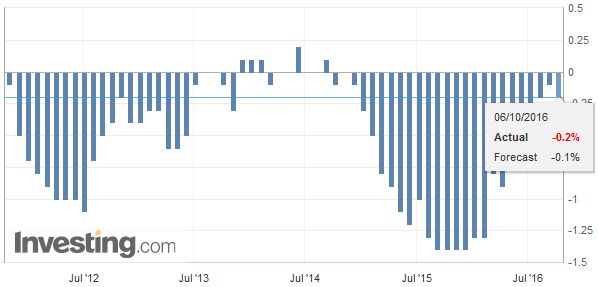
Switzerland Consumer Price Index in October 2016: -0.2 percent against 2015, +0.1 percent against last month
Swiss consumer price inflation remain the lowest in comparison with different countries in the euro zone and the United States. Consumer prices in the U.S. are driven by rising health care costs and asset price inflation in shelter.
Read More »
Read More »
Statistics on tourist accommodation in September 2016: Increase in overnight stays in September
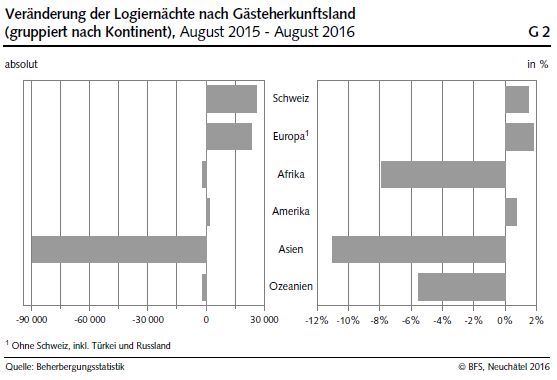
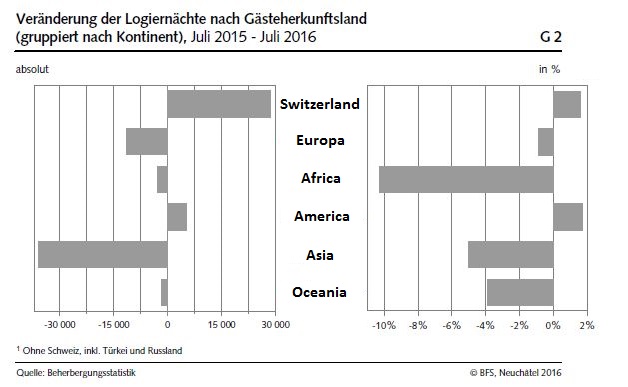
The Swiss hotel industry registered 3.4 million overnight stays in September 2016, which corresponds to a growth of 0.7% (+23,000 overnight stays) compared with September 2015. Domestic visitors registered 1.6 million overnight stays, i.e. an increase of 1.0% (+16,000). Foreign visitors registered 1.8 million overnight stays, i.e. an increase of 0.4% (+7300). These are provisional results from the Federal Statistical Office (FSO).
Read More »
Read More »
Swiss Consumer Sentiment Still Lukewarm
The latest survey shows that there was hardly any change in consumer sentiment in Switzerland between July and October 2016*. The index currently stands at -13 points and has consistently come in at a value below its long-term average for over a year now. However, consumers believe that the outlook for the economy over the coming months is considerably better than in July. The assessment of price trends also underwent an upward adjustment.
Read More »
Read More »
Swiss real estate market UBS Swiss Real Estate Bubble Index 3Q 2016
Risks to the Swiss property market remained elevated in the three months through September, according to UBS Group AG’s quarterly index. “While the buy-to-rent price ratio reached an all-time high, moderate mortgage growth and the slightly-improved economy prevented imbalances in the owner-occupied housing market from widening,” it said in a report.
Read More »
Read More »
Great Graphic: Sentix Shows a Shift
The risk that the eurozone implodes over the next year has risen, but is still modest. Italy has surpassed Greece as the most likely candidate. The December referendum is the second part of Renzi's political reforms.
Read More »
Read More »
Swiss Retail Sales -2.7 percent nominal (YoY) and -2.3 percent real (YoY)
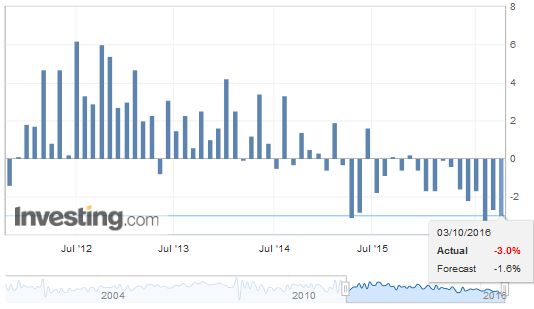
Real turnover in the retail sector also adjusted for sales days and holidays fell by 2.3% in September 2016 compared with the previous year. Real growth takes inflation into consideration. Compared with the previous month, real, seasonally adjusted retail trade turnover registered an increase of 0.2%.
Read More »
Read More »
When It Comes To Household Income, Sweden & Germany Rank With Kentucky
Last year, I posted an article titled "If Sweden and Germany Became US States, They Would be Among the Poorest States" which, produced a sizable and heated debate, including that found in the comments below this article at The Washington Post. The reason for the controversy, of course, is that it has nearly reached the point of dogma with many leftists that European countries enjoy higher standards of living thanks to more government regulation and...
Read More »
Read More »
Switzerland UBS Consumption Indicator September: Confidence despite weakness in retail
The UBS consumption indicator rose from 1.53 to 1.59 points in September. The positive trend continues and points to further growth in private consumption for the fourth quarter. The driving forces are new vehicle registrations, which are at a record level, and the upsurge in domestic tourism in August.
Read More »
Read More »
Great Graphic: Italian Banks and a German Bank
DB and Italian bank stocks have been moving in tandem. They suffer from fundamentally different problems. The euro has been selling off as the bank shares rebound.
Read More »
Read More »
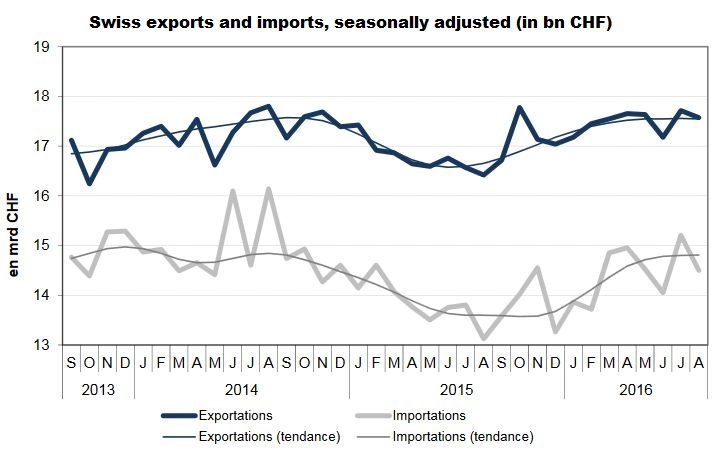
Swiss Quarterly Trade Surplus over 10 bn CHF for the First Time. Exports + 8.1 percent YoY, Imports +7.9 percent in Q3/2016.
In the third quarter of 2016, the Swiss quarterly trade surplus rose over 10 bn. CHF for the first time in history. Exports rose by 8.1% and Imports by 7.9%.
Read More »
Read More »
The ECB Made A Mistake During Its Daily Bond Purchases
Something unexpected happened when the ECB released its latest bond purchase data at during its scheduled release time on Monday: in addition to the purchase of at least 20 separate corporate bonds under the bank's CSPP bond buying program during the week ended October 14, amounting to a total of €1.84 billion, which lifted the number of securities held by the central bank to 660, bringing the total to amount of its holdings to €33.8 billion, or...
Read More »
Read More »
Swiss cross-border shopping declines
Residents of German-speaking Switzerland appear to doing less shopping across the border, something that has also been observed in Geneva. According to the newspaper the Handelszeitung, Swiss cross-border shopping peaked in 2015 and local customs posts have seen a decline in VAT and duty collected since March.
Read More »
Read More »
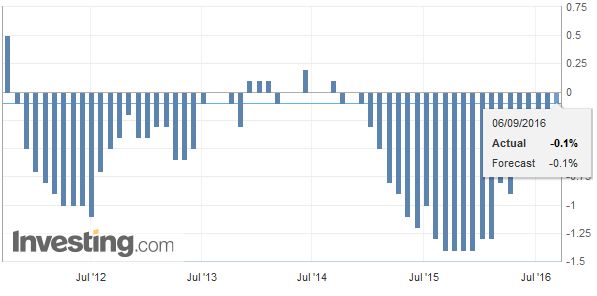
Swiss Producer and Import Price Index, September 2016: +0.3 percent MoM, -0.1 percent YoY
The Producer and Import Price Index rose in September 2016 by 0.3% compared with the previous month, reaching 99.7 points (base December 2015 = 100). The rise is due in particular to higher prices for petroleum products. Compared with September 2015, the price level of the whole range of domestic and imported products fell by 0.1%.
Read More »
Read More »
Swiss nominal and minimum wages increase by 0.4% and 0.7% respectively
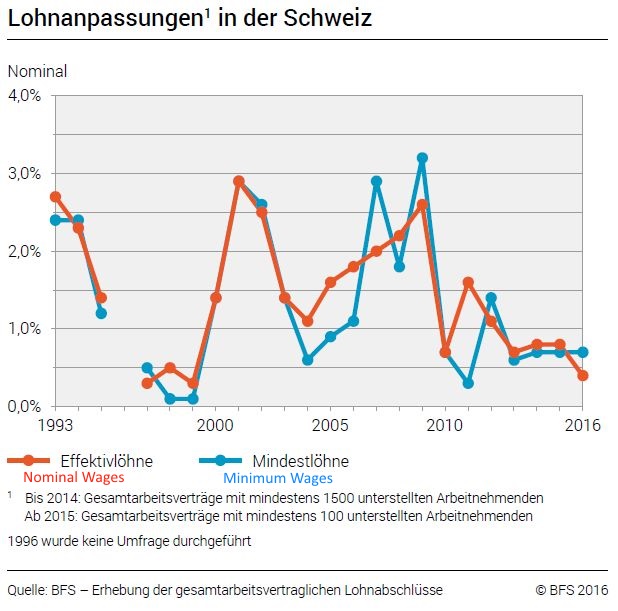
The social partners signing the collective labour agreements (CLA) have agreed a nominal rise in real wages estimated at 0.4% for 2016, of which 0.2% is to be awarded collectively and 0.2% at individual level. Minimum wages were increased by 0.7%. The graph shows nominal wages since 1993.
Read More »
Read More »
Great Graphic: US-German 2-Yr Differential and the Euro
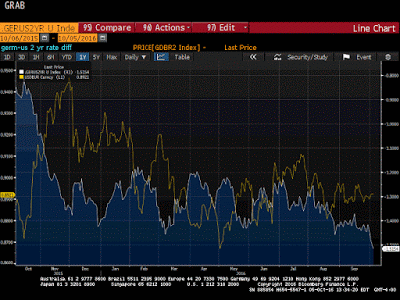
The US premium over Germany is at its widest since 2006. This is despite a small reduction in odds of a hike in December. There are many forces are work, but over time, the widening differential will likely give the dollar better traction.
Read More »
Read More »
Deutsche Bank CEO Returns Home Empty-Handed After Failing To Reach ‘Deal’ With DOJ: Bild
Following the seemingly endless procession of short-squeeze-fueling trial balloons last week - from settlement rumors to German blue-chip bailouts to Qatari investors - Germany's Bild newspaper confirms the rumors that sparked weakness on Friday: Deutsche bank CEO John Cryan has failed to reach an agreement with the US Justice Department.
Read More »
Read More »
Swiss Consumer Price Index 0.1 percent MoM, -0.2 percent YoY
We often look at parts of the CPI. For example food inflation is relevant in emerging markets or poorer people in developed nations. Food inflation in Switzerland has risen by 1.3% YoY in August compared to 0.2% in the U.S., and 1.4% in the eurozone and 1.1% in neighbour Germany. Furtunately it has fallen again.
Read More »
Read More »