







Permanent link to this article: https://snbchf.com/2021/10/flood-why-central-banks-higher-inflation/
 On Swiss National Bank
-
Heads up for NZD and CHF traders, RBNZ Gov Breman and SNB Chair Schlegel to speak
-
Swiss franc appreciation has led to tighter monetary conditions – SNB minutes
-
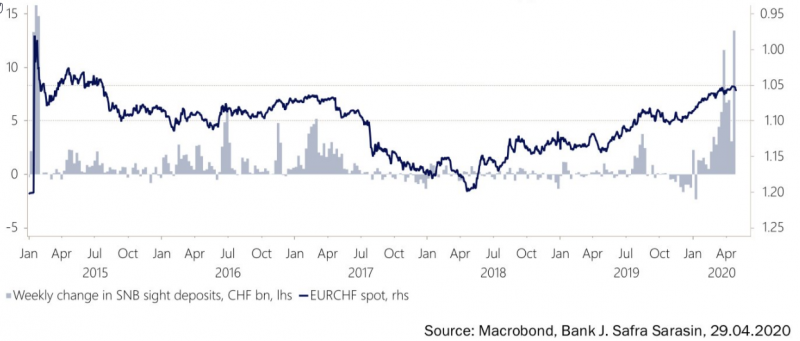
SNB Sight Deposits: decreased by 3.1 billion francs compared to the previous week
-
SNB’s Chairman Schlegel: A few months of negative inflation wouldn’t be a problem
-
2025-07-31 – Interim results of the Swiss National Bank as at 30 June 2025
Main SNB Background Info

Featured and recent
-
 4-24-26 Smart Wealth Transfer Strategies
 -
 Markus Koch im Fragenfluss!
 -
 Breadth Is Lacking: Is The Rally Sustainable?
 -
 Government Debt: Not What The Doom Crowd Thinks It Is
 -
 Absurd! Bundeskanzler Merz: “Rente nur noch Basisabsicherung”
 -
 VERBOT Auswandern und Ausreise ist möglich – 4 Tipps, was du jetzt tun kannst
 -
 Deutschland vs. Schweiz – Lebenshaltungskostenvergleich #thorstenwittmann #finanzstrategien
 -
 Wofür Du deine Altersvorsorge wirklich brauchst
 -
 4-23-26 The Truth Behind The “Fed Buying Debt” Panic
 -
 Kommt die Inflation richtig zurück?
More from this category
 Breadth Is Lacking: Is The Rally Sustainable?
24 Apr 2026
 Government Debt: Not What The Doom Crowd Thinks It Is
24 Apr 2026
- A Look Behind the Fed’s Curtains
23 Apr 2026
- A Look Behind the Fed’s Curtains
23 Apr 2026
- God Bless Captain Vere: When Constitutional Duty Yields to Institutional Power
23 Apr 2026
 SWISS and other Lufthansa airlines introduce new fares
23 Apr 2026
- How War and Fiat Currencies Drive the Price of Gold and Oil
23 Apr 2026
 Switzerland signs investment protection deal with Saudi Arabia
23 Apr 2026
 Swiss hotel sector expects difficult summer season
23 Apr 2026
 Swiss tax revenues get bump from OECD minimum tax rate
23 Apr 2026
- The Next Food Pyramid: Lab-Grown Meat and the New Moral Orthodoxy
23 Apr 2026
 Roche faces strong currency winds in first quarter
23 Apr 2026
 Can Warsh Reform The Fed
23 Apr 2026
 Swiss defence firm RUAG to rely entirely on Swiss AI
23 Apr 2026
- The Critical Issue Is Not Dependence on Oil, but the Destruction Caused by States
23 Apr 2026
 How Nestlé’s pioneering China business fell into disarray
23 Apr 2026
 UBS rejects Swiss government proposal on capital requirements
23 Apr 2026
- Rothbard Was Right: Libertarians Must Never Warm to the Warfare State
22 Apr 2026
- 39 Going on 40 (Trillion)
22 Apr 2026
 Swiss government wants UBS to increase its capital by $20 billion
22 Apr 2026
Why Do Central Banks Want Higher Inflation?
Published on October 23, 2021
Stephen Flood
My articles My videosMy books
Follow on:
Why do Central Banks want higher inflation?
The debt ceiling debate in U.S. Congress and related political nonsense brings even more to light the exponential growth in US federal government debt. US government debt has doubled in the 10 years since the last major debacle Congress created over raising the debt ceiling back 2011. The debate and Congress’s unwillingness to increase the limit back in August 2011 resulted in declining equity markets. It also resulted in Standard and Poor’s downgrading U.S. debt to AA+ from AAA!
The Political Standoff
The political standoff over raising this arbitrary restriction of how much debt the US can issue has become just another political lever in the dysfunctional Congress. As Secretary Yellen points out…
Borrowing Through The Good Times & Through Bad
The chart below shows the debt ceiling limit (red bar) and the Total debt issued (yellow bar). The debt issued line runs right with the debt limit bar. Both have seen exponential growth, approximately doubling every 10 years over the last 40 years.
Going back to Keynesian principles governments should borrow and increase spending during times of economic downturns (recessions) to help stabilize their economies. Then when the economy recovers the government can pay down the debt through increased revenues and less economic stabilizers – such as unemployment insurance, turning the deficit into a surplus. However, in recent times governments have increased debt levels in recessions and proceed to continue spending more than their revenues when the economy recovers. This leads to exponentially growing debt levels. As the chart below shows higher debt to GDP levels as debt grows faster than GDP. As the chart below shows – U.S. government debt has grown from 40% of GDP to over 125% of GDP.
US Government Debt Ceiling Limit Tracks Total Debt
And here in one chart is why Central Banks want higher inflation!
After all the economist Milton Friedman did say…
It is challenging to read any newspaper, social media feed, or participate in a discussion forum without the topic of inflation coming up these days.
And the extra money printed by central banks around the world for the last 40 years, which has also grown exponentially for the last 15 years is now creating that inflation. A country’s nominal GDP growth is a combination of real growth, meaning how much an economy increases output and then inflation added on top. On the chart below of US debt as a percent of GDP; we have added brackets of the average CPI (Consumer Price Inflation) rate for each of the changes in trend. Starting with the period of 1965 to 1980 CPI averaged 6.9% but has declined to average only 1.7% since 2010. Bottom line is that all else being equal, higher inflation will help reduce the massive government debt levels.
.
We leave you with a quote on inflation:
Full story here Are you the author?Follow on:
No related photos.
Tags: central-banks,Commentary,Economics,Featured,inflation,newsletter