



 by
by Lance Roberts
My articles My offerMy siteAbout meMy videosMy books
Follow on:TwitterSeeking AlphaFacebookAmazon
Every few years, someone discovers that the United States government owes a very large amount of dollars and concludes that Rome is about to fall. A recent piece in RealClearMarkets by Nash, Thomas, Lang, and Rastin does exactly this. They rely on the Roman Empire’s collapse and the Weimar Republic’s hyperinflation as cautionary parallels to America’s $39 trillion in federal government debt.
The argument is tidy, emotionally satisfying, but wrong in several important ways. Crucially, government debt is not what the doom crowd thinks it is, and the historical comparisons they love most have almost nothing in common with the American fiscal situation today.
The Accounting Identity No One Mentions
Here’s where I want to start, because this is the point that almost every government debt analysis, including the article we’re responding to, completely ignores. Government debt doesn’t disappear into a void. By definition, if the Government borrows capital from someone, that capital must flow somewhere. That “somewhere” is the private sector balance sheet.
Economist Wynne Godley formalized this relationship in what’s now called the sectoral balances identity. Strip away the academic language, and it’s straightforward: in a closed economy, one sector’s deficit is another sector’s surplus. Every dollar the federal government spends in excess of what it collects in taxes is a dollar that shows up as net financial wealth in the private or foreign sectors. The accounting identity is not a theory. It’s an arithmetic fact, like a double-entry ledger that must balance.

As we discussed in “Money Supply Growth, A Thesis With A Fatal Flaw,” this understanding is crucially important. Debt and deficits are not inherently destructive. They fund spending that becomes income for households and businesses, supporting economic activity. In fact, deficits often stabilize the economy during recessions, providing the private sector with liquidity and helping repair balance sheets.
We see this in real time. The federal government ran a deficit of roughly $1.8 trillion in fiscal year 2024. That same $1.8 trillion, minus what flowed to foreign holders of Treasury securities, landed on the balance sheets of American households, corporations, and pension funds as net financial assets. U.S. Treasuries are not a liability to “future taxpayers” in some abstract existential sense. They’re a financial asset held right now by American savers, retirement accounts, banks, and insurance companies.
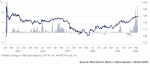
We can see these “sectoral balances” visually.

Look at that relationship carefully. Every time the government deficit widened, as during the 2001 recession, 2008 crisis, and 2020 pandemic, the private sector surplus expanded by a nearly equal amount. That inverse correlation is not a coincidence; it’s the identity at work. When policymakers forced the government toward surplus in the late 1990s, the private sector was driven into deficit. That private debt binge was a primary driver of the 2008 financial crisis.
This also brings us another major flaw in the “perpetual purveyors of doom” ongoing thesis. The article worries about “debt per taxpayer” exceeding $350,000. That metric means nothing without the corresponding asset side. Every dollar of that figure is simultaneously an asset on someone’s balance sheet. Abolish the national debt tomorrow, and you’d simultaneously abolish $28 trillion in financial assets held by savers, pension funds, and the Federal Reserve.
Now, that would be a financial crisis.

The Balance Sheet Everyone Ignores
Consider a household analogy before we look at the numbers. A professional earning $100,000 a year carries a $300,000 mortgage. By the logic of the RealClearMarkets piece, that person is deeply insolvent, as the debt is three times annual income. But no banker in America would call that household bankrupt. Why? Because the mortgage is backed by an asset. If you assume this individual put 20% down when they bought the house, the home is worth somewhere near $360,000. With the person's income steady and likely growing, the monthly debt service is well within reach. The debt-to-income ratio, stripped of context, tells you almost nothing. What matters is the asset on the other side of the ledger, the reliability of the income stream, and the capacity to service the obligation. The U.S. federal government is no different.
The problem with the "doom crowd" constant screeching over debt levels is that, like the article, it treats U.S. government debt as a liability with no corresponding asset. That’s not even true on the official books, let alone in any economically meaningful sense.
The FY 2024 Financial Report of the United States Government reports $5.7 trillion in balance sheet assets, cash, loans receivable, property and equipment, against $45.5 trillion in total liabilities, yielding a negative net position. While critics quickly seize on that figure, they should at least take the time to read the footnotes. The balance sheet explicitly excludes what Treasury calls “stewardship assets," such as:
- 640 million acres of federally owned land,
- the mineral and spectrum rights attached to that land,
- the nation’s entire public infrastructure stock,
- national parks,
- military installations,
- and, most importantly, the sovereign power to tax the world’s largest economy.

Estimates of federal land value alone run from $1.8 trillion to over $5 trillion, depending on methodology. None of that appears on the official balance sheet. More important than any specific asset is the tax base. The federal government collects roughly 17 to 18 percent of GDP in annual tax receipts, which is about $5.1 trillion drawn from a $30 trillion economy. Total federal debt stood at $37.6 trillion at the end of fiscal year 2025. With that in mind, the better analogy is not "debt versus income," but it’s the relationship between a growing asset base, a reliable revenue stream, and the carrying cost of the debt. On that measure, the U.S. looks leveraged, not insolvent.
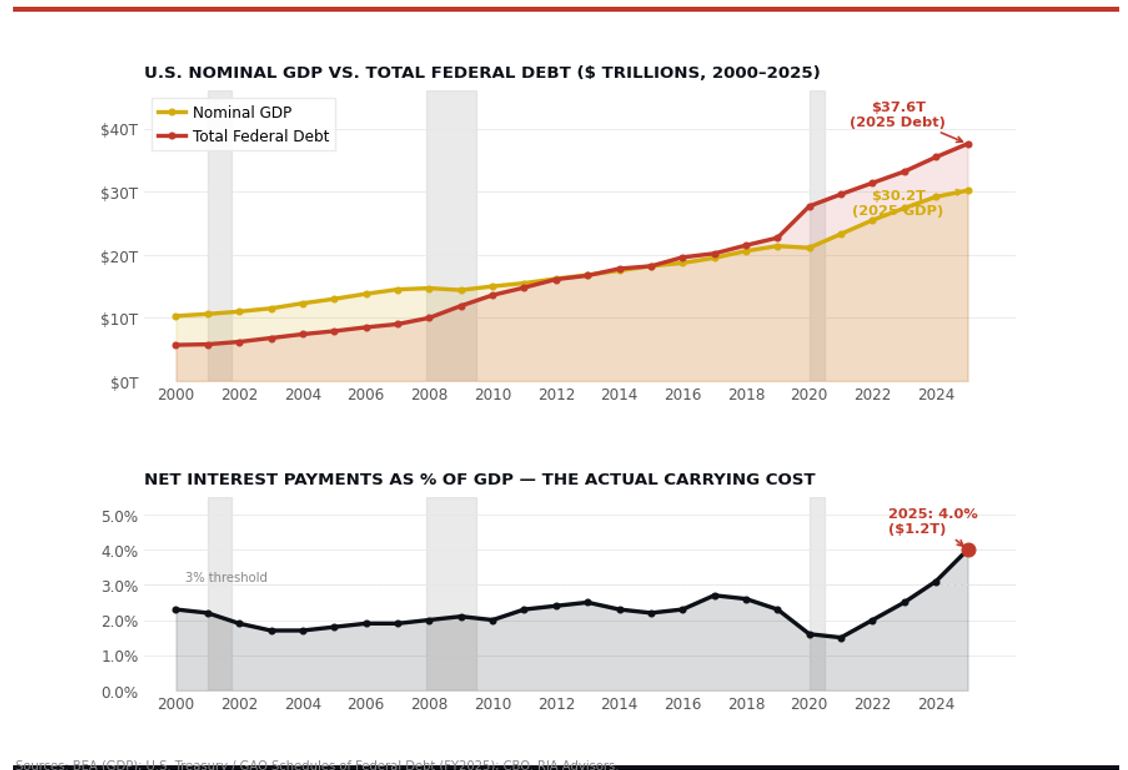
Context is crucial, and something that eludes the "purveyors of doom." While they are busy penning articles about the demise of the U.S., they never discuss Japan, which does NOT have the luxury of being the world's reserve currency.

Just something to consider as we discuss the "elephant in the room."
Why Rome And Weimar Are The Wrong Analogs
Rome and Weimar are where the doom narratives break down. I want to be very specific, as vague historical analogies get repeated so often that they acquire a false credibility. There are key differences between the Roman Republic, Weimar, and the United States.
Let's start with Rome. Its currency crisis was a physical one, as the denarius was a silver coin. When the empire needed more money, emperors literally reduced the silver content of the coin. This is actual "debasement," the process of reducing the underlying commodity that backs a currency. By the reign of Gallienus (253–268 AD), the antoninianus, the coin that had replaced the denarius as Rome's workhorse currency, had been stripped from roughly 50% silver under Septimius Severus to under 5%, sometimes as low as 2.5%, over a span of roughly two generations. Given that there was no means to "create" currency, the constraint was metallurgical, not monetary. The destruction of purchasing power was direct and immediate, as every coin in circulation was affected simultaneously.
In today's world, currencies are "fiat," meaning they are backed only by the "full faith and credit of the issuer." Therefore, you cannot "debase" the US Dollar in the Roman sense, as it has no physical commodity backing. The purchasing power of a fiat currency is reduced only by inflation over time or by a loss of confidence in the issuer's ability to honor the currency. This is why the Weimar example is so misunderstood.
Germany's hyperinflation of the early 1920s was not caused solely by deficits in marks. Its roots ran deeper. The German government had financed World War I almost entirely through borrowing, accumulating 156 billion marks in war debts by 1918. Reparations of 132 billion gold marks, effectively a foreign-currency obligation, were then imposed. Germany had to earn dollars and gold through exports to pay France and Britain. When that proved impossible, the Reichsbank printed marks to purchase foreign exchange on open markets. The more marks they printed, the more the exchange rate collapsed, prompting further printing. The final trigger came in January 1923, when France and Belgium occupied the Ruhr industrial region after Germany fell behind on reparations payments. The German government financed workers' passive resistance through unlimited money printing, and the currency disintegrated within months.
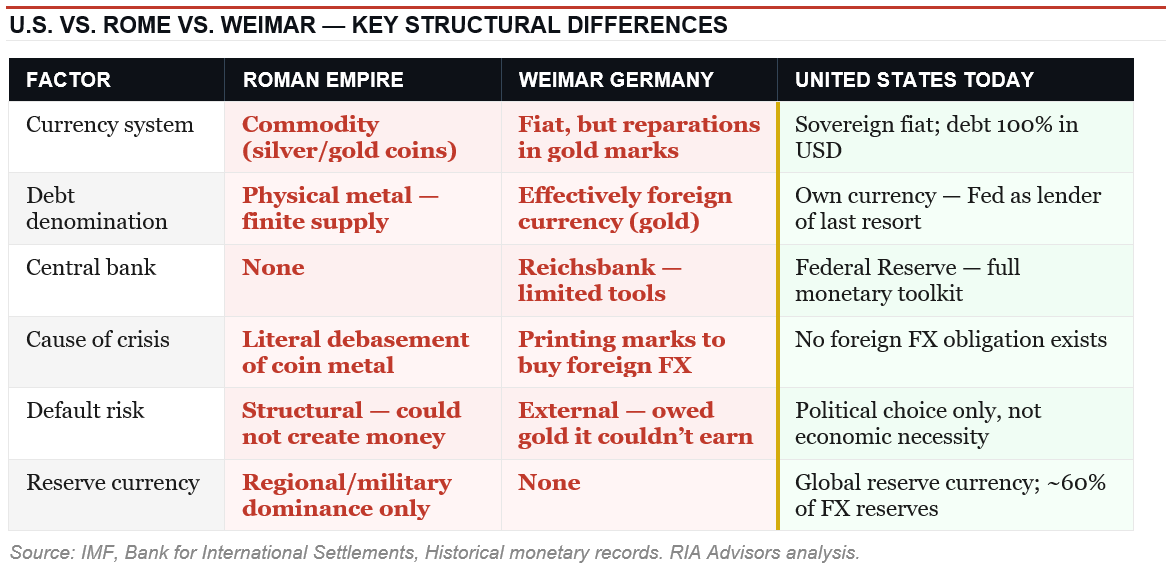
Today, the United States owes not a single dollar denominated in any foreign currency. Every bond, bill, and note is payable in dollars, a currency the Federal Reserve can supply without limit. That doesn’t mean inflation is impossible or even unlikely at current deficit trajectories. It means the mechanism of collapse that destroyed Rome and Weimar simply doesn’t exist in the American monetary system. The risk for the U.S. isn’t default; a government that issues its own currency doesn’t accidentally run out of it. The risk is inflation, and those are two very different problems requiring very different responses.
What You Should Actually Pay Attention To
None of this means deficits are costless. Net interest payments hit $1.2 trillion in fiscal year 2025. That is roughly 4% of GDP and the second-largest line item in the federal budget, behind only Social Security. That is real fiscal drag, and it is accelerating. More crucially, the actual risk is not default but disinflation, as debt diverts revenue from productive investments into debt service. As we discussed at length in "The Deficit Problem."
"Excess “debt” has a zero-to-negative multiplier effect, as Economists Jones and De Rugy showed in a study by the Mercatus Center at George Mason University.
The multiplier looks at the return in economic output when the government spends a dollar. If the multiplier is above one, it means that government spending draws in the private sector and generates more private consumer spending, private investment, and exports to foreign countries. (Inflationary) If the multiplier is below one, the government spending crowds out the private sector, hence reducing it all. (Deflationary)
'The evidence suggests that government purchases probably reduce the size of the private sector as they increase the size of the government sector. On net, incomes grow, but privately produced incomes shrink.
Lastly, I do agree with Nash, Thomas, Lang, and Rastin: the current deficit trajectory isn’t sustainable indefinitely, and policymakers have delayed hard conversations about entitlement reform for decades. That’s genuine. However, the framing matters. Frame government debt as a Roman-style collapse and you reach for austerity prescriptions that, as Greece painfully demonstrated, can deepen the very weakness you’re trying to cure.

SOURCES & REFERENCES
- Godley, W. (2005). “Some Unpleasant American Arithmetic.” Levy Economics Institute Policy Note. Annandale-on-Hudson, NY.
- U.S. Office of Management and Budget / Congressional Budget Office (2024). Monthly Budget Review: FY 2024 Summary. Washington, D.C.
- Godley, W. & Lavoie, M. (2007). Monetary Economics: An Integrated Approach to Credit, Money, Income, Production, and Wealth. Palgrave Macmillan.
- U.S. Department of the Treasury, Bureau of the Fiscal Service (2024). Financial Report of the United States Government, Fiscal Year 2024. fiscal.treasury.gov.
- Congressional Budget Office (2022). The Federal Government’s Ownership of Land and Mineral Rights. Washington, D.C.: CBO.
- Reed, L.W. (1988). “The Fall of Rome and Modern Parallels.” In When We Are Free (Foreword by Milton Friedman). Northwood University Press.
- Ferguson, A. (1975). When Money Dies: The Nightmare of the Weimar Hyperinflation. William Kimber. See also Eichengreen, B. (1992). Golden Fetters. Oxford University Press.
The post Government Debt: Not What The Doom Crowd Thinks It Is appeared first on RIA.
Full story here Are you the author?You Might Also Like
 BLS Jobs Report Is Broken. Is There A Better Measure?
2026-04-17
“March’s 178,000 BLS jobs report came in nearly three times Wall Street’s 60,000 estimate. Markets celebrated. Almost nobody mentioned the entire beat traced back to doctors returning from a strike and weather rebounds. That’s not strength.
 Rubino: Fiat Currencies Are In A Death Spiral
2026-03-27
The fiat currency collapse narrative is one of the most emotionally satisfying arguments in all of financial punditry. It feels intellectually rigorous, draws on genuine history, and speaks to deep and legitimate anxieties about government overreach, monetary recklessness, and the long-term consequences of unlimited debt creation. Monetary analyst John Rubino makes the case as well …
 USD Stablecoins And The Rebasement Of The US Dollar
2026-03-06
The “fiat is dying” argument has become a catchphrase narrative among digital asset bulls, gold bugs, and cryptocurrency advocates. That narrative’s core is that central banks have printed vast amounts of money. The “money printing” has led to currency debasement and rendered the U.S. dollar obsolete. We discussed this “debasement” narrative previously. The narrative is …
 The Reflation Narrative
2026-02-06
The market got off to a strong start in 2026, with investors chasing industrials, materials, and commodity-related stocks as the reflation narrative gained traction. The “reflation narrative” is the belief that a range of policies will boost the rate of economic growth in the U.S. without triggering inflation. As I discussed at our recent 2026 …
Tags: Economics,Featured,newsletter