



 by
by Marc Chandler
My articles My offerMy siteAbout meMy videosMy books
Follow on:LinkedINTwitterSeeking AlphaAmazon

The markets remain on edge. President Trump’s five-day hiatus announced yesterday is looked upon suspiciously. Much of what has been claimed seems to be part of the psych-operations associated with warfare, like initiating the war during negotiations. Many seem to share our sense that the five-day period will allow more US troops to enter the region and perhaps attempt to take Kharg Island. The US strategy seems to waver between destroying Iran’s capability to even make a paperclip to seeking regime change and keeping the energy infrastructure intact to allow the new regime to rebuild. Meanwhile, more ships appear to be passing through the Strait of Hormuz, which appears becoming a toll booth for $2 mln passage fee to be paid in yuan. Meanwhile, the US has given Europe an ultimatum of its own: Agree to the trade deal by March 26 of lose favorable access to the US liquified natural gas.
Follow-through dollar selling has been limited today after yesterday’s setback. The market lacks near-term conviction. The preliminary March PMIs were mostly weaker, and this is only the initial inkling of the disruptive impact of the war. Yesterday’s hopeful optimism has yielded to a more wary stance today.
Prices
G10
• In yesterday’s volatile session that saw the US back away from the ultimatum issued over the weekend and cited talks that the Iranian leaders denied took place. The euro traded on both sides of the pre-weekend range, traded above the 20-day moving average since the war on Iran began, and settled at its highest level since March 4. The euro retraced a little more than half of this month’s losses. There has been no follow-through buying today, despite the constructive price action. Amid the consolidative tone, the euro found support near $1.1575. Options for 1.1 bln euros at $1.16 expire today.
• The dollar reached JPY159.65 before President Trump lifted the ultimatum he issued about 36 hours previously and gave Tehran another five days. The greenback was sold to around JPY158.20. After the low was set, the dollar consolidated mostly below JPY158.80. Yesterday’s low is holding today and the greenback returned to almost JPY158.80.
• Sterling edged out the yen yesterday as the strongest G10 currency. It rose by about 0.60%. Its performance was recorded alongside a sharp decline in UK rates. The two-year Gilts yield tumbled 15 bp, nearly completely unwinding the pre-weekend jump. The swaps market is discounting about 60 bp of hikes this year, compared with 84 bp before the weekend. Sterling settled near $1.3480 before the war and nearly reached that yesterday. Today’s session so far, below yesterday’s settlement. It found new bids in Europe around $1.3380.
• Despite the wide intra-day range, the Canadian dollar was little changed at settlement yesterday. In the flurry position adjustment amid the hopeful optimism that the war on Iran might not escalate as feared, the greenback was sold to a five-day low (~CAD1.3670). It recovered to around CAD1.3735 before stalling. It made a marginal new two-month high slightly above CAD1.3760 today. Support now is seen in the CAD1.3725 area and a push higher can test the CAD1.3800 area.
• The Australian dollar was punched to almost $0.6910 yesterday, its lowest level since early February. Hope the war on Iran is not going to escalate saw the Aussie snap back. It, too, settled little changed, above $0.7020. A particularly poor preliminary PMI reading and the broadly firmer US dollar pushed the Aussie back to around $0.6955 today. There are A$700 mln of options at $0.6975 that expire today.
EM
• The Mexican peso recovered alongside risk appetites yesterday. The dollar initially reached almost MXN18.09 as the North American session was about to begin. President Trump’s social media reversed the greenback’s gains and sent it to almost MXN17.69. It traded briefly below the pre-weekend low (~MXN17.71) but it settled within last Friday’s range. The US dollar is firmer today. It is in trading in the upper end of today’s range (MXN17.85-MXN17.8775) as ahead of the start of the North American session.
• The yuan recovered alongside the other major currencies yesterday. The dollar reached a two-week high slightly below CNH6.92 before it was sold to new session lows near CNH6.8775. It is consolidating in yesterday’s range—holding above CNH6.8825 and below CNH6.90. The PBOC set the dollar’s reference rate at CNY6.8943 compared with CNY6.9041 yesterday.
• Hope that even if the war on Iran does not end soon, Indian ships will be allowed passage, may have helped the rupee snap a three-day drop. After gapping higher yesterday, the dollar gapped lower today. It closed both gaps and settled firmly near INR93.8750.
Other Markets
• Equities are mixed. Asia Pacific bourses responded positively to yesterday’s recovery in the US. Most of the large bourses gained more than 1%. Taiwan, Malaysia, and New Zealand were exceptions. After snapping a four-day slide yesterday, Europe’s Stoxx 600 is straddling little changed levels today, while US index futures are softer.
• Asia Pacific yields played a little catch-up and pulled back 4-6 bp after the US yields fell yesterday. Despite the weak preliminary PMI, European benchmark 10-year yields are mostly 1-3 bp firmer. The 10-year US Treasury yield is a couple of basis points higher, slightly above 4.36%.
• Gold recovered after testing its 200-day moving average yesterday, slightly below $4100. The yellow metal is trading firmly in Europe and is in the upper end of today’s range, which extends to around $4448. Silver is faring a little better and is probing yesterday’s high (~$70.75) after having been sold to almost $61 yesterday, a new low for the year.
• May WTI is trading relatively quietly but firmly today. It is in the middle of the roughly $88.50-$92.30 range in Europe. June Brent reached $81.65 yesterday, settled near $85.35 and is trading above $87 in late European morning turnover.
Data
• US high-frequency data is of little more than passing interest today. The March Philadelphia Fed’s non-manufacturing survey and the Richmon Fed survey have been superseded by events, as has the preliminary March PMI. Unit labor costs and productivity are not observed directly, and the downward sharp downward revision in Q4 GDP (0.7% annualized from 1.4%) warns that productivity will be slashed from 2.8% and unit labor cost rose more than the 2.8% initially estimated.
• Mexico’s January IGAE economic activity, which is similar to a monthly GDP estimate may have contracted for the second time in three months, though yesterday’s January retail sales jumped 1% (vs. 0.2% gain projected by the median in Bloomberg’s survey). Also, it will report the first half of March CPI. Both the headline and core rates finished February above the top of the target range (2%-4%). The central bank meets later this week, and as of last week, slightly more than half of the two dozen economists polled by Bloomberg anticipate a cut. We are less sanguine and agree with the swap market that is discounting. steady policy.
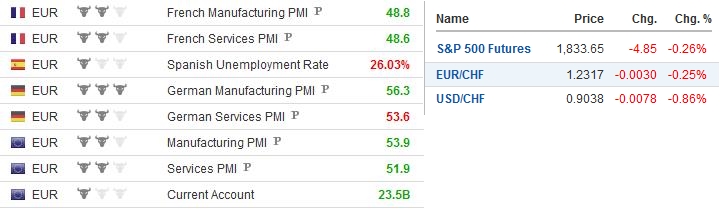
• The eurozone’s preliminary March PMI was mixed. After rising above the 50 boom/bust level for the first time in a few years, the manufacturing PMI rose to 51.4. Services disappointed. The PMI fell back to 50.1 (from 51.9) and were the weakest since last May. The composite eased to 505 (from 51.9), unwinding the improvement since the middle of last year.
• The UK’s preliminary March PMI softened. The composite PMI fell to 51.0 (from 53.7). Manufacturing and services PMI fell, as well. February CPI is due first thing tomorrow. Given the base effect, the 0.4% monthly increase would keep the year-over-year rate steady at 3.0%. The core is also seen steady at 3.1%. The data has little significance given the disruption of the war.
• Australia’s preliminary March PMI fell hard. The composite fell for the second consecutive month. At 47.0 (from 52.4) it is the lowest in a couple of years. The manufacturing PMI held slightly above the 50 boom/bust level, but the services PMI did not. Australia also reported February CPI figures tomorrow. It is expected to be steady at 3.8% before the war began.
• Japan’s February CPI eased to 1.3% from 1.5%. The core rate, which excludes fresh food, eased to 1.6% (from 2.0%). This is the rate the Bank of Japan targets at 2.0%. It is below the target rate for the first time since March 2022The measure that excludes energy and fresh food eased to 2.5% from 2.6%. Energy subsidies, before the war, seemed to be a key driver. The preliminary March PMI pulled back. The composite now stands at 52.5 after having reached 53.9 in February, the highest since May 2023.
You Might Also Like
 Threat of Massive Escalation of the War Drags Financial Markets Lower, While Lifting the Greenback
2026-03-23
After seemingly teasing the market ahead of the weekend that he was considering “winding down” military operations, President Trump issued Iran an ultimatum that threatens to escalate the conflict. He issued a 48-hour ultimatum that appears to expire around 7:45 pm ET today that if the Strait of Hormuz is not open, Iranian power plants …
 Japanese Data Disappoint and Sends Yen Lower, While the Greenback Consolidates more Broadly
2026-02-16
In subdued foreign exchange turnover, the dollar enjoys a firmer bias against most G10 currencies amid on broadly consolidative tone. The US markets are closed for President’s Day, while Chinese markets are closed for the week to celebrate the Lunar New Year. Disappointing Japanese data, including Q4 GDP and December industrial output weighed on the …
 Dramatic Victory for Takaichi, Beijing Cautions on US Treasuries, and Starmer’s Woes Persist
2026-02-09
There are three important developments. First, Japan’s Prime Minister Takaichi led the LDP to a landslide victory that secured a 2/3 “super majority” that is understood as a powerful mandate and provides an opportunity to change the constitution. While JGBs were sold and Japanese equities bought, after some initial volatility, as many anticipated, the yen …
 Dollar Sold Broadly, while Yen Soars on Fear of Joint Intervention
2026-01-26
The US dollar came under strong selling pressure at the start of today’s trading. The fear of joint intervention after the pre-weekend Fed checking on rates, ostensibly on behalf of the US Treasury, and underscored by Japanese officials, including Prime Minister Takaichi. Meanwhile, another tragic ICE related death in Minnesota has sparked a threat from …
 Yen Sold as Takaichi becomes Japan’s Prime Minister
2025-10-21
Overview: The US dollar is mostly firmer today as its pullback from last week’s highs is retraced. Although the US 10-year yield is spending more time below the 4.0% floor, the yen is the weakest of the G10 currencies, off about 0.70%, as Takaichi became Japan’s first woman prime minister and the many investors are …
Tags: Currency Movement,Featured,newsletter