



 by
by Marc Chandler
My articles My offerMy siteAbout meMy videosMy books
Follow on:LinkedINTwitterSeeking AlphaAmazon

President Trump’s national address seemed to contain little more than a reading of some of his recent social media posts. The market was eager for some sign of confirmation of its hope that had buoyed the capital markets in the last couple of sessions. It found none. The threat of escalating attacks while reiterating that the US military operation can wind down in the next two-three weeks failed to underpin sentiment ahead of what will be a long holiday weekend for many.
Risk appetites have been squashed. Equities and bonds have tumbled. The US dollar has surged. The Trump administration is likely to be disappointed with the market’s reaction, and some damage control may be attempted today, but ahead of the long weekend, which begins tomorrow for many financial centers, some of which will remain closed on Monday as well, it be difficult to rebuild the animal spirits. Fear now overwhelms hope that had held center stage for the past couple of sessions.
Prices
G10
• The euro stalled yesterday ahead of the last week’s highs in the $1.1630-40 area. Short-term players may have cut their longs after a 1.5-cent rally in two sessions, ahead of President Trump’s address. The retreat extended about $1.1515 today, which meets a retracement target of this week’s recovery from around $1.1445. Nearby support by be in the $1.1485-$1.1500 area. Note that options for 720 mln euros at $1.1513 and 2 bln at $1.1500 expire today.
• From Monday’s high to yesterday’s low, the dollar fell about 1.35% against the Japanese yen. This breaks the one-way market that Japanese officials commented on the dollar climbed four days in a row last week. The risk-off and jump in US yields have helped lift the greenback to almost JPY159.75 today, and once again JPY160 comes into view. Options for nearly $1.5 bln struck there expire today. Initial support is seen in the JPY159.35 area.
• Sterling peaked 1/100 of cent below last Friday’s high yesterday, according to Bloomberg’s pricing. After poking barely above $1.3345, sterling slipped back below $1.3300. It has been sold slightly through $1.3200 today. The four-month low was recorded on Tuesday, near $1.3160. The intraday momentum indicator oversold. Nearby resistance is seen in the $1.3240-50 area.
• The US dollar peaked against the Canadian dollar on Tuesday a little above CAD1.3965 and was sold to almost CAD1.3870 yesterday. It made a marginal new low today before it was pushed above yesterday’s high shy of CAD1.3920. The week’s high was recorded on Tuesday (~CAD1.3965). Above there, resistance is seen in the CAD1.4000-20 area.
• The Australian dollar extended its recovery from around $0.6835 on Monday and Tuesday to a little more than $0.6960 yesterday. The upside momentum faded, and the Aussie dipped below $0.6915 in late dealings in North America. It was sold to $0.6865 today. A break may spur at re-test on the week’s low. Stronger support is seen closer to $0.6800, where options for nearly A$1.2 bln expire today.
EM
• The Mexican peso had a good day yesterday. The US dollar traded below the 20-day moving average against the peso for the first time in nearly a month (~MXN17.8165 today). It failed to settle below it and straddled the MXN17.85 area in late dealings. It has returned to almost MXN17.96 today. Latam currencies accounted for four of the best performing emerging market currencies yesterday. The Brazilian real’s 0.45% gain did not make the cut. The Argentine peso did not but for a different reason. Its 0.65% loss yesterday gave it the distinction of being the weakest currency in the world.
• The dollar was pressed to its lowest level in about three weeks yesterday against the offshore yuan, almost CNH6.87. It recovered to sightly above the mid-point of the session’s range in the North American afternoon around CNH6.88. The greenback has steadily climbed to a little above CNH6.90 after the initial quiet start in the local session. The PBOC set the dollar’s reference rate lower for the third consecutive session today (CNY6.8880 vs. CNY6.9025 yesterday). It was the second consecutive session of an outside reduction of more than 0.20% adjustment, which is the largest two-day move since September 2024.
• The Indian rupee soared around 1.85% today, its biggest advance since 2013 as the central bank intensified capital controls that spurred a powerful short squeeze. Banks were prohibited from offering some non-deliverable forward rupee contracts to residents and non-residents. A measure of volatility jumped to six-year highs, which in turn prompted the central-bank supervised clear house to boost margin requirements for forwards, which further squeezed the market. The dollar settled near INR94.8325 before the two-day holiday and is now around INR93.1050, having fallen to almost INR92.8260.
Other Markets
• The hope that had lifted equities in recent days was questioned after President Trump’s address. Asia Pacific equities tumbled with most large bourses off 1-2%. Hong Kong was down a little less, while South Korea’s Kospi was tagged for almost 4.5%. India’s equities are bucking the trend and are holding small gains in late turnover. Europe’s Stoxx 600 is snapping a three-day advance of almost 4% and is off a little more than 1% in late morning turnover. US index futures are off around 1.0%-1.5%.
• Benchmark 10-year yields are jumping higher today. A weak reception at Japan’s 10-year bond auction saw yields rise as much as nine basis points today. European 10-year yields are 3-7 bp higher and the 10-year Treasury yield is up about four basis points to poke above 4.36%.
• Gold’s recovery was initially extended to $4800 today to fray the 20-day moving average for the first time in three weeks. It was sold to almost $4555 before finding bids. It stalled near $4650 in early European turnover. Silver held below its 20-day moving average (~$76.35) and was sold to slightly below $69.70. It has stabilized to staddle the $71 area in the European morning.
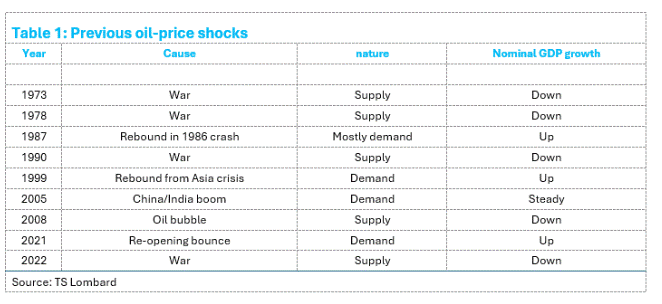
• May WTI opened near $99 today and initially slipped to $97.50 before hope faded. The contract reached slightly above $108, the highest price since the peak on March 9 (~$113.40). June Brent briefly traded below $100 and then reached almost $109.20. Tuesday’s high was closer to $110 and the war-high was recorded on March 19, a little above $112.
Data
• US Challenger job cuts and the weekly jobless claims play second fiddle today ahead of tomorrow’s March jobs report. February’s trade data gets the spotlight. It will help economists forecast Q1 GDP, which the Atlanta Fed says is tracking 2%. Liberation Day came and went, and the US 2025 trade deficit was little changed from 2024, almost $912 bln, even if the composition shifted away from China. Still, note that in the three months through January 2026, the US trade shortfall was about $184 bln compared with $305 bln in the three months through January 2025. Imports are seen slipping for the second consecutive month. Imports were virtually flat last year, while exports rose by an average of 0.5% a month. After jumping 5.5% in January, exports are expected to have fallen by around 2.3% in February. St. Louis Fed President Musalem and Chicago Fed President Goolsbee address monetary policy today, while Governor Barr discusses AI and consumer issues.
• Canada reports its February merchandise trade balance today. As we have noted, there was sharp deterioration last year. The goods trade deficit swell to C$31.6 bln in 2025 from almost C$7.2 bln in 2024. It ran a C$7.5 bln deficit in the three months through January compared with a C$4.6 bln surplus in the three months through January 2025. The broader measure of trade, the current account, saw the deficit widen to 0.9% of GDP last year from 0.5% in 2024.
• Australia reported its February goods trade earlier today. It widened dramatically to A$5.68 bln from A$2.26 bln in January and A$2.7 bln in February 2025. Exports surged 4.9% (after falling a revised 1.6% in January, which was initially reported as a 0.9% decline). Imports fell by 3.2% in February (after rising a revised 1.1% in January, which was initially estimated as a 0.8% increase). Last year, Australia’s goods trade surplus narrowed to about A$45.1 bln from A$66.9 bln in 2024. Imports rose by an average of 0.5% a month in 2025 after averaging 0.8% increase in 2024. Exports rose by an average of 0.4% last year and fell by the same amount on average in 2024. Australia’s current account deficit widened to 2.6% of GDP in 2025 from a 2.2% shortfall in 2024.
You Might Also Like
 Dollar Jumps on War, but Treasuries are No Safe Haven
2026-03-02
There is one fundamental driver today and that is the Middle East war. After finishing last week on a soft note, the greenback has rallied. It is up by 0.5% or more against most of the G10 currencies. The Canadian dollar, which often performs relatively better in a strong US dollar environment is off the …
 US Dollar Retraces Some of Yesterday’s Dramatic Losses
2026-01-28
President Trump’s comments sent the dollar spiraling lower yesterday. His lack of concern about the dollar after it has been falling sharply in recent days played on market fears that the administration wants a weaker dollar. It follows on the heels of what appears to have been tantamount to verbal intervention to support the yen …
 Greenback Mostly Consolidates, while Yen Gyrations Point to Nervous Market
2026-01-27
The greenback is mostly softer against the G10 currencies today. Initial gains had carried the dollar to almost JPY154.90 before a large order, market nervousness over intervention saw a quick drop in early European turnover through yesterday’s lows (~JPY153.30) to about JPY153.20 before steadying. Dollar sentiment is poor amid fear of intervention and a new …
 USD Continues to Consolidate: Tomorrow’s Employment Data and Supreme Court Decision Awaited
2026-01-08
The US dollar is mixed against the G10 currencies. Yet the broad consolidative tone remains intact. It may be challenged tomorrow with the US employment report and the anticipated Supreme Court decision on the president’s use of emergency powers to levy tariffs. Meanwhile, President Trump announced more domestic initiatives including curbs on defense contractors’ CEO …
 Is the Dollar’s Consolidation a Prelude to an Upside Correction?
2025-12-02
Overview: The dollar has traded heavily in recent days, and it is consolidating in narrow ranges with a slightly firmer bias today. US rates, which jumped yesterday, are sustaining higher levels through the Asia Pacific session and the European morning. We suspect the greenback has scope for additional near-term corrective gains. Despite a solid 10-year …
 Risk-Off Friday
2025-11-21
Overview: The sharp fall in global equities after the stunning reversal in the US yesterday is the main development today. The largest markets in the Asia Pacific region fell more than 2% today. Europe’s Stoxx 600 is off more than 1%. It is selling off for the sixth session in the past seven. After posting …
 No Relaxation of US-China Tensions, Japanese Political Challenges, and a Rise in UK Unemployment, Send Ripples Through the Capital Markets
2025-10-14
Overview: The markets wanted to believe that the President Trump and Treasury Secretary Bessent were right, China overreacted with the broadening and tightening of export licensing requirements for critical materials and de-escalation would result. But this does not seem to be the case. The risk-off mood has sent stocks tumbling and bonds rallying. The dollar …
 North American Leadership Awaited in FX
2025-10-09
Overview: There was some, albeit limited follow-through dollar buying today, but the early gains have been pared as the European morning progressed. That leaves the greenback narrowly mixed among the G10 currencies, with the Scandis, sterling, and the New Zealand dollar underperforming. North American leadership is awaited. Emerging market currencies are also mixed. News that …
Tags: Currency Movement,Featured,newsletter