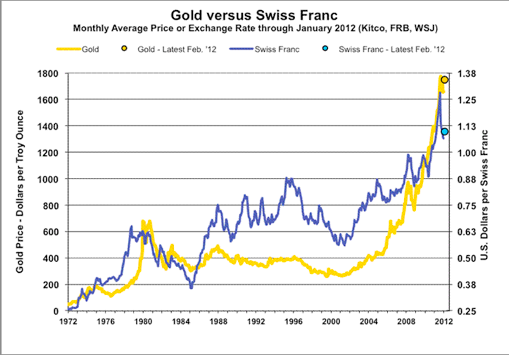




There seems to be widespread disbelief among gold investors, as gold prices have fallen by over 10% since the US and Israel started bombing Iran on February 28th. Many investors think that gold is a safe haven that should do its best during crisis periods, as we are in. This assumption fails to consider the biggest driver of all asset prices, liquidity.
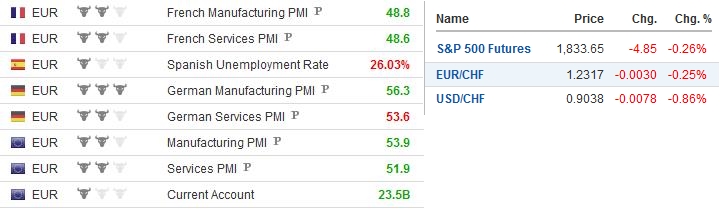
Today, as is typical in crises, liquidity tightens, and many foreign countries and companies demand dollars. As such, the dollar appreciates versus other currencies. With the depreciation of foreign currencies, gold becomes more expensive. For instance, the euro is down about 7% versus the dollar since the conflict started. Thus, the price of gold is 7% higher for Europeans than it otherwise would have been. This causes demand for gold to decline, while the need to sell gold for liquidity purposes rises.
Alongside the dollar appreciation, Treasury yields have been rising. With long-term bond yields now approaching 5%, the opportunity cost of holding gold, which earns 0%, becomes higher. While we wait on official data, we suspect that foreign buying of UST bonds has been brisk.
Higher yields and a stronger dollar create a feedback loop that results in further dollar appreciation and lower gold prices. As a result, gold is trading like stocks and not the safe haven many expect it to be.

What To Watch Today
Earnings

Economy

Market Trading Update
Yesterday, we touched on the technical backdrop of the market. We also took a deep dive into the market breadth and relative strength, and what history tells us about when these measures become contrarian indicators.
The correction that we have seen so far has been quite normal, despite the more "doom and gloom" narratives being expoused on the interwebs. Nonetheless, the recent 5-week streak of consecutive weekly declines is certainly worrisome. However, it isn't unprecedented.

Since 1965, the S&P 500 has experienced 26 instances of five or more consecutive weekly declines—roughly once every 2.3 years. While these streaks feel alarming in real time, the historical evidence suggests they function more as contrarian buy signals than warnings of further collapse.
The statistics tell a compelling story. In the week immediately following these streaks, returns averaged -0.5%, with only 48% of occurrences posting a gain, reflecting residual selling pressure and lingering fear. At four weeks out, the average return was a modest +0.3%, though only 40% of cases were positive, indicating that bottoming processes take time and rarely produce V-shaped recoveries.
The picture shifts meaningfully at longer horizons. At 12 weeks, the average return remained slightly negative at -0.5%, with 40% positive. At 26 weeks, the average return was -1.7%, with just 36% positive, dragged lower by catastrophic events such as the 2008 Financial Crisis (-28.5%) and the dot-com collapse (-17.7%). These outliers skew the averages, but the median at 26 weeks of -5.5% confirms that half of all instances still posted losses at the six-month mark.
However, the 52-week forward returns reveal the true contrarian nature of these events. The average one-year return was +3.8%, with 56% of instances posting positive returns and a median gain of +1.9%. Removing the two worst outliers—2008 and the dot-com bust—the average surges higher, underscoring that most of these decline streaks occurred near meaningful market lows rather than the beginning of prolonged bear markets.
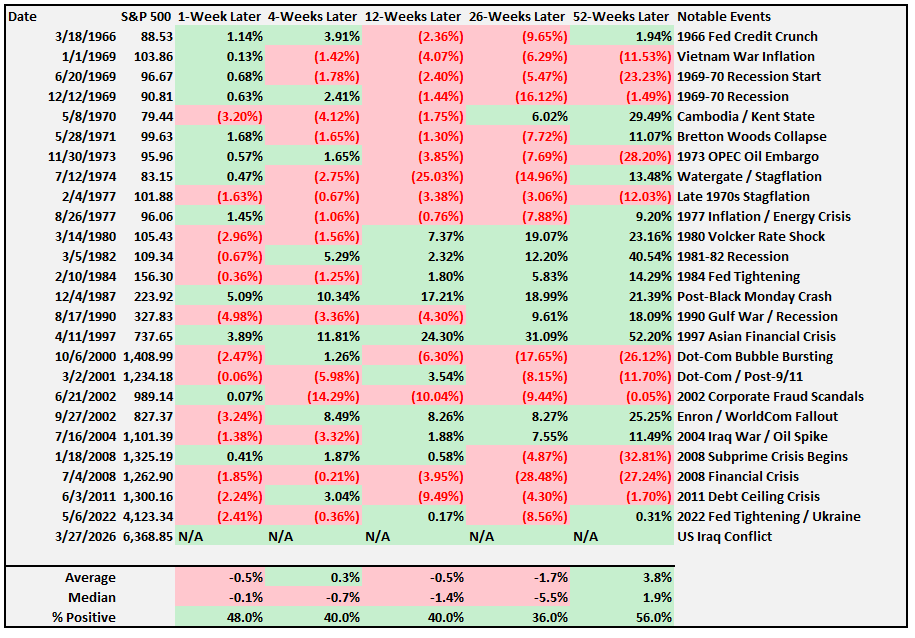
What makes these streaks contrarian is what they represent: widespread capitulation, extreme negative sentiment, and indiscriminate selling. Events like the 1997 Asian Financial Crisis (+52.2% one year later), the 1981-82 Recession (+40.5%), and the Enron/WorldCom fallout (+25.3%) all demonstrate that peak pessimism often coincides with attractive entry points.
For today's market, the current five-week losing streak, occurring amid rising geopolitical tensions, places us squarely within this historical pattern. History does not guarantee a rally, and the near-term path (1-to-26 weeks) often remains choppy. But the weight of evidence suggests that investors who maintain discipline and avoid panic selling during these episodes are more often rewarded than punished over the following year. The discomfort of the moment is typically the price of admission for forward returns.
With this in mind, let me review what we discussed in yesterday's blog post linked above.
“Stock market breadth will eventually resolve, either by individual stocks recovering toward the benchmark level, or by the index itself catching down to the damage that’s already been inflicted.”
History says the former is far more likely given the current configuration of indicators. Given that backdrop, here are some steps to consider for your personal situation, goals, and objectives.

The goal isn’t to time the bottom. Nobody does that consistently. The goal is to avoid permanent capital impairment from panic selling, reduce risk through disciplined rebalancing, and be positioned to participate in the recovery. Based on every comparable episode in the modern era, that recovery has come, and it has come faster than the fear of the moment would suggest.

Value Over Growth Is Back In Vogue
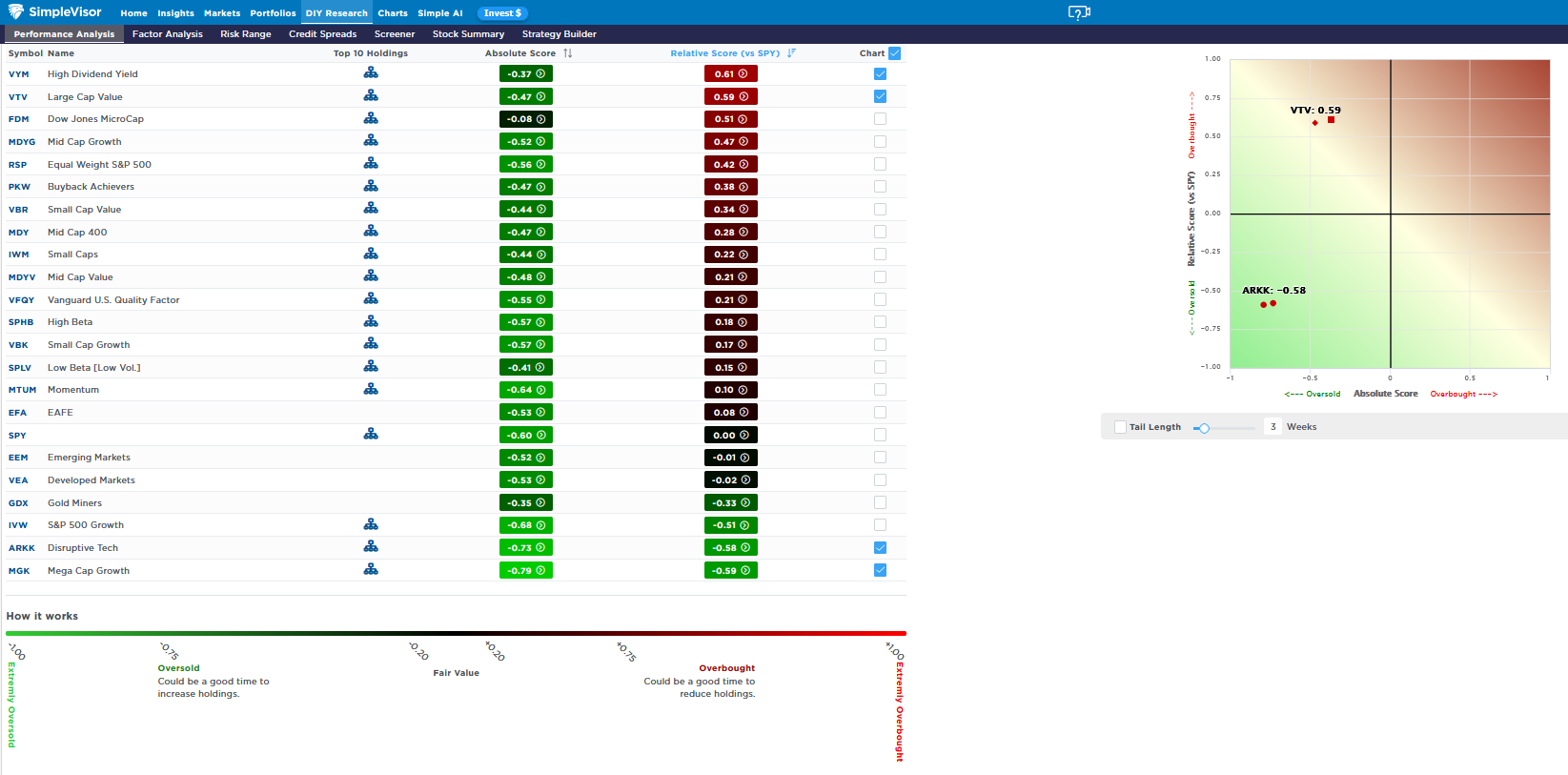
As was the trend prior to the Iranian conflict, value has reasserted itself as the preferred sectors and factors for investors. Growth stocks, especially mega-cap growth and the Magnificent Seven, were among the worst performers last week. The graphic below, courtesy of SimpleVisor, shows that high-dividend-yield and large-cap value stocks are the most overbought relative to other sectors. However, they are decently oversold on an absolute basis. Mega Cap Growth and Disruptive Tech (ARKK) are very oversold on a relative and absolute basis. Note that a large majority of the factors are overbought relative to the market, meaning many stocks are outperforming the S&P 500 during this downturn.
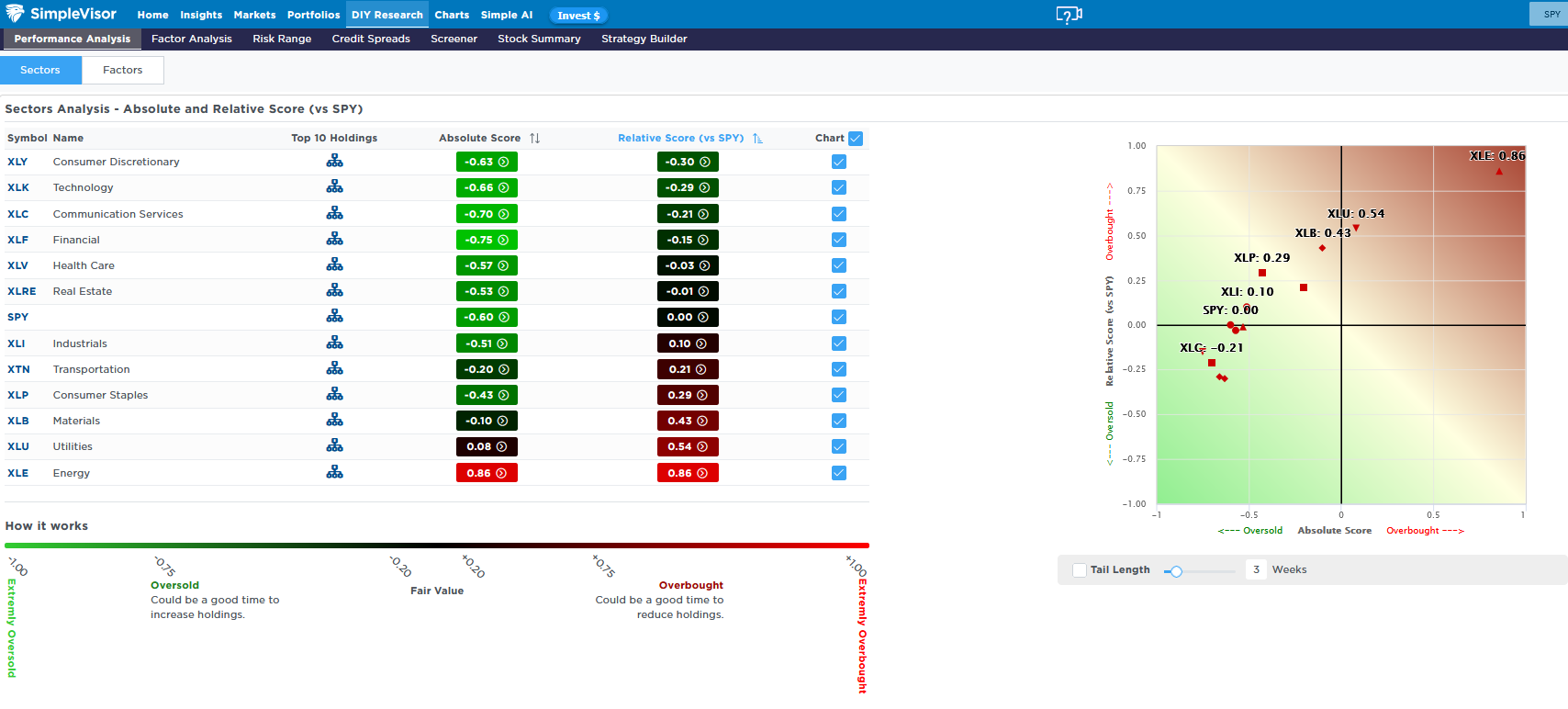
The second graphic shows that almost all sectors, except energy stocks, are oversold on an absolute basis. Energy, not surprisingly, is grossly overbought. It may remain so until oil prices normalize. We advise taking profits in the sector and being ready to rotate out of energy if the conflict shows signs or the flow of oil resumes toward more normal levels.
Stock Market Breadth: Warning Or Opportunity
The S&P 500 is down roughly 7% from its January 27 all-time high. Unsurprisingly, the media is full of “red” headlines discussing the seemingly “endless” correction we are in. Unsurprisingly, previously complacent investors are now anxious, as nothing seems to be working. But that index-level headline conceals something far more alarming: stock market breadth has collapsed. According to Morgan Stanley, approximately 42% of S&P 500 members are already down 20% or more from their 52-week highs. More than 200 companies are in their own private bear markets, even as the index itself is not in one.
This was a point we noted in this past weekend’s Bull Bear Report:
“J.P. Morgan captured the paradox: the S&P 500 is down only ~9% despite oil rising 70% and the Fed shifting from pricing two cuts to a 50% probability of a hike, and software falling 20%. As we noted recently, a much larger correction is underway in the market.”

While “times have been tough lately,” this is not a new phenomenon.
Tweet of the Day
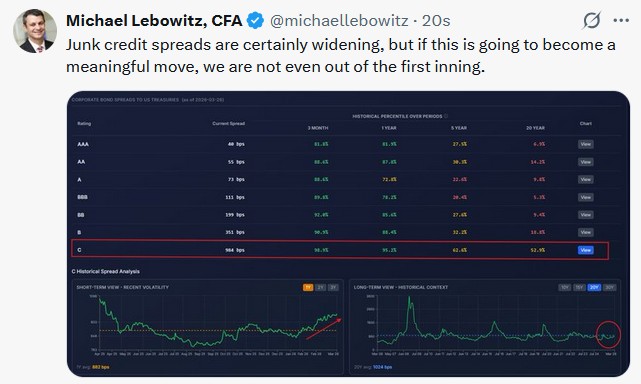
“Want to achieve better long-term success in managing your portfolio? Here are our 15-trading rules for managing market risks.”
Please subscribe to the daily commentary to receive these updates every morning before the opening bell.
If you found this blog useful, please send it to someone else, share it on social media, or contact us to set up a meeting.
The post Why Gold Is Failing As A Safe Haven appeared first on RIA.
Full story here Are you the author?You Might Also Like
 A Fed Balancing Act: Oil, Iran, Slower Growth
2026-03-19
Few Fed meetings in recent memory have presented the FOMC with a more uncomfortable set of competing signals than yesterday’s. The Iranian conflict and its impact on oil and oil-dependent product prices have created the potential for an inflationary impulse, yet higher oil prices would likely slow economic activity, leading to higher unemployment. As if …
 The Reflation Narrative Stumbles Out Of The Gate
2026-01-26
With a 4.4% increase in economic growth in the third quarter and expectations that it could be higher in the fourth quarter, the so-called reflation narrative appears primed to dash out of the gates in 2026 at its current strong pace. The problem with assuming the reflation narrative will hold in 2026 is that it …
 Hawkish Or Less Dovish? QE Or Not QE?
2025-12-11
There is a growing divergence of views among FOMC members. Some remain dovish, favoring more rate cuts. Their argument is based on a belief that inflation will continue to move toward the 2% target and that the weakening labor market benefits from lower interest rates. On the other side of the aisle are hawkish views. …
Tags: Featured,newsletter