







| I’ve found that most wars are filled with surprises, but the stakes of this conflict are obvious: it all comes down to who controls the Strait of Hormuz. We’ve seen this pattern before—with the Dutch in the 17th century and the British in 1956. When a world power reveals military and financial weakness, the world order shifts. In my latest article, I look at the mechanics of the current Middle East crisis. You can find it here: https://raydalio.substack.com/p/it-all-comes-down-to-who-controls?r=7i6zcq |

You Might Also Like
 Investing During a Changing World Order
2026-02-25
Last week, I shared a chapter from my 2021 book Principles for Dealing with the Changing World Order that details the classic signs to watch for as the world geopolitical order breaks down in a classic progression of events that I call the "Big Cycle." By knowing what this classic process looks like and then comparing it with what is happening, one can better understand what is happening and what might happen. The article was very popular, getting more than 75 million views, and a number of people asked what it all meant for investing.
Because so many people asked, I am now passing along to you the book’s next chapter, "Investing in Light of the Big Cycle." I think that it gives a good perspective on investing at this time. You can read the full chapter here:
 Ray Dalio’s Point of View on Wealth Taxes
2026-01-28
The income and wealth gap in the US are the highest they’ve been in almost 100 years. It’s something that need to be addressed before it creates even more extreme internal conflicts.
However, I worry about the practical impacts of wealth taxes on the economic system. And that’s because there’s a difference between wealth and money.
It’s all about the mechanics. Bubbles burst when there’s a need for money to generate cash flow. Wealth taxes would create a situation where people who are wealthy on paper need to sell assets to cover their liabilities. And that can quickly create a dynamic that leads to a broader issue.
It’s something to watch in the coming years.
#wealthtaxes #wef26
 The Most Important Lesson: Humility
2025-12-01
In 1979, I was so broke that I had to borrow $4,000 from my Dad to help take care of my family.
I had calculated that American banks had lent much more money to foreign countries than they would be able to pay back, and anticipated an imminent debt crisis.
But I couldn’t have been more wrong. I didn’t fully understand the impacts of quantitative easing, and so I lost money for myself and I lost money for my clients.
Looking back, it was the most painful experience I could imagine — but it was also the best thing that ever happened to me, because it taught me humility.
 Charitable Gifting This Holiday Season
2025-11-29
Trying to figure out your holiday gift giving this year? I have a great suggestion for you.
There are organizations like @TisBestCards and @donorschooseorg that will give a donation to your recipient’s favorite charity, on your behalf.
I think gifts like these are more in keeping with what the holiday season is really about, so I wanted to pass it along. #redefinegifting
 The Best Principle to Deal with Pain
2025-11-10
Don’t just react to pain — reflect on it. To overcome any obstacle, you must think deeply about how reality works and develop principles to guide your actions. That’s the only way to learn from your mistakes so you don’t repeat them. The pain is the signal! @TheDiaryOfACEO
 Ray Dalio On How Expectation Impact Happiness
2025-11-07
My perspective on how #expectations impact #happiness.
 Why Adding Gold to Your Portfolio is a Good Idea
2025-11-05
As an investor, you don’t want to concentrate your bets — you want diversification, so you’re protected in different economic environments. That’s why alternative assets like gold are so valuable in balancing your portfolio. @TheProfGPod
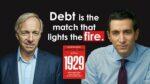 Ray Dalio & Andrew Ross Sorkin on His New Book “1929” and How Debt Drives Every Crash
2025-10-30
I sat down with CNBC’s Andrew Ross Sorkin to discuss his latest book, 1929: Inside the Greatest Crash in Wall Street History — and How It Shattered a Nation.
A lot of what Andrew learned researching this book is analogous to what happened during the 2008 financial crisis, and also to what is happening today. That’s because history moves in cycles — the same cause-effect relationships are at play, and there are important lessons to be learned.
While the details are different, the mechanics behind people’s behaviors and policy choices are largely the same.
Throughout history, people ignore these similarities because the mechanics are not well understood. My hope is that research and conversations like these can help us collectively make better choices in the future. Learn more about
Tags: Featured,newsletter,Ray Dalio




















20 pings
Skip to comment form ↓