




| One principle that I’ve really learned is “Pain + Reflect = Progress.” |
You Might Also Like
How the Economic Machine Works Part 5
2025-10-31
This simple animated video series answers the question, "How does the #economy really work?" Based on my practical template for understanding the economy.
This series breaks down economic concepts like #credit, #deficits and #interest rates, allowing viewers to learn the basic driving forces behind the economy, how economic policies work and why economic cycles occur.
This is Part 5, I hope you find these helpful.
Interest is the United States’ Second Largest Expenditure
2025-10-28
This year, the US will spend 40% more than it’s taking in. This number is increasing each year — and our debt plays a major role.
This is a big problem, especially because cutting our spending is a difficult political issue. And as we continue to add to the debt, the supply-demand picture worsens.
I fear that we are approaching the point where we won’t be able to rectify it.
@TheProfGPod
Ray Dalio on His Biggest Failure
2025-10-23
In the late 1970’s, I calculated that we were going to have a global debt default. I was so confident in what that meant for the markets that I went to Congress to share my perspective.
I couldn’t have been more wrong. While several countries defaulted on their debt, the impact on markets was the opposite of what I expected.
And I lost a lot of money — for me and for my clients. I had to let all of my employees go.
But it was the best experience that ever happened to me because it taught me that pain + reflection = progress.
And it taught me three lessons that became the foundation of Bridgewater’s success.
1) It gave me humility — the fear of being wrong was so strong that I had to always ask, “How do I know I’m right?”
2) It taught me the power of diversification — and how 15
Ray Dalio Explains Gold v. Fiat Currencies
2025-09-23
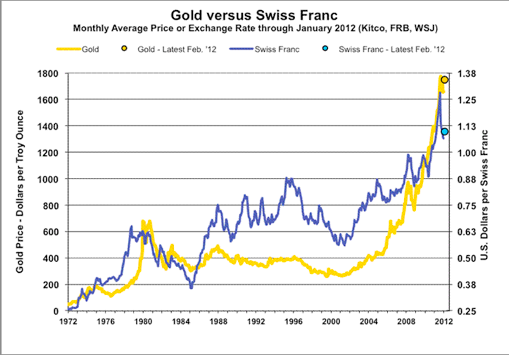
Gold is now the second largest reserve currency, behind the US dollar.
To understand why, you need to look at the history of fiat currencies (like the dollar) and hard currencies (like gold).
The way I see it, we’re currently facing a classic currency devaluation similar to what we saw in the 1970s or the 1930s. In both of those cases, fiat currencies around the world all went down together — and also went down in relationship to hard currencies, like gold.
If events today follow a similar pattern, that makes hard currencies an attractive asset to hold.
At least, that’s how it looks through my eyes. I’m curious to hear what you think.
You can watch the full conversation here: ?feature=shared
My Biggest Failure Became My Strength
2025-08-20
One principle that I’ve really learned is “Pain + Reflect = Progress.”
Will We See the U.S. Dollar Backed By Gold Again?
2025-08-05
The U.S. dollar used to be backed by gold — and it’s not farfetched to think we may be headed there again in the future.
History shows us that the same cycles repeat time and time again. One such cycle is related to currency devaluation.
Once people start to lose trust in the fiat system, we see a specific cause and effect reaction occur.
1) Governments print a lot of money
2) They pay off the debt with the cheap money
3) Nobody wants to hold the devalued currency
4) Governments go back and link money to gold
Will this same pattern happen again? It’s hard to say, and it wouldn’t happen anytime soon. But it is conceivable.
Ray Dalio Explains Money Vs Credit
2025-07-30
In an advanced economy, credit does more good than bad. But it’s important to remember that borrowing creates cycles — and if the cycle goes up, it eventually needs to come down.
I explain why this is particularly important today in my new book, How Countries Go Broke.
But if you’d like more context on how all of these pieces come together, I recommend you watch my 30-minute explainer “How the Economic Machine Works” here: &t=1444s
#principles #howcountriesgobroke #economics #credit
Dalio’s 3% 3 Part Solution to Decrease the Deficit
2025-06-16
The US is approaching the end of the long-term debt cycle. There are 3 levers we can pull to bring the deficit down to ~3% of GDP and mitigate our debt burdens: 1) reducing spending, 2) increasing taxes, and 3) lowering interest rates.
While we need to consider each of these levers, I recently discussed why reducing interest rates will ultimately have the greatest impact on the budget deficit with @the_IMF.
You can learn more about my proposed 3% 3-part solution to the US debt crisis in my new book, How Countries Go Broke: The Big Cycle, available now wherever books are sold.
#principles #howcountriesgobroke #economics
Tags: Featured,newsletter,Ray Dalio



4 pings