







A Libertarian Party presidential nominee said he was open to a carbon tax. Mises would have had a different suggestion, and Timothy Terrell explains what it was.
Read More »
Category Archive: 6b.) Mises.org
Human Action: The Antidote to Progressivism
There are only three possible economic systems: capitalism, socialism, and interventionism. Mises spent his career proving the third is the least understood and the most dangerous.
Read More »
Read More »
Human Action and the Foundations of Economic Prosperity
A labor economist at the University of Chicago devoted his career to Veblen's institutionalism. When he finally saw through the foundations, he told a friend: all my work has been bunk.
Read More »
Read More »
Mises and Rothbard on Credit Contraction during a Downturn
Should banks contract credit during a bust? Mises said yes. Rothbard disagreed. Patrick Newman traces a subtle but consequential rift between master and student.
Read More »
Read More »
There’s Many a Slip ‘twixt Cup and Lip
The engineer and the gambler both face uncertainty, but only one can control the forces involved. Jonathan Newman explores the gap between plan and outcome that drives all economic life.
Read More »
Read More »
Dualism and Calculation: What Mises Taught Me about Economics and Capitalism
Mises said the modern theory of value didn't just improve economics. It created an entirely new science: the general theory of human action.
Read More »
Read More »
Property Rights and Entrepreneurial Judgment
Armen Alchian opened a seminar by reading a paragraph on property. Only one person in the room recognized it from Mises's Human Action. It changed everything.
Read More »
Read More »
The Challenge of Praxeological Realism
Hülsmann opened Mises's 1912 Theory of Money and Credit expecting a historical curiosity. He found a work that surpassed everything published since.
Read More »
Read More »
My Discovery of Human Action and of Mises as a Philosopher
To spend his compulsory East German currency, Hoppe's only options were Marx, Engels, and Russian novels. Then he found his way to Mises through Friedman and Hayek.
Read More »
Read More »
Human Action: Foundations for the Modern Austrian School
By 1950, the Austrian School was nearly dead. Keynesianism had displaced its business cycle theory, and the profession declared Mises wrong on socialism. Human Action was the counterattack.
Read More »
Read More »
Human Action, the Way Forward
Mainstream economics starts with models and works backward to reality. Mises started with reality and worked forward to theory. Herbener explains why that distinction changes everything.
Read More »
Read More »
Ludwig von Mises’s Epicurean Ethics
Mises was a psychological hedonist, but not the kind you think. David Gordon untangles a philosophical position most Austrians have never examined closely.
Read More »
Read More »
How Human Action Shaped My Teaching and Research Career
DiLorenzo learned more about inflation and recession in 45 minutes of reading Mises than in two semesters of macroeconomics. That, he argues, is the Austrian School's greatest advantage: anyone can become their own economist.
Read More »
Read More »
The Law of Association: Foundation of Human Society
Ricardo's law of comparative advantage wasn't just about trade between nations. Mises saw something deeper: it's the reason human society exists at all.
Read More »
Read More »
Preface to The Influence and Significance of Human Action After 75 Years
Ludwig von Mises nearly titled his masterwork Social Cooperation. Salerno explains why that alternative title reveals more about the book's ambition than most readers realize.
Read More »
Read More »
The Influence and Significance of Human Action After 75 Years
Human Action is more than a book about economics broadly construed. It is a guide to civilized social life which elucidates the laws of reality that apply if human persons are to engage in peaceful and prosperous social cooperation under the division of labor.
Read More »
Read More »
How Money Acquires Its Value
From Monetarists to advocates of modern monetary theory, government edicts give money its value. Austrian economists from Menger to Mises to Rothbard know better.
Read More »
Read More »
America’s States Are Too Big and Too Centralized
Ryan McMaken argues that the American constitutional structure has become a suicide pact. It's a system that guarantees growing conflict and provides only one approved solution: more centralized power in Washington.
Read More »
Read More »
Why young and old men are leaving the labor force at record rates
On top of mounting numbers of retirees, record numbers of young men are claiming to be disabled or sick.
Read More »
Read More »
Coordination, Not Conflict: What Hayek Got Right About Social Order
There is a recurring temptation in political economy to reduce social order to a problem of conflict rather than recognizing the significance of voluntary cooperation.
Read More »
Read More »
 On Swiss National Bank
-
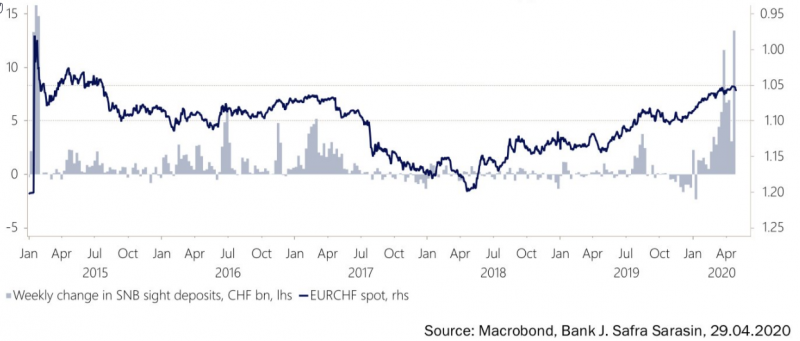
SNB Sight Deposits: decreased by 2.2 billion francs compared to the previous week
-
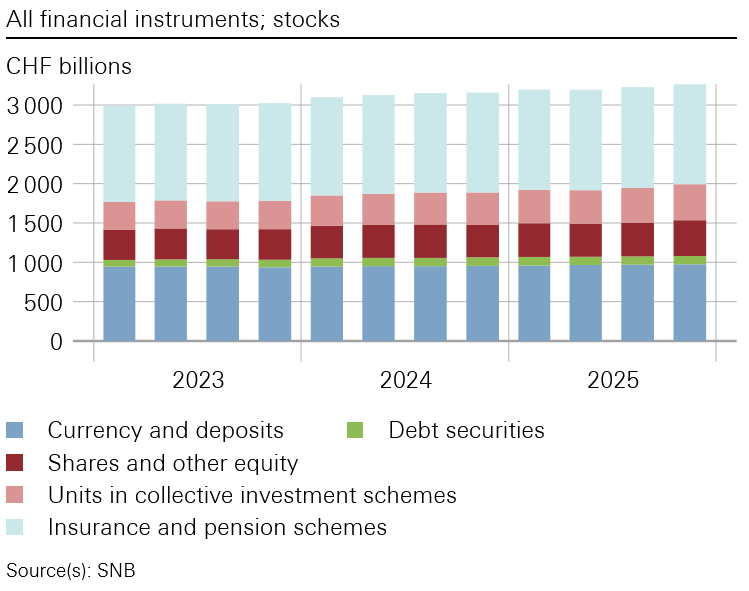
Household wealth in 2025
-
Heads up for NZD and CHF traders, RBNZ Gov Breman and SNB Chair Schlegel to speak
-
Swiss franc appreciation has led to tighter monetary conditions – SNB minutes
-
SNB’s Chairman Schlegel: A few months of negative inflation wouldn’t be a problem
Main SNB Background Info

Featured and recent
-
 SNB Sight Deposits: decreased by 2.2 billion francs compared to the previous week
 -
 Corrections vs. Bear Markets: Why 20% Declines Are Obsolete
 -
 -40 Kilo! Ricarda Lang feiert Abnehmerfolg! Das Internet feiert!
 -
 Steuerrecht digitalisieren mit KI – eine gute Idee?
 -
 Why Switzerland is launching a charm offensive in Southeast Asia
 -
 Ex-Raiffeisen bank CEO fined for tax evasion
 -
 The price of gold matters, but availability matters more.
 -
 FATAL: EU Chefdiplomatin blamiert ganz Europa! China außer sich!
 -
 India’s situation shows why physical gold is different from paper exposure.
 -
 ZUGRIFF auf dein Vermögen: So schützen sich INSIDER