







The national average price for a gallon of gasoline was $4.46 on May 4, up from $4.11 on April 27.
Read More »
Category Archive: 6b.) Mises.org
Freedom candidate Thomas Massie may lose thanks to the over-65 crowd
When broken out by age, Massie has huge leads among voters under age 46. Voters over 66 are against Massie. Older voters consistently favor more war and government spending.
Read More »
Read More »
Marx Was Wrong About the “Necessary” Ruin of Small Landed Property
Karl Marx not only misunderstood value and production, but he also was wrong about large-scale and small-scale property owners.
Read More »
Read More »
New Book: ‘The Influence and Significance of Human Action After 75 Years’
Human Action is more than a book about economics broadly construed. It is a guide to civilized social life which elucidates the laws of reality that apply if human persons are to engage in peaceful and prosperous social cooperation under the division of labor.
Read More »
Read More »
The Cost of Money: Coinage, Fiat Power, and the Quiet Corruption of Value
Governments take valuable things like paper and minerals, stamp something on them, and call them money, in the process rendering these things almost worthless. Something is wrong with this picture.
Read More »
Read More »
Progressives and Conservatives Are Wrong About Taxing the Rich
Both progressives and conservatives show a complete unwillingness or inability to distinguish between those who got rich by genuinely creating value by serving others and those who are getting rich by expropriating wealth through force.
Read More »
Read More »
The Hidden Cost of Central Banking: Why Inflation Is Not “Neutral”
Inflation is not neutral, it is a hidden tax, a distortion of entrepreneurial signals, and a corrosive force against social trust.
Read More »
Read More »
The Inconsistencies of John Stuart Mill
John Stuart Mill is a study in contrasts. He wrote On Liberty, yet many of his ideas and theories promoted anything but liberty.
Read More »
Read More »
Someone Always Knows First
Political power over markets doesn’t just corrupt individuals—it corrupts the price system itself.
Read More »
Read More »
Depopulation Won’t Save Us or the Planet
The recent death of Paul Ehrlich reminds us that his crackpot overpopulation theories still are with us, even as they are being regularly discredited.
Read More »
Read More »
Depopulation Won’t Save Us or the Planet
The recent death of Paul Ehrlich reminds us that his crackpot overpopulation theories still are with us, even as they are being regularly discredited.
Read More »
Read More »
Enhancing Economic Analysis Through Corporate Finance
Corporate finance can help introduce classifications such as the distinction between the assets of a natural person and a legal person, but also by incorporating profitability, liquidity, and solvency variables into economic policy analysis.
Read More »
Read More »
The Influence and Significance of <em>Human Action</em> After 75 Years
For Human Action is more than a book about economics broadly construed. It is a guide to civilized social life which elucidates the laws of reality that apply if human persons are to engage in peaceful and prosperous social cooperation under the division of labor.
Read More »
Read More »
Living Under the Weight of Keynes’s Shadow Wealth
In Graham Moore’s The Wealth of Shadows, John Maynard Keynes is a hero for his monetary manipulations. However, in the real world, the economics of Keynes has brought economic ruin.
Read More »
Read More »
Nations by Consent
Every nation-state boundary was drawn by force. Should we treat them as sacred the same way we treat a house or factory? Rothbard says no, and proposes something more radical.
Read More »
Read More »
Remembering Pre-Chair Kevin Warsh
A central banker has two lives: the first is spent studying neoclassical money supply mechanics; the second begins when they realize the real world doesn’t work that way.
Read More »
Read More »
Nation-States and National Borders
In this episode of Radio Rothbard, Ryan McMaken looks at Rothbard's essay "Nations by Consent: Decomposing the Nation State."
Read More »
Read More »
Today’s AIs Show the Marginal Revolution’s Unfinished Business
In 1871, the “discovery” of marginal economic analysis soon took a wrong turn, moving towards quantification, data, and mathematics. It is time to “rediscover” the margin, this time the margin as explained by Carl Menger.
Read More »
Read More »
Is Human Action the Hidden Impact Crater of Modern Economics?
Human Action sold thousands of copies, earned accolades from across the political spectrum, and made zero acknowledged impression on the economics profession. Or did it?
Read More »
Read More »
 On Swiss National Bank
-
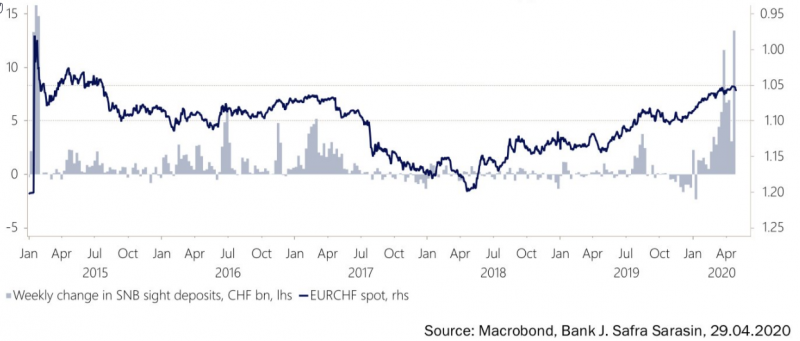
SNB Sight Deposits: decreased by 2.2 billion francs compared to the previous week
-
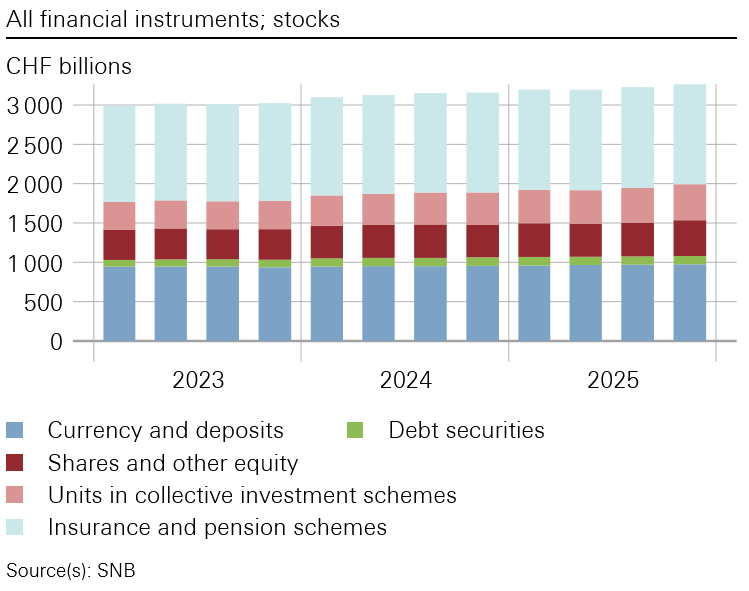
Household wealth in 2025
-
Heads up for NZD and CHF traders, RBNZ Gov Breman and SNB Chair Schlegel to speak
-
Swiss franc appreciation has led to tighter monetary conditions – SNB minutes
-
SNB’s Chairman Schlegel: A few months of negative inflation wouldn’t be a problem
Main SNB Background Info

Featured and recent
-
 SNB Sight Deposits: decreased by 2.2 billion francs compared to the previous week
 -
 Corrections vs. Bear Markets: Why 20% Declines Are Obsolete
 -
 -40 Kilo! Ricarda Lang feiert Abnehmerfolg! Das Internet feiert!
 -
 Steuerrecht digitalisieren mit KI – eine gute Idee?
 -
 Why Switzerland is launching a charm offensive in Southeast Asia
 -
 Ex-Raiffeisen bank CEO fined for tax evasion
 -
 The price of gold matters, but availability matters more.
 -
 FATAL: EU Chefdiplomatin blamiert ganz Europa! China außer sich!
 -
 India’s situation shows why physical gold is different from paper exposure.
 -
 ZUGRIFF auf dein Vermögen: So schützen sich INSIDER