







Thanks to Trump-caused global price hikes, the Chilean Left has a much easier time destroying Chile's new Catholic anti-socialist leader.
Read More »
Category Archive: 6b.) Mises.org
Israeli state targets Christians by forcing holy sites to close
For the first time in many centuries, Christians cannot enter the the Church of the Holy Sepulchre.
Read More »
Read More »
Americans assume Saudi Arabia is the top foreign oil source for the US. They’re wrong.
Only 22% of surveyed Americans correctly stated the top source of foreign oil in the US: Canada.
Read More »
Read More »
Iran’s grip on Strait of Hormuz is tighter than ever after a month of war
So far in March barely six vessels per day on average have traversed the strait. That compares with about 135 a day in normal times.
Read More »
Read More »
How the Jacksonians Caused America’s Industrial Revolution
America’s industrial revolution didn’t just happen. It came about because of the free market initiatives that came from the Andrew Jackson presidency.
Read More »
Read More »
Why Sovereign Debt Is Structurally Insulated from Market Discipline
Government debt is junk investment, but the markets treat it as gold. That is because government greases the skids, keeping its paper from the market discipline that private investments experience.
Read More »
Read More »
How the Jacksonians Caused America’s Industrial Revolution
America’s industrial revolution didn’t just happen. It came about because of the free market initiatives that came from the Andrew Jackson presidency.
Read More »
Read More »
Murray N. Rothbard and the Truth About Central Banking
Drawing on Rothbard's writings on money and central banking, Murray Sabrin makes the case that inflation is a hidden tax, the Federal Reserve is neither independent nor beneficial, and that ending central banking is the unfinished business of the American Revolution.
Read More »
Read More »
Atlanta, TSA, and a Test Case for Interventionist Non-Intervention
The TSA stories, especially at Atlanta, are illustrations of interventionist non-intervention: non-delivery of promised, paid-for, and monopolized service.
Read More »
Read More »
What Rothbard Can Teach the Public About Inequality
Drawing on Rothbard's essay on inequality and the division of labor, Dr. Lucas Engelhardt argues that human diversity is the very foundation of comparative advantage and prosperity, and that billionaires arise either by serving large numbers of people through the market or by extracting wealth through political connections.
Read More »
Read More »
Murray N. Rothbard on the Capitalist-Entrepreneur
Dr. Per Bylund unpacks Rothbard's concept of the capitalist entrepreneur as the economy's true mover and shaker: the figure who not only forecasts future consumer demand but puts real capital behind those forecasts, bearing uncertainty and driving the structure of production.
Read More »
Read More »
What Rothbard Can Teach the Public about Public Economics
Dr. Tate Fegley uses Rothbard's theory of demonstrated preference to dismantle the mainstream public goods framework, showing that claims of market failure and welfare improvement by the state have no scientific basis because they contradict what individuals actually reveal through their choices.
Read More »
Read More »
What Rothbard Can Teach the Informed Layperson About Prices and Competition
Drawing on Man, Economy, and State, Dr. Jonathan Newman walks through Rothbard's theory of price formation and competition, showing that prices reflect subjective preferences, not seller greed, and that the only consumer-harming monopolies are those created by the state.
Read More »
Read More »
Corruption in the System
Government corruption isn’t an anomaly. It is part of the system itself. We should expect government to be corrupt. Free markets are the antidote to this corruption.
Read More »
Read More »
Atlanta, TSA, and a Test Case for Interventionist Non-Intervention
The TSA stories, especially at Atlanta, are illustrations of interventionist non-intervention: non-delivery of promised, paid-for, and monopolized service.
Read More »
Read More »
Huerta de Soto Exposes the Failures of Socialism
A century after Ludwig von Mises exposed the fundamental weakness in the socialist economy, Jesús Huerta de Soto demonstrates why Mises was right and his detractors were wrong. In Friday Philosophy, Dr. David Gordon explains why Huerta de Soto is right.
Read More »
Read More »
What Would a Strategic Victory Look Like in Iran?
Foreign policy scholar Brandan Buck joins Ryan McMaken to talk about whether or not a US tactical victory in Iran can lead to a strategic victory as well. And what does victory for the Iranian state look like? Are there any prospects for a lasting peace?
Read More »
Read More »
Can AI Solve the Socialist Calculation Problem?
Bob untangles two arguments that even Austrian economists sometimes conflate: Mises' calculation problem and Hayek's knowledge problem. Then, he explains why the distinction matters, especially in light of recent claims that AI and modern computing could finally make central planning viable.
Read More »
Read More »
 On Swiss National Bank
-
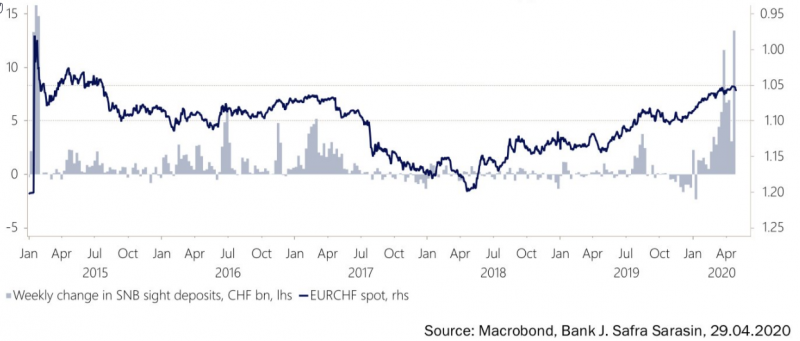
SNB Sight Deposits: decreased by 2.2 billion francs compared to the previous week
-
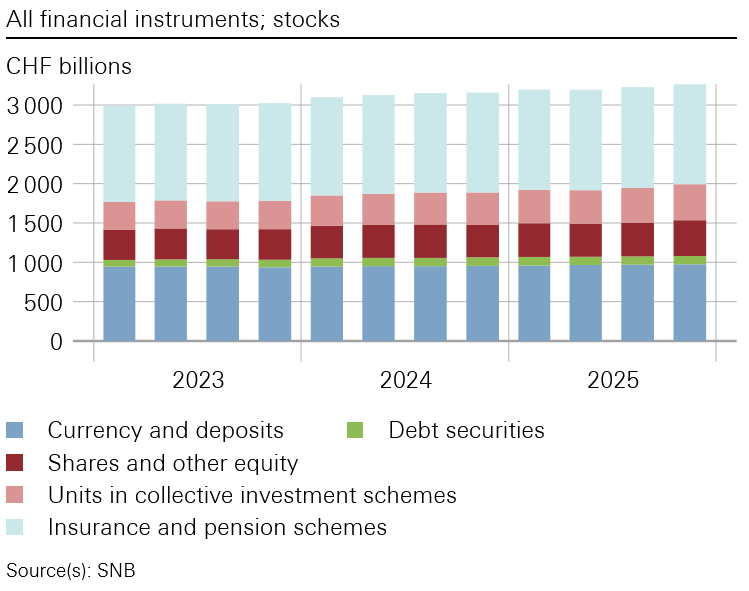
Household wealth in 2025
-
Heads up for NZD and CHF traders, RBNZ Gov Breman and SNB Chair Schlegel to speak
-
Swiss franc appreciation has led to tighter monetary conditions – SNB minutes
-
SNB’s Chairman Schlegel: A few months of negative inflation wouldn’t be a problem
Main SNB Background Info


Featured and recent
-
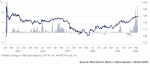 SNB Sight Deposits: decreased by 2.2 billion francs compared to the previous week
 -
 Corrections vs. Bear Markets: Why 20% Declines Are Obsolete
 -
 -40 Kilo! Ricarda Lang feiert Abnehmerfolg! Das Internet feiert!
 -
 Steuerrecht digitalisieren mit KI – eine gute Idee?
 -
 Why Switzerland is launching a charm offensive in Southeast Asia
 -
 Ex-Raiffeisen bank CEO fined for tax evasion
 -
 The price of gold matters, but availability matters more.
 -
 FATAL: EU Chefdiplomatin blamiert ganz Europa! China außer sich!
 -
 India’s situation shows why physical gold is different from paper exposure.
 -
 ZUGRIFF auf dein Vermögen: So schützen sich INSIDER