







Nominalist ideas influenced the scientific revolution, shaping its departure from metaphysics, its mechanistic perspective, and the mathematization of all sciences. This paradigm has brought about some errors in economic thinking.
Read More »
Category Archive: 6b.) Mises.org
The Federal Judiciary’s War on Trump Is Not About Protecting Us from Government Overreach
As President Trump racks up defeat after defeat before the federal courts, the legacy media claims that federal judges are protecting us from government overreach. In reality, government overreach as we know it has been made possible by the federal judiciary.
Read More »
Read More »
The Optimal Supply of Money: A Simple Argument
How much money does an economy need in circulation to function? Austrians believe that a growing economy does not need a growing supply of money, which sets Austrian economics apart from other schools of economic thought.
Read More »
Read More »
Trump’s Trade Trilemma
While President Trump rails against US trade deficits, he forgets that they are due to the fact that the US dollar is the world‘s reserve currency. This, in turn, encourages deficit spending and a bloated national debt.
Read More »
Read More »
DiLorenzo talks about the Fed on “Behind The Deep State”
Thomas DiLorenzo joins the New American's Alex Newman to discuss " Federal Reserve: The Ultimate Deep State Tool of Control & Destruction"
Read More »
Read More »
Why a Gold Standard is Silently Coming Back to the States
Thomas DiLorenzo joins CapitalCosm to discuss the growing interest in gold at the state level
Read More »
Read More »
Why Lending Money (at Interest) Is Not Usury in the Modern World
In contrast to an ancient agrarian economy, the developing economy presented many risks and costs for lenders, and the idea of what was fair and just in money lending had to change.
Read More »
Read More »
The Federal Judiciary’s War on Trump Is Not About Protecting Us from Government Overreach
As President Trump racks up defeat after defeat before the federal courts, the legacy media claims that federal judges are protecting us from government overreach. In reality, government overreach as we know it has been made possible by the federal judiciary.
Read More »
Read More »
Lab-Grown Meat Protectionism
The fight against lab-grown meat has picked up considerable steam over the past year, with multiple states now prohibiting its manufacture, sale, and distribution.
Read More »
Read More »
Frédéric Bastiat: Who will Feed Paris?
Frederic Bastiat understood better than most how free markets and market prices actually promote social harmony. And unlike most, he understood why Paris, which had little agricultural land, had plenty of food for its inhabitants.
Read More »
Read More »
The Failure to Stop Thomas Paine
Tom Paine is one of the forgotten names of the American Revolution, but it can be argued that no other man was as important in galvanizing the thoughts of American colonials toward independence.
Read More »
Read More »
Trump is building an unprecedented spy machine to track Americans
Trump is partnering with CIA-funded surveillance operation Palantir to build a database on all Americans.
Read More »
Read More »
India Foreign Exchange Controls Leads to Loss of Freedom
The central government intervention suspending each foreign currency exchange license in the country is an example leading to a loss of freedom for each NGO operating in the country.
Read More »
Read More »
Trump Is Building a Bigger Deep State with the Help of “Libertarian” Peter Thiel
JD Vance is Palantir’s man and every call for “Vance 2028” is likely music to the ears of the deep state and its Big Tech allies.
Read More »
Read More »
Seattle’s Other Monorail: Some Lessons for California
While this page has covered rail boondoggles in California and elsewhere, we also look at Seattle, which looked at building a monorail system, but then later wisely back off, saving the city‘s taxpayers hundreds of millions of dollars of future taxes.
Read More »
Read More »
1995: When I Testified Before the Train Wreck Known as Congress
Elon Musk has found out the hard way that one can ferret out hundreds of billions of dollars that Congress wastes, but fail in getting its members to stop wasteful spending. Jim Bovard learned that hard lesson 30 years ago.
Read More »
Read More »
What Is the Optimal Growth Rate for the Money Supply?
The mainstream economic belief is that a growing economy needs a growing money supply to ensure “price stability.” Austrian economists, however, believe that there is no “optimum” money supply, which means government should not engage in monetary expansion.
Read More »
Read More »
What the World Needs Now from Pope Leo XIV
The pope must defend the family from the state‘s attacks while promoting peace and asserting independence from state power.
Read More »
Read More »
The History of Freedom in Christianity
“The only influence capable of resisting the feudal hierarchy was the ecclesiastical hierarchy; and they came into collision, when the process of feudalism threatened the independence of the Church...”
Read More »
Read More »
 On Swiss National Bank
-
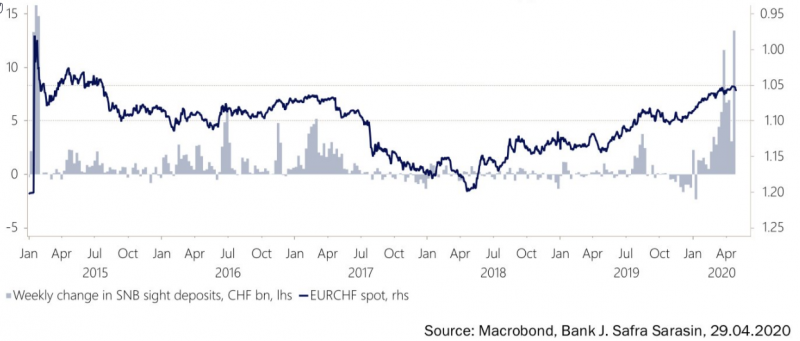
SNB Sight Deposits: decreased by 5.7 billion francs compared to the previous week
-
SNB’s Chairman Schlegel: A few months of negative inflation wouldn’t be a problem
-
2025-07-31 – Interim results of the Swiss National Bank as at 30 June 2025
-
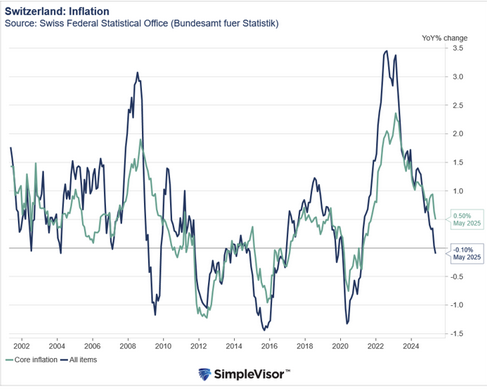
SNB Brings Back Zero Percent Interest Rates
-
Hold-up sur l’eau potable (2/2) : la supercherie de « l’hydrogène vert ». Par Vincent Held
Main SNB Background Info

Featured and recent
-
 What central banks are really signalling with their record gold purchases
 -
 Öl, Gold & Aktien: Warum ich jetzt absolut optimistisch bleibe
 -
 Der RSI 14 Mythos: Warum Standard-Einstellungen oft scheitern
 -
 Sie feiern IHN #krieg #iran #usa #trump #putin #europa #wirtschaft #deutschland #khamenei #israel
 -
 Swiss foreign minister to strengthen partnerships on tour of Africa
 -
 Swiss city draws positive results after three years of controlled cannabis sales
 -
 Could direct democracy put the brakes on trade?
 -
 Long bei Erdöl?
 -
 3-19-26 Will The Fed Backstop Exuberance Again?
 -
 Swiss National Bank keeps interest rate unchanged