Michael Lebowitz


Articles by Michael Lebowitz

Fed Regime Change: Groupthink May Be Ending

Starting in the aftermath of the 2008 financial crisis, a profound change to the Fed’s liquidity-providing role in the capital markets was underway.  We can sum up the Fed regime change with a popular quip: The Fed has shifted from lender of last resort to the lender of only resort! In our articles QE Is …

Continue reading »

Read More »

TPUs Or GPUs: Is Nvidia’s Moat Eroding?

Markets have priced Nvidia as the clear winner in AI chip production. To some, its moat appears impenetrable. Google’s developments suggest there may be some competition. Google has been training and serving its AI platform with in-house tensor processing units (TPUs). These chips are more cost-effective and power-efficient than Nvidia’s GPUs. By using TPUs in …

Continue reading »

Read More »

How The Fed Deals Liquidity: The Monetary Toolbox

In our last article, QE Is Coming, we focused on why the capital and financial markets have become so dependent on the Fed for liquidity.  The article explains that, in the aftermath of the crisis, a slew of regulations drastically changed the liquidity landscape. As a result, the Fed—not the private market—is now the primary …

Continue reading »

Read More »

Is Strategy Dragging Bitcoin Down?

Bitcoin is up 2% year to date, but the share price of the world’s largest holder of Bitcoin, Strategy (MSTR – formerly MicroStrategy), is down about 30% year to date. As we have noted in the past, Strategy is a Bitcoin holding company, a leveraged alternative to holding Bitcoin. Its original business, enterprise analytics software, …

Continue reading »

Read More »

QE Is Coming: The 2008 Roots Of Fed Dominance

Here we go again. The overnight funding markets are showing signs of stress, and the scent of QE is in the air. Per New York Fed President John Williams: Based on recent sustained repo market pressures and other growing signs of reserves moving from abundant to ample, I expect that it will not be long …

Continue reading »

Read More »

Nvidia Deals: Round Tripping Or Vendor Financing?

“Nvidia takes a $1 billion stake in Nokia” reads a recent CNBC headline. As part of the agreement, Nokia commits to purchasing Nvidia’s AI chips and computer platforms. Additionally, the companies will collaborate to develop 6G cellular technology. Deals like this are becoming more common in the AI industry. Some view Nvidia’s recent investment in …

Continue reading »

Read More »

SimpleVisor Alert

Please be advised that we are making changes to the backend of the SimpleVisor website. As a result, we are facing a few complications with subscriptions and logins. We are currently working on the problems and hope to have them resolved shortly. Thank you for your patience. The post SimpleVisor Alert appeared first on RIA.

Read More »

Dollar Debasement: Reality Or A Dangerous Narrative?

Gold prices are soaring. And with each tick higher, more and more market pundits and investors are coming out of the woodwork, asserting that dollar debasement is the reason. Is that the correct reason, or might gold be in a momentum-fueled speculative bubble like many other assets? The answer has significant implications for the price …

Continue reading »

Read More »

SRF: The Fed’s Newest Liquidity Backstop In Action

In July of 2021, after the pandemic and the liquidity issues that arose in 2019, the Fed established a new liquidity backstop. This program, the Standing Repo Facility (SRF), allows financial institutions to borrow on a collateralized basis from the Fed. Unlike the Overnight Reverse Repurchase facility (ON RRP), which allows financial institutions to park …

Continue reading »

Read More »

Capitalism: The Road To Wealth And Happiness

The graph below presents another opportunity to revisit how capitalism and the economic freedom it entails lead to prosperity. The scatter plot below shows the intersection of The Fraser Institute’s Economic Freedom Index with per capita GDP for 102 of the largest economies. Before analyzing the graph and what it implies for capitalism, let’s gain …

Continue reading »

Read More »

Recession And Bonds: Navigating The Next Recession

It’s odd to consider, but a recession could flip our bullish outlook on bonds to bearish. It’s unusual because typically, inflation drops during a recession, leading to lower yields and higher bond prices. While we believe that if an economic downturn or recession occurs soon, the immediate effect on bonds will be favorable. However, the …

Continue reading »

Read More »

Miran Says Rates Are Too High: Politics Or Reality?

Stephen Miran, Donald Trump’s recent addition to the Fed, joined the Federal Reserve the day before the last meeting. At that meeting, he was the only dissenting vote, supporting a 50-basis-point rate cut. All other members voted for a 25-basis-point cut. Additionally, Miran is likely the FOMC participant who thinks the Fed Funds rate should …

Continue reading »

Read More »

Valuations Are Extreme: Navigating A Bubble

Some pundits warn that, given extremely high stock valuations, one should sell everything. Yet, despite having the same information, other pundits show little concern and believe the bull market has further to run. The stark contradiction of opinions in today’s market leaves many investors understandably confused and anxious about what to do. Based on valuations, …

Continue reading »

Read More »

UPS Is At Pandemic Lows: Value Or Value Trap?

Shares of UPS are around the same price they were in March 2020, when the pandemic shut down economic activity. At the time, the global economy was decimated.  In unprecedented fashion, the unemployment rate skyrocketed from 3.5% to 14.8% in one month. While the economic impact was tremendous, there was no relief in sight. The …

Continue reading »

Read More »

The Low Beta Boom: Sidestepping The Dotcom Bust

Following the release of our article The High Beta Melt Up- Echoes of 1999, we received a few emails complaining that we left our readers hanging. They wanted to know how investors could have shifted their holdings from high beta and momentum stocks to sidestep massive losses when the dot-com bubble burst. In the first …

Continue reading »

Read More »

The High Beta Melt Up: Echoes Of 1999

In our recent article, “The Magnificent Seven Are Mediocre,” we pondered whether the stock market is entering a melt-up phase, where investors driven by extreme speculative behavior and hopes for exponential returns favor volatile stocks with high betas. To be clear, we do not know whether we are in a melt-up phase. The market could …

Continue reading »

Read More »

AI Is Powering Markets

On May 6, 2010, the US stock markets dropped nearly 10% within minutes. What would be called a “flash crash” wasn’t caused by news, economic data, or a Fed policy decision. According to the U.S. Commodity Futures Trading Commission (CFTC), a large sell order on E-Mini S&P 500 futures, executed by a mutual fund and …

Continue reading »

Read More »

The Magnificent Seven Are Mediocre

In 2023, the “Magnificent Seven” (NVDA, META, TSLA, AAPL, MSFT, AMZN, and GOOG) became a popular nickname for the seven largest stocks by market capitalization. “Magnificent” was used because these stocks led the S&P 500 higher throughout the year. These same stocks had a strong showing again in 2024, as all seven were among the …

Continue reading »

Read More »

Might Lower Rates Be The Cure For Higher Prices?

The Fed is resisting interest rate cuts to help soften inflation to its 2% target. Supporting their policy is the belief that high interest rates lead to lower inflation. Most investors assume that the Fed is all-knowing and that its theories are logical. Are they? Might they be wrong, and lower interest rates are what …

Continue reading »

Read More »

Behind The Meter Solutions Investment Guide- Part 2

Part 1 of this article (Fueling AI Data Centers: Behind The Meter Solutions) explained how data centers are leveraging the abundance and relative affordability of natural gas to fuel Behind the Meter (BTM) power generators. Part Two advances the discussion to investing in this promising innovation. This article looks past the data center operators and …

Continue reading »

Read More »

Deficits And The Tradeoffs Required To Fix Them

By falling significantly short of its intended savings goals, the DOGE program underscores the substantial challenges that hinder efforts to reduce federal spending and cut the deficit. Furthermore, its failure suggests that a more expedient way to reduce the deficit might be to increase federal revenue. Thus, we pose the simple hypothetical question: What if …

Continue reading »

Read More »

Stablecoins To The Treasury’s Rescue

Digital Money was the title of TBAC’s April 30, 2025, presentation to the U.S. Treasury Department, and an important topic worth discussing. TBAC, short for the Treasury Borrowing Advisory Committee, is comprised of senior investment professionals from the largest banks, brokers, hedge funds, and insurance companies. Most often, the committee informs the Treasury staff on …

Continue reading »

Read More »

Narratives vs. Fundamentals: Battle In The Bond Market

On January 8, 2025, we answered many of your questions with an article entitled Why Are Bond Yields Rising? Since then, bond yields initially fell but have recently risen back to early January levels. Unsurprisingly, our email boxes are again filled with the same questions we got in early January. This article presents a different …

Continue reading »

Read More »

Death Of The Dollar: An Eternal Tale

The following paragraph, courtesy of Amazon, reviews the book Death of the Dollar by William Rickenbacker. Death of the Dollar by William F. Rickenbacker is a critical examination of the economic policies and monetary mismanagement that the author argues are eroding the value of the U.S. dollar and threatening financial stability. Rickenbacker contends that the …

Continue reading »

Read More »

The Wealth Effect Is Not Always Virtuous

In 2010, following the financial crisis and market meltdown in 2008 and early 2009, Fed Chairman Ben Bernanke made a notable speech explaining the virtues of the wealth effect. To wit: Higher stock prices will boost consumer wealth and help increase confidence, which can also spur spending. Increased spending will lead to higher incomes and profits that, in a virtuous circle, will further support economic expansion.

Read More »

The Storm Before The Calm

Risk management is critical to wealth preservation, especially in today’s turbulent market storm. However, during such volatile times, we must also not consider what tomorrow may have in store.  Are you prepared to adjust your portfolio in the coming months for the possibility that calm, tranquil markets and a resumption of the bullish trend emerge?

Read More »

Interest Rate Swaps: Plumbing Of The Financial System

Our recent article, Swaps and Basis Trades Warn Of Mounting Liquidity Problems, touched on negative interest rate swap spreads as an omen of potential liquidity problems. To stay on the topic of liquidity, we didn’t provide much detail about swaps. Nor did we discuss their importance to the financial system. Accordingly, we ended the discussion …

Continue reading »

Read More »

Growth To Value: Which Rotation Is Next?

The Magnificent Seven and many other large-cap growth stocks were among the winners in 2024. However, in 2025, investors are shunning the largest market cap growth and highest-beta stocks and moving into value, particularly large-cap value. Shifting investor preferences to large-cap value from large-cap growth and high beta provides an excellent example of sector and …

Continue reading »

Read More »

Tokenization: The New Frontier For Capital Markets

There is tremendous value in the world of crypto! Given some of our recent opinions (linked below), you probably did not expect to hear those words from us. Digital tokenization of assets, made possible by the crypto-blockchain construct, can boost efficiency in the capital markets, thus greasing the wheels that drive the economy.   Our …

Continue reading »

Read More »

Behavioral Economics: Managing Your Inner Voice

The combination of extremely rich equity valuations, high interest rates, and a new President taking bold actions will likely continue to whip stocks around for the foreseeable future. Alongside those volatility-provoking factors is that the S&P 500 just posted two annual twenty-plus percent gains in a row. Accordingly, seeing average or below-average returns this year …

Continue reading »

Read More »

Why Bitcoin Will Not Replace The Dollar

Some will rightfully say we are a glutton for punishment. Our previous articles on Bitcoin and cryptocurrencies have been met with boos and hisses (to be kind) from laser-eyed crypto crusaders. Despite what many of our critics think, we are agnostic about cryptocurrency, but we are willing to expose details that most crypto supporters refuse …

Continue reading »

Read More »

Growth And Value Are Not Mutually Exclusive

Might Nvidia and Tesla, with price-to-earnings ratios (P/E) nearly double and quadruple that of the S&P 500, respectively, be value stocks? Conversely, is it possible that Ford is not a value stock despite a P/E of 10, a price-to-sales ratio (P/S) of .20, and a 7.5% dividend yield? Based solely on that information, answering the …

Continue reading »

Read More »

Where Does Money Come From?

All money is lent into existence. The Federal Reserve or the government does not print money. Those two facts are vital to understanding our lead question: where does money come from? Furthermore, knowing who does and doesn’t print money and the incentives and disincentives that change the money supply are critical to inflation forecasting.   …

Continue reading »

Read More »

Meme Coins Do Not Create Wealth: They Destroy It

The latest craze in cryptocurrency is the release of the $TRUMP and $MELANIA meme coins. Immediately upon issuance, the cryptocurrency coins surged in value, turning worthless 0s and 1s of computer code into tens of billions of dollars. Many in the financial media, alongside crypto devotees, claim these meme coins, and others like Fart Coin, …

Continue reading »

Read More »

Its The Dollar Stupid

Our recent article, Why Are Bond Yields Rising, explains that the recent 1% increase in yields, as shown below, is almost entirely due to negative sentiment. As we wrote, the bond market calls sentiment the term premium. Of the 1% yield increase, only 10% is due to fundamental factors, leaving 90% a function of bond …

Continue reading »

Read More »

Technical Analysis Is Not Voodoo, Its Vital Context

If you draw enough lines on a stock chart, one of them is bound to predict the future accurately! Given that technical analysis is perfect in hindsight and flawed in foresight, many investors mock it as arbitrary. Some, like Aaron Brown, link its practice with horoscopes, tarot cards, and crystal balls.  The difference between science …

Continue reading »

Read More »

Why Are Bond Yields Rising?

The question asked of us most often recently: “Why are bond yields rising?” After verbally answering it plenty of times, it’s time to put our answer in writing for everyone to see. The answer will help you understand what is causing bond yields to rise, and more importantly, it will help you better appreciate when …

Continue reading »

Read More »

Global Conditions Portend A Catch-Down In America

For $20,000, you can buy a global airline pass to see the world. Or, for the low price of free, you can take a quick trip with us worldwide. Unfortunately, our global trip is not as exciting as an around-the-world pass. Still, it may enlighten you about some economic struggles abroad. Moreover, why, in time, …

Continue reading »

Read More »

MicroStrategy And Its Convertible Debt Scheme

MicroStrategy (MSTR) stock is soaring alongside Bitcoin. In the wake of extreme confidence, we fear many MicroStrategy investors fail to grasp the inherent risks with its unique convertible bond funding and leverage scheme. A recent podcast featuring Tom Lee presented some positive facts about MicroStrategy’s recent convertible bond offering but failed to tell the whole …

Continue reading »

Read More »

Trump Tariffs Are Inflationary Claim The Experts

The headlines regarding Trump’s proposed tariffs and their inflationary consequences are undoubtedly worrying, but will they prove correct? Instead of taking the “experts” word, let’s consider how tariffs may affect the prices of all goods and services, not just the items subject to tariffs. Furthermore, it’s worth discussing how tariffs could impact the economy, as …

Continue reading »

Read More »

The MACD: A Guide To This Powerful Momentum Gauge

When we discuss technical analysis in our articles and podcasts, we often examine the moving average convergence divergence indicator, better known as the MACD, or colloquially the Mac D. The MACD is one of our favored technical indicators to help forecast prices and manage risk. Accordingly, let’s learn more about the MACD to see how …

Continue reading »

Read More »

Why Is Gold Surging?

Record deficit spending, soaring money supply, and inflation are among the likely responses we would hear from investors to the question of why gold is surging. Instead of presuming those or other market narratives about gold prices are correct, let’s analyze historical correlations between gold and economic and market data. In addition to helping you …

Continue reading »

Read More »

Why Is Gold Surging?

Record deficit spending, soaring money supply, and inflation are among the likely responses we would hear from investors to the question of why gold is surging. Instead of presuming those or other market narratives about gold prices are correct, let’s analyze historical correlations between gold and economic and market data.

In addition to helping you better appreciate why gold is surging, our analysis will help you recognize that market narratives explaining asset price movements can be wrong, no matter how reasonable they may seem at first blush.

What Is Gold?

Gold is neither a claim on the promise of future earnings like a stock nor a liability owed by a public institution or a private party like a bond. Unlike currency, it lacks the full faith and credit of most

Read More »

Can Paul Tudor Jones and Stanley Druckenmiller Be Wrong?

Can famed investors Paul Tudor Jones and Stan Druckenmiller, who recently proclaimed they are short bonds, thus betting on higher yields, be wrong? Instead of mindlessly assuming such legendary investors are correct, let’s do some homework. First, though, let’s remind ourselves that Paul Tudor Jones and Stanley Druckenmiller are known for their aggressive trading styles. …

Continue reading »

Read More »

Can Paul Tudor Jones and Stanley Druckenmiller Be Wrong?

Can famed investors Paul Tudor Jones and Stan Druckenmiller, who recently proclaimed they are short bonds, thus betting on higher yields, be wrong? Instead of mindlessly assuming such legendary investors are correct, let’s do some homework.

First, though, let’s remind ourselves that Paul Tudor Jones and Stanley Druckenmiller are known for their aggressive trading styles. Therefore, we don’t know whether their bets are short term trades for a quick profit, or longer-term bets on significantly higher yields. Moreover, maybe their negative bond commentary is just “talking their books” to get traders and investors to follow them and boost their profits. Such a proven strategy by famous traders can be a recipe for losses by those who try to mimic their trades.

The recent 50-basis point

Read More »

Memory Inflation Warps Bond Yields

The Mayo Clinic defines Post Traumatic Stress Disorder, or PTSD, as “a mental health condition that’s caused by an extremely stressful or terrifying event — either being part of it or witnessing it.” Within the field of PTSD research is a concept called “memory inflation.” Memory inflation occurs when memories of traumatic events become more intense over time.   

Memory inflation of past events amplifies one’s emotions and behaviors. As we will discuss, distress from recent price inflation is causing many investors to overly fear that a similar situation will reoccur.

Given the tight relationship between inflation and bond yields, memory inflation negatively affects bond prices. Additionally, memory inflation may prevent some investors from seeing an opportunity to profit from the

Read More »

The VIX And Market Climb: Should We Care?

The financial media frequently opines on what the daily gyrations of the VIX (implied volatility index) signal regarding investor sentiment. Despite how often it is quoted and discussed, many investors do not truly appreciate what implied volatility measures.

We take this opportunity to help you better understand implied volatility. Furthermore, we discuss other lesser-followed measures of implied volatility that help better assess whether implied VIX readings infer bullish or bearish sentiment. 

The timing of this article is essential as the VIX has been rising alongside the market in a non-typical fashion. With the presidential election in a few weeks, the Fed changing course on monetary policy, and Israel potentially attacking Iranian oil facilities, the increasing level of

Read More »

Are Agency REITs Right For Your Portfolio?

Numerous reader requests following our article, Agency REITs For A Bull Steepener, prompted us to write this follow-up with more detail about how to analyze agency REITs. This article doesn’t recommend specific agency REITs, but it does lay out some of the fundamental basics of the largest publicly traded agency REITs. In doing so, this analysis and the prior article provide a solid foundation for further evaluating agency REITs.

Before diving in, it’s worth noting that most agency REITs offer preferred shares. While we do not discuss them in this article, preferred shares may also prove rewarding and less risky in the current bull-steepening interest rate environment. 

(Disclosure: RIA Advisors has a position in NLY and REM in its client portfolios.)

Managing A REIT

An agency

Read More »

A Crystal Ball Isnt Enough: The Importance Of Context

On September 18, 2024, the headlines read the Fed cut the Fed Funds rate by 50 basis points. At first blush, one would think that a trader with a crystal ball a couple of days before the Fed action would buy bonds and lick their chops over the money they would soon make. In this case, the crystal ball was a curse.

Bond yields rose following the rate cut despite what many investment professionals perceive to be a bullish event. If you scour the media, you will find rationales for the sell-off. Such includes the Fed stoking inflation or China’s massive stimulus package. In our opinion, it’s much more straightforward; it all comes down to context.

We were inspired to write this by a message asking us in disbelief if we had ever seen such an adverse bond market reaction to a rate cut.

Read More »

Agency REITs For A Bull Steepener

In our recent two-part series on the yield curve (Part One  Part Two) we discussed the four predominant yield curve shifts and what they imply about economic activity and monetary policy. Additionally, given the current bullish steepening trend of the yield curve, we provided data on how prior bull steepening environments impacted various stock indexes, sectors, and factors. Missing from our analysis was a discussion of a specific type of REIT whose valuations are well correlated with the shape of the yield curve. If you are buying this bull steepener, agency REITs are worth your consideration.

What is an Agency Mortgage REIT?

REITs own, manage, or hold the debt on income-producing properties. REITs must pay out at least 90% of their taxable profits to shareholders annually. This

Read More »

Cash Cow Clues: Can Dividend Yields Forecast Interest Rates?

We have written many articles and commentaries forecasting interest rates. The analysis has used prior and current inflation and economic activity. Additionally, we have looked at market data on inflation expectations, Fed Funds futures, and other factors that influence interest rates. Today, we add an unorthodox factor to the list: cash cows.

This article introduces a unique way to imply where dividend investors think interest rates will be in the future. The impetus for this article came from a recent SimpleVisor Friday Favorites article in which we reviewed the Campbell Soup Company (CPB). Friday Favorites typically analyzes a company’s fundamental and technical conditions and valuations.

This time, however, because the company was a cash cow, we took it further and studied its

Read More »

Bull Steepening Is Bearish For Stocks – Part Two

Part One of this article described the burgeoning bull steepening yield curve environment and what it implies about economic growth and Fed policy. It also discussed the three other predominant types of yield curve shifts and what they suggest for the economy and Fed policy.

Persistent yield curve shifts tend to correlate with different stock performances. With the odds growing that a long bull steepening may be upon us, it’s incumbent upon us to quantify how various stock indices, sectors, and factors have done during similar yield curve movements.

Limiting Losses With Yield Curve Analysis

Stocks spend a lot more time trending upward than downward. However, in those relatively brief periods where longer-term bearish trends endure, investors are advised to take steps to reduce

Read More »

Yield Curve Shifts Offer Signals For Stockholders

The level of U.S. Treasury yields and the changing shape of the Treasury yield curve provide investors with critical feedback regarding the market’s expectations for economic growth, inflation, and monetary policy. Short- and long-term yields have recently fallen, with short-term maturities leading the charge. The changes result in what bond traders call a bull steepening yield curve shift. The shift is due to weakening economic conditions, moderating inflation, and the increasing likelihood that the Fed will lower rates.

Yield curves are essential indicators that bond investors closely follow. However, many stock investors do not track yield curves despite the importance of bond yields on stock returns. Therefore, in this two-part series, we start with an introductory discussion of

Read More »

Fed Funds Futures Offer Bond Market Insights

Profitable bond trading opportunities arise when your expectations about Fed policy differ from those of the market. Therefore, with the Fed seemingly embarking on a series of interest rate cuts, it behooves us to appreciate how many interest rate cuts the Fed Funds futures market expects and over what period. Equally important, Fed Funds futures help us assess the market’s economic growth and inflation expectations.

Currently, Fed Funds futures imply the Fed will start cutting rates in September and reduce them by 2.25% to 3.09% in early 2026. From that point, the market expects the Fed to slowly increase Fed Funds to 3.50%. The limited rate cuts and relatively high trough in Fed Funds tell us the market is not pricing in a recession but a normalization of GDP with inflation running

Read More »

Stealth QE Or Rubbish From Dr Doom?

A recent article co-authored by Stephen Miran and Dr. Nouriel Roubini, aka Dr. Doom, accuses the U.S. Treasury Department of using its debt-issuance powers to manipulate financial conditions. They liken recent Treasury debt issuance decisions to stealth QE. Per the first paragraph of the article’s executive summary:

By adjusting the maturity profile of its debt issuance, the Treasury is dynamically managing financial conditions and through them, the economy, usurping core functions of the Federal Reserve. We dub this novel tool “activist Treasury issuance,” or ATI. By manipulating the amount of interest rate risk owned by investors, ATI works through the same channels as the Fed’s quantitative easing programs. 

Is their accusation reasonable?

Given the significant impact that

Read More »

Confidence Is The Underappreciated Economic Engine

Ask economists how they forecast economic activity. It’s likely they will mention productivity, demographics, debt, the Fed, interest rates, and a litany of other elements. Economic confidence is probably not at the top of the list for most economists. It is tricky to gauge as it can be inconsistent. However, confidence can sometimes change quickly and often with significant economic impacts.

Look at the two pictures below. Can you spot a difference between them?

The difference is subtle. The restaurant on the left has 54 diners. While the one on the right is missing the three diners in the front.

What if the three missing diners decided to eat at home that day due to waning confidence in the economy and, ultimately, concerns about the safety of their jobs and investments?

Read More »

Irrational Exuberance Then And Now

On December 5, 1996, Chairman of the Fed Alan Greenspan offered that stock prices may be too high, thus risking a correction that could result in an economic fallout. He wondered out loud if the market had reached a state of “irrational exuberance.”

Read More »

Is Gold Warning Us Or Running With The Markets?

Having risen by about 40% since last October, Gold is on a moonshot. Many investment professionals consider gold prices to be a macro barometer, measuring the level of anxiety in the economy, inflation, currency, and geopolitics.

Read More »
Snap Goes The Economy

“…the macro environment has deteriorated further and faster than we anticipated when we issued our quarterly guidance last month.” -Snap CEO Evan Spiegel

Read More »
The Lifeline of Markets – Liquidity Defined

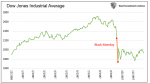
Dow Jones Industrial Average, Dec 1986 - 1987

We recently read an analogy in which the author compares the current state of asset prices to an airplane flying at 50,000 feet. Unfortunately, we cannot find the article and provide a link. The gist is market valuations are flying at an abnormally high altitude. While our market plane cannot sustain such heights in the long run, there is little reason to suspect it will fall from the sky either.

Read More »
Taper Is Coming: Got Bonds?

Taper Is Coming: Got Bonds? The solid economic recovery and easing of COVID restrictions lead us to believe a tapering of QE may not be far off. Further supporting our opinion, inflation has fully recovered to pre-pandemic levels, and employment is improving rapidly.

Read More »
The Battle Royale: Stocks vs. Bonds (Which Is Right?)

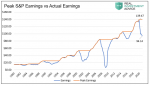
Peak S&P Earnings vs Actual Earnings, 1980-2020

The Battle Royale: Stocks vs. Bonds. The S&P 500 is at valuations higher than those in 1929 and rival those of 1999. Despite a recession, the index is 25% above where it was trading before the pandemic. The equity stampede is undoubtedly bullish about corporate earnings prospects and, by default, economic growth.  

Read More »