






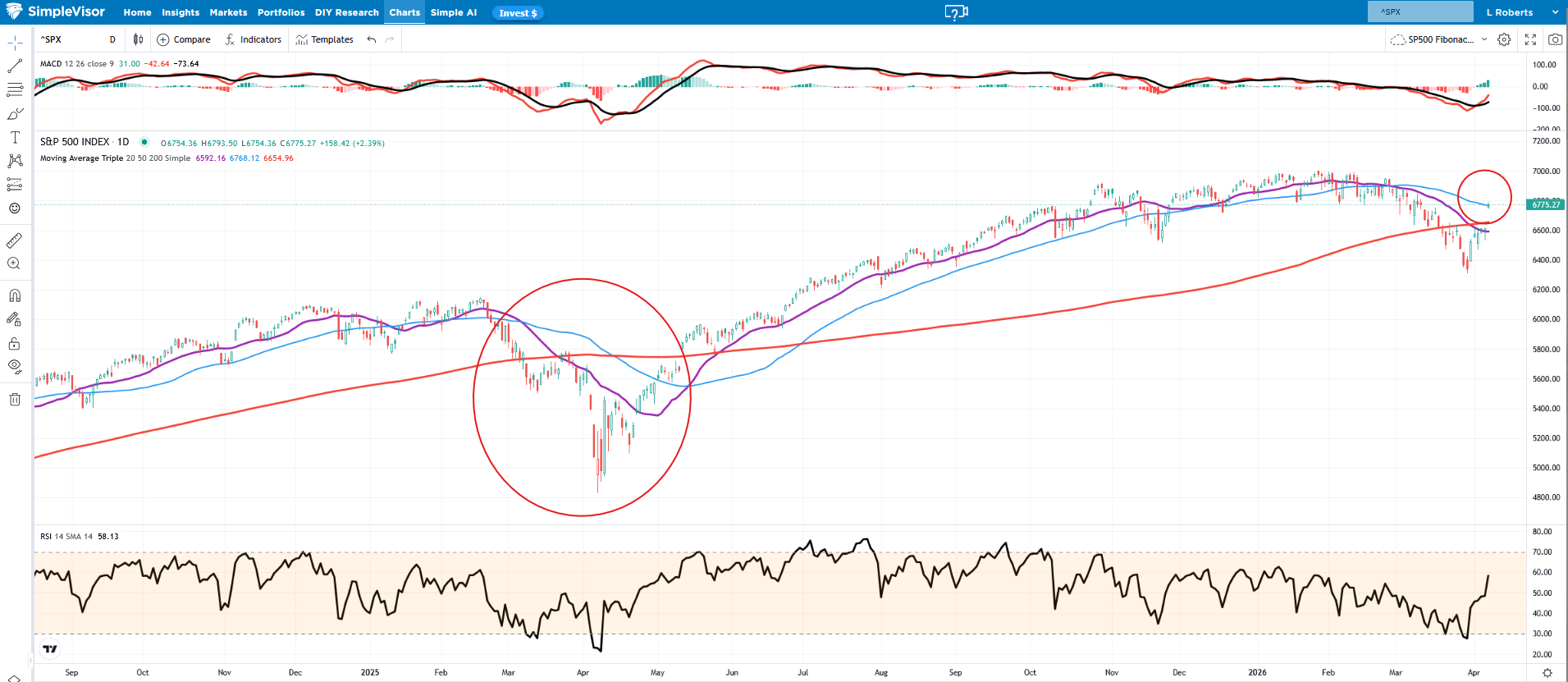
Upon hearing of the ceasefire, oil prices plummeted by nearly 20%, and the stock market surged. In doing so, the S&P 500 broke well above resistance. Accordingly, the old resistance of the 200-day moving average (DMA) now becomes support. While no one knows whether the ceasefire will hold, the market is entering a seasonally favorable period. Further, with lower prices, especially for many of the largest-cap stocks, we suspect these companies will announce large buyback programs. The positive combination of events should be bullish. To confirm, we will want to see the moving averages that previously crossed in a bearish fashion, uncross, and for prices to start establishing higher highs. To wit, we would like to see the S&P 500 rise above the arching trend that was in place prior to the conflict.
We recently noticed a strong market parallel to the 2025 tariff-induced Liberation Day market downturn, as circled below. At that time, the market dropped through the 200 DMA and then tested it from the bottom, but failed to hold. While the recent activity looked similar, we are now decisively above the moving average and sitting at the 50 DMA (blue). The moving averages will act as support, and trapped longs will likely act as resistance. The 2025 scenario circled below is off the table for now. Obviously, the ceasefire will be fragile, so headlines will still have a big impact on prices.
What To Watch Today
Earnings

Economy

Market Trading Update
Over the last two days, we discussed that a rally-building setup was in place, and all that was needed was a catalyst. As mentioned above, that actually came yesterday. But there is more to this analysis.
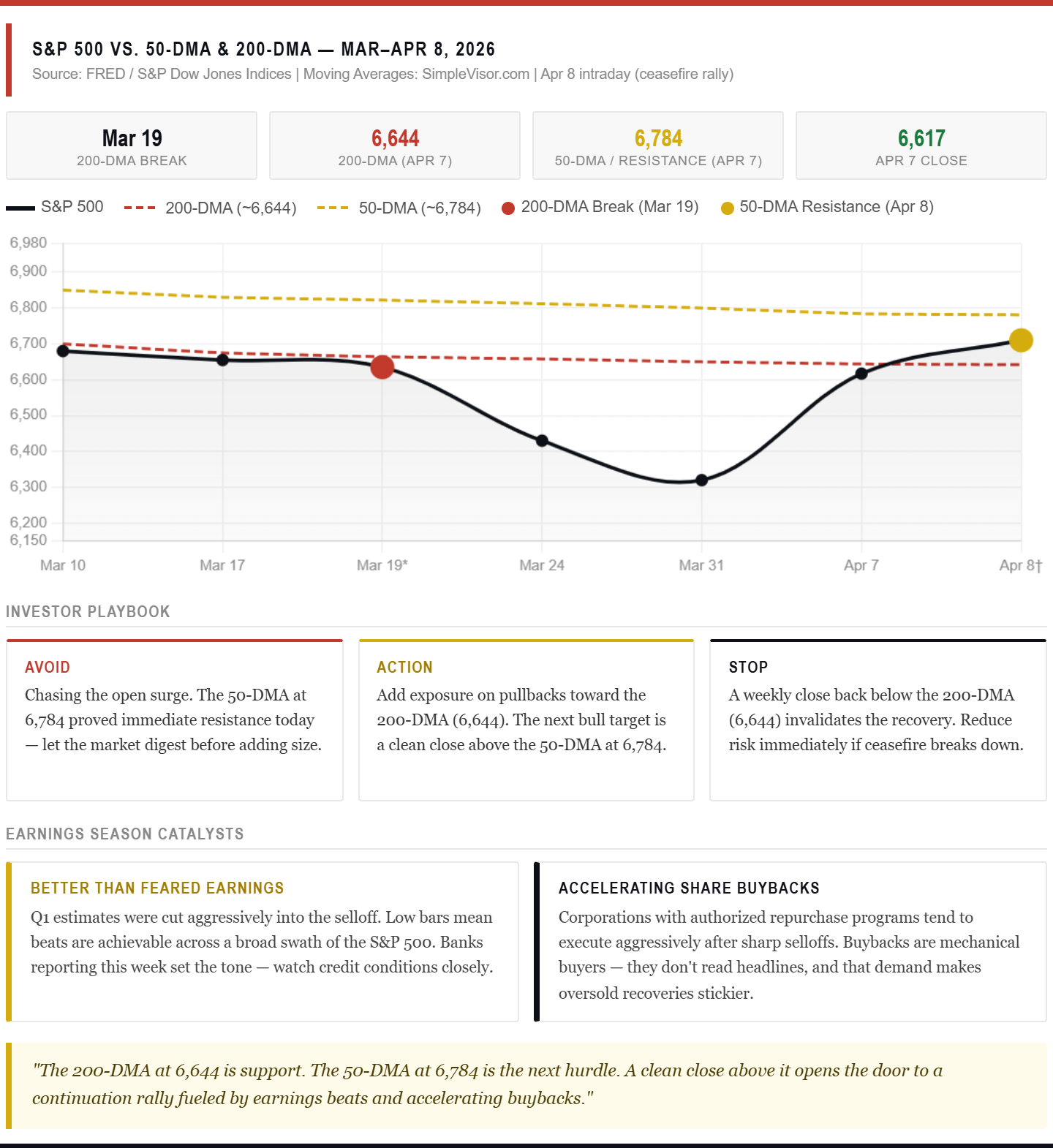
Three weeks ago, the S&P 500 broke its 200-day moving average at 6,644. That breach, on March 19, triggered a swift continuation lower as the index dropped into the low 6,300s before buyers stepped in. Yesterday's close sat at 6,617, still a handful of points below the 200-DMA. Then this morning, the ceasefire announcement changed the math entirely.
The opening gap carried the index cleanly through the 200-DMA. That's the good news. The complication arrived almost immediately as the rally ran straight into the 50-day moving average at 6,784 and stalled. That's not surprising. The 50-DMA has been declining since February, and overhead resistance from a falling moving average doesn't evaporate on a single day's news. The market is now sandwiched between two key levels: 6,644 to the downside and 6,784 to the upside. How it resolves that range in the coming sessions tells you a great deal about whether this is a durable recovery or a relief rally that fades.
There's reason for measured optimism. The selloff from March 19 into the lows wasn't a calm, orderly decline. Put option volume approached record territory, VIX spiked hard, and breadth collapsed to levels last seen in late 2022. That kind of fear doesn't just evaporate; it creates fuel. Deeply oversold markets that reverse on a catalyst tend to follow through, particularly when the catalyst is credible enough to shift institutional positioning.
Earnings season adds another layer. Q1 reports start landing this week, and expectations were cut aggressively enough during the selloff that "better than feared" is a realistic bar for a broad swath of S&P 500 companies. Modest beats matter here because they tend to accelerate the execution of share buybacks. Companies sitting on authorized repurchase programs often step in after sharp drawdowns: management sees the stock as cheap, the board has already approved the authorization, and buybacks become mechanical, underpinning the rally regardless of the next headline.
The two-level framework is the right lens for investors right now. Use pullbacks toward the 200-DMA at 6,644 to add exposure; that's your line in the sand. The next bull objective is a clean weekly close above the 50-DMA at 6,784. Until that happens, size your positions accordingly. The ceasefire gave the market a catalyst. Earnings season gives it a second one. Neither guarantees a straight line higher, but the setup is better than it looks on the surface.

Oils Plunge Feeds Fed Funds Trades
Crude oil prices collapsed by more than 15% on the ceasefire agreement, one of its sharpest single-session drops in years. Assuming the Strait of Hormuz is open, the supply shock will lessen dramatically. From the Fed's view, rising energy prices were causing angst. Weakening labor market data, coupled with inflationary high oil prices, essentially put monetary policy in a wait-and-see mode, from what was likely a cut or two by year's end.
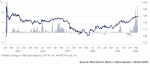
Energy is both a direct input into CPI and a psychological anchor for consumer expectations. With crude prices retreating, the disinflationary impulse could show up in data within weeks. Following the ceasefire, Fed funds futures, as shown below, now price in a 27% probability of a rate cut by December, a decent shift from zero expectations just 24 hours ago.
For now, the bond market is treating the ceasefire as a green light — and the energy-to-rate-cut pipeline is the trade to watch for both bonds and stocks.

The Apple AI Strategy: Discipline Over Hype
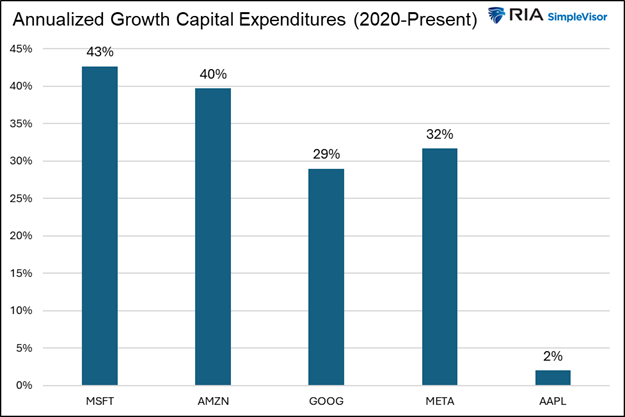
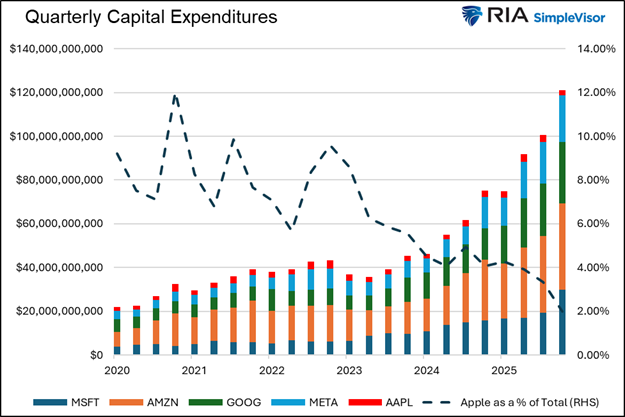
While tech giants invest billions in AI, Apple executives are quietly sitting on their hands and a mountain of cash. Given the massive growth in AI investments, as shown in the graphs below, executives of leading companies at the forefront of AI development must be ecstatic about the prospect of AI significantly boosting their bottom lines. The puzzling question, however, is why Apple isn’t following suit. Or could they be taking a different approach to winning the AI arms race?

Tweet of the Day

“Want to achieve better long-term success in managing your portfolio? Here are our 15-trading rules for managing market risks.”
Please subscribe to the daily commentary to receive these updates every morning before the opening bell.
If you found this blog useful, please send it to someone else, share it on social media, or contact us to set up a meeting.
The post Ceasefire Rally: Can The Market Hold New Support appeared first on RIA.
Full story here Are you the author?You Might Also Like
 The Apple AI Strategy: Discipline Over Hype
2026-04-08
While tech giants invest billions in AI, Apple executives are quietly sitting on their hands and a mountain of cash. Given the massive growth in AI investments, as shown in the graphs below, executives of leading companies at the forefront of AI development must be ecstatic about the prospect of AI significantly boosting their bottom …
 Is A Squeeze In Bonds Coming?
2026-04-06
As sentiment shifts from a Fed rate-cutting forecast to one that now sees a chance of a rate increase, a potentially powerful short squeeze setup might be emerging in the Treasury market. Heading into the Iran conflict, speculative short positions in TLT and Treasury futures were near historically elevated levels, reflecting a broad consensus that …
 The VIX Is Lying: Or Is It?
2026-03-30
Expected and historical (realized) volatility are sending investors a puzzling signal. Because of the Iran conflict, intense oil price swings, and rising interest rates, the VIX, or implied volatility (what options markets are pricing in as future fear), is elevated. However, actual realized volatility has been much more subdued. That gap between the VIX and …
 Mag 7 Debt & Declining Free Cash Flow: Worrisome Or Not?
2026-02-23
We have read a few articles expressing concern that the free cash flow for many of the Magnificent (Mag) 7 companies that are heavily involved in AI development and/or data center construction has leveled off. Furthermore, the hyperscalers, including Amazon, Microsoft, Google, and Oracle, issued over $120 billion in debt last year. Additionally, Google just …
 The Business Cycle Narrative & War With Iran
2026-02-21
🔎 At a Glance 🏛️ Market Brief – War With Iran On Friday, the Supreme Court struck down Trump’s signature tariffs. The ruling affects tariffs levied under the International Emergency Economic Powers Act (IEEPA) which includes the so-called reciprocal tariffs at various levels against nations all around the world to address trade imbalances, as well …
 A No Landing Outcome Is Assumed: Should It Be?
2026-02-19
Quite often, investors describe economic forecasts as a hard landing (recession), a soft landing (weak growth but no recession), or no landing (moderate to strong economic growth). As evidenced by the massive rotation toward economically sensitive sectors like industrials and materials and the significant underperformance of interest-rate-sensitive growth stocks, the no landing, or as it’s …
 Financial Nihilism & The Trap Young Investors Are Walking Into
2026-02-13
The article from the Wall Street Journal titled “Why My Generation Is Turning to Financial Nihilism” by Kyla Scanlon argues that Gen Z is embracing high-risk financial behavior out of despair and detachment. Of course, it is essential to recognize that Kyla, although well-intentioned, is a young twenty-something influencer with limited real-life experience, and sees …
 Market Outlook For 2026
2026-01-03
🔎 At a Glance 💬 Don’t Miss Our Upcoming “Live & In Person” Summit Our 2026 Summit is a limited-seating event, so secure your tickets now before they sell out. Topics Include: I look forward to seeing you there. 🏛️ Market Brief – Strong Year-End Returns Lead to Bullish Market Outlooks Let’s start this week …
Tags: Featured,newsletter