







Profits and losses play an important role in a free market system. However, as government intervenes to protect politically-connected firms from losses, the entire market becomes distorted and less reliable.
Read More »
Category Archive: 6b.) Mises.org
DOJ Opens Criminal Investigation Into FOMC’s Lisa Cook
Cook allegedly committed mortgage fraud, but the prosecution is really part of an effort to put more Trump personnel on the Fed Board of Governors.
Read More »
Read More »
The US Now Has More Unemployed People than Job Openings
This does not bode well for new potential workers entering the labor force. Remarkably, things look especially bad for recent college graduates.
Read More »
Read More »
Most Trump tariffs are not legal, US appeals court rules
Trump claimed he could single-handedly raise taxes (tariffs) under the International Emergency Economic Powers Act. The appeals court disagreed.
Read More »
Read More »
America Should Follow Iran’s Lead and Legalize Organ Sales
Unfortunately, the only country to have accepted a semi-free market in organs is Iran; however, the results there have been stunning.
Read More »
Read More »
The Venezuela Military Deployment Is about Cronyism, Not National Security
President Trump has deployed naval vessels off the coast of Venezuela, citing its escalation of the war on drugs. However, the true motivation for Washington’s involvement in the region is likelier related to disputed oil claims affecting well-connected energy companies.
Read More »
Read More »
The Short-Lived German Free Trade Movement
John Prince Smith, a British national who settled in Germany, led a free-trade movement in that country in the mid-19th century. Unfortunately, his movement ultimately was overpowered by the rise of Bismarck's Realpolitik.
Read More »
Read More »
How Democratic Socialism Inverts the Logic of Civil Society
Portrayed as a socialist system that is established through the democratic voting system and not imposed by revolutionary violence, democratic socialism leads to an ossified, bureaucratic, iron-fisted system.
Read More »
Read More »
The Venezuela Military Deployment Is About Cronyism, Not National Security
President Trump has deployed naval vessels off the coast of Venezuela, citing its escalation of the war on drugs. However, the true motivation for Washington’s involvement in the region is likelier related to disputed oil claims affecting well-connected energy companies.
Read More »
Read More »
Political Context of Black Suffrage in the Reconstruction Era
Discussions about black suffrage following the Civil War usually are focused upon black voting rights in the South. However, during that same time, northern states passed laws limiting black suffrage, something that often escapes the history books.
Read More »
Read More »
Steve Hanke join CapitalCosm to Discuss Trump and Powell, Interest rates, and Inflation
Following Jerome Powell’s latest signal on rate cuts, economist Steve Hanke explains why markets and policymakers keep fixating on the wrong variable. Interest rates don’t drive the cycle, he argues—changes in the money supply do, with long and variable lags.
Read More »
Read More »
Ending a War That Never Should Have Started
President Trump’s recent efforts to end the Ukraine War have been made more difficult because the EU, NATO, and the US government encouraged Ukraine to fight no matter what. The result has been a bloody disaster.
Read More »
Read More »
Democrats and Republicans Unite to Misuse Taxpayer Funds on Intercity Bus Subsidies
Who says Republicans and Democrats can’t agree on anything. They have both agreed to continue foolish and counterproductive subsidies for buses and other forms of inter-city public transportation.
Read More »
Read More »
Department of War?
Last week President Trump took steps to re-name the Department of Defense the “Department of War”—arguably, a more appropriate name.
Read More »
Read More »
What’s Good About Democracy?
Can a majority vote to end democracy? If it can, democracy would no longer exist. But if it can’t, then not all political issues are decided by majority vote.
Read More »
Read More »
Deposit Insurance: Not an Assurance, But a Warning Label
The Federal Deposit Insurance Corporation (FDIC) is widely seen as a pillar of financial stability, but it is actually it is a warning label that confirms systemic fragility.
Read More »
Read More »
One of These Things Is Absolutely Not Like the Others
While people might speak of the “business of government,” there really is no way to compare the two. Business is voluntary; government is coercive.
Read More »
Read More »
Milton Friedman’s Guitar String Boom-Bust Cycle Theory
In an attempt to explain business cycles, Milton Friedman came up with a plucked-string analogy. Like all Monetarist theories, however, this also had fatal flaws.
Read More »
Read More »
 On Swiss National Bank
-
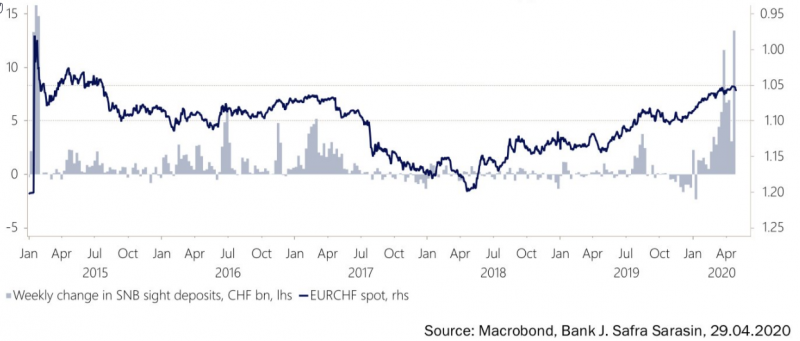
SNB Sight Deposits: decreased by 5.7 billion francs compared to the previous week
-
SNB’s Chairman Schlegel: A few months of negative inflation wouldn’t be a problem
-
2025-07-31 – Interim results of the Swiss National Bank as at 30 June 2025
-
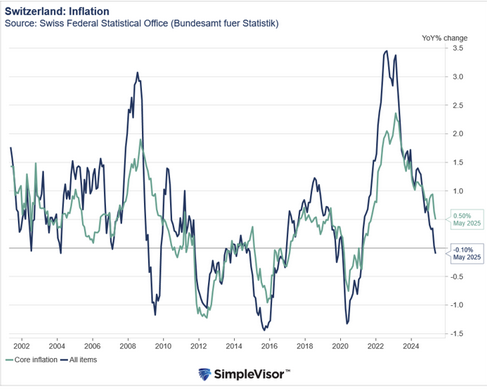
SNB Brings Back Zero Percent Interest Rates
-
Hold-up sur l’eau potable (2/2) : la supercherie de « l’hydrogène vert ». Par Vincent Held
Main SNB Background Info

Featured and recent
-
 What central banks are really signalling with their record gold purchases
 -
 Öl, Gold & Aktien: Warum ich jetzt absolut optimistisch bleibe
 -
 Der RSI 14 Mythos: Warum Standard-Einstellungen oft scheitern
 -
 Sie feiern IHN #krieg #iran #usa #trump #putin #europa #wirtschaft #deutschland #khamenei #israel
 -
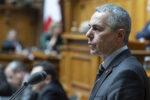 Swiss foreign minister to strengthen partnerships on tour of Africa
 -
 Swiss city draws positive results after three years of controlled cannabis sales
 -
 Could direct democracy put the brakes on trade?
 -
 Long bei Erdöl?
 -
 3-19-26 Will The Fed Backstop Exuberance Again?
 -
 Swiss National Bank keeps interest rate unchanged