







In studying history, it is key to avoid definitional anachronism—failing to note how a word has changed over time and assuming the present meaning was the same in the past. This is often the case with the word currency as used in colonial America.
Read More »
Category Archive: 6b.) Mises.org
A Note on “Currency” in Colonial America
In studying history, it is key to avoid definitional anachronism—failing to note how a word has changed over time and assuming the present meaning was the same in the past. This is often the case with the word currency as used in colonial America.
Read More »
Read More »
Ex Nihilo No More
Mises described the problem, Hayek proposed the direction, Kirzner explains why the market will not stop. And the market, as so many times before, has already found the first step.
Read More »
Read More »
Japan’s 10-year yield just hit the highest level in 27 years
Inflation pressure, plus uncertainty means Japan, like the US, faces upward pressure in bond yields. This will bring down a lot of overleveraged households and businesses.
Read More »
Read More »
On the Skids
Modern moral philosophers often come up with immoral ways to undermine free markets. In this week’s Friday Philosophy, Dr. David Gordon examines the book How Much Is Enough? by Robert and Edward Skidelsky and questions the authors’ conclusions.
Read More »
Read More »
Melania Trump claims (unconvincingly) that she had no relationship with Epstein and Maxwell
But why did she bring it up? It could be the Iran war is going so badly that the White House would rather we talk about Epstein instead.
Read More »
Read More »
A Libertarian Theory of Parental Obligations
Parental obligations can't be reduced to a contractual or property-based relationship. Jake Desyllas joins Ryan McMaken to talk about why parents are responsible for the well-being of their children.
Read More »
Read More »
Trump’s Total 2027 National Security Spending Will Exceed $2.5 Trillion
The true total of US national security spending in 2027 will be far beyond the already record-shattering $1.5 trillion military budget President Trump has requested.
Read More »
Read More »
Alex Pollock on the Future of Fannie Mae and Freddie Mac
Mises Institute Senior Fellow Alex J. Pollock was featured last month at the AEI's symposium on Fannie Mae and Freddie Mac.
Read More »
Read More »
Fear, Time Preference, and the Distortion of Human Action
Periods of crisis reveal something unsettling about human behavior—fear leads to the acceptance of what would have been unthinkable.
Read More »
Read More »
Turns Out the Elites Like the Administrative State Better than Democracy
The New York Times claims that the “administrative state”—that is, governance by unelected bureaucrats—protects our country and enhances democracy.
Read More »
Read More »
Iran to allow no more than 15 vessels per day through Hormuz
"This new regulatory framework ... has been officially communicated to regional parties. There will be no return to the pre-war status quo."
Read More »
Read More »
Turns Out the Elites Like the Administrative State Better than Democracy
The New York Times claims that the "administrative state"—that is, governance by unelected bureaucrats—protects our country and enhances democracy.
Read More »
Read More »
The Theft of Your Good Deflation
Mainstream economists, not to mention most financial journalists, claim that deflation is as bad or worse than inflation. The Austrians know better. We need deflation and we need it now.
Read More »
Read More »
Is a Ceasefire Happening? + Should Christians be Socialist?
On this episode of Power and Market, Ryan, Connor, and Tho look at the updates on the Iran war front, including whether or not a ceasefire will last and recent reporting on Israel's influence on Trump's war decision. Plus, discussion about a recent Tucker Carlson Show guest and his view that Christianity is inherently socialist.
Read More »
Read More »
Why Rent Control Fails: Lessons From New York to Portland
The question is not whether a politician’s intention is good. The market does not care about intentions. It responds to incentives.
Read More »
Read More »
More Federal Reserve officials see possible rate hikes this year, minutes show
"The number of Fed policymakers willing to consider an interest rate hike rose ... as higher gas prices stemming from the Iran war threatened to worsen inflation in the coming months."
Read More »
Read More »
The Economic Destruction of Trump’s War Goes Far Beyond High Gas Prices
This war is not just making energy more expensive, it’s knocking out the higher order goods the global structure of production depends on. This has already locked in dangerous shortages in critical industries like healthcare, food production, and much more.
Read More »
Read More »
 On Swiss National Bank
-
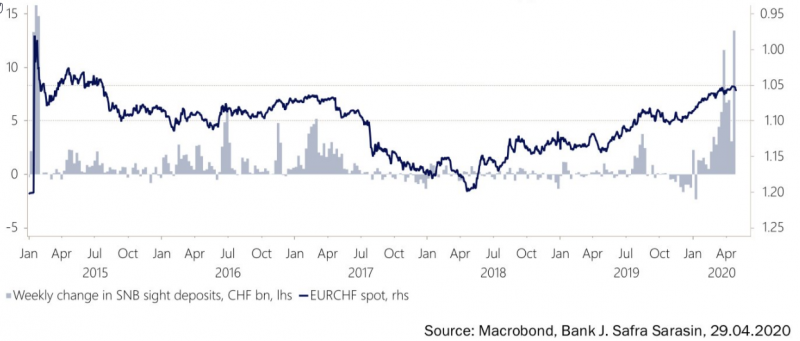
SNB Sight Deposits: decreased by 2.2 billion francs compared to the previous week
-
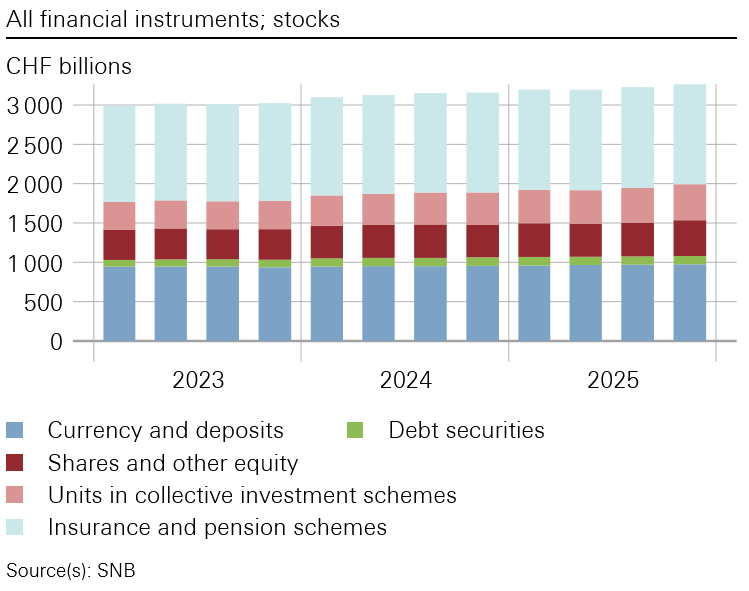
Household wealth in 2025
-
Heads up for NZD and CHF traders, RBNZ Gov Breman and SNB Chair Schlegel to speak
-
Swiss franc appreciation has led to tighter monetary conditions – SNB minutes
-
SNB’s Chairman Schlegel: A few months of negative inflation wouldn’t be a problem
Main SNB Background Info
Featured and recent
-
 SNB Sight Deposits: decreased by 2.2 billion francs compared to the previous week
 -
 Corrections vs. Bear Markets: Why 20% Declines Are Obsolete
 -
 -40 Kilo! Ricarda Lang feiert Abnehmerfolg! Das Internet feiert!
 -
 Steuerrecht digitalisieren mit KI – eine gute Idee?
 -
 Why Switzerland is launching a charm offensive in Southeast Asia
 -
 Ex-Raiffeisen bank CEO fined for tax evasion
 -
 The price of gold matters, but availability matters more.
 -
 FATAL: EU Chefdiplomatin blamiert ganz Europa! China außer sich!
 -
 India’s situation shows why physical gold is different from paper exposure.
 -
 ZUGRIFF auf dein Vermögen: So schützen sich INSIDER