







" a return to near-zero rates 'remains significant over the medium to long term…due to recent elevated uncertainty.'" In Fedspeak, "uncertainty" means "bad economy."
Read More »
Category Archive: 6b.) Mises.org
Dr. Steve Hanke, Leading Authority on Hyperinflation, Named Mises Institute Senior Distinguished Scholar
The Mises Institute is proud to announce that Dr. Steve Hanke has accepted a new position as Senior Distinguished Fellow at the Mises Institute.
Read More »
Read More »
The Texas Floods and Political Opportunism
As the Texas floodwaters receded, politicians like Chuck Schumer twisted facts about the tragedy to score a political win. Examining what went wrong to prevent such tragedies from happening again is the right thing to do. But that involves looking at the actual facts.
Read More »
Read More »
The Mythology of Methodological Collectivism
A central belief of collectivists is that people think collectively, too. Whether one is a member of a class, religious group, or ethnic group, collectivism holds that each group has distinct interests that determine how individuals in the group think. Mises would have disagreed.
Read More »
Read More »
The Mythology of Methodological Collectivism
A central belief of collectivists is that people think collectively, too. Whether one is a member of a class, religious group, or ethnic group, collectivism holds that each group has distinct interests that determine how individuals in the group think. Mises would have disagreed.
Read More »
Read More »
Mortgage Delinquency Rates Grew Faster Than Any Other Debt Type In May
As prices surge, loan amounts get bigger. "Larger mortgage balances have put pressure on homeowners and likely caused an increase in delinquencies."
Read More »
Read More »
The Homeownership Rate Is Lower Now than it Was 45 Years Ago
Now is the time to admit that easy-money policy and corporate bailouts—imposed in the name of increasing homeownership—has only made housing more unaffordable.
Read More »
Read More »
The Homeownership Rate Is Lower Now than it Was 45 Years Ago
Now is the time to admit that easy-money policy and corporate bailouts—imposed in the name of increasing homeownership—has only made housing more unaffordable.
Read More »
Read More »
Riots Are a Symptom of the Statist Disease
President Trump cracked down on the latest version of the LA riots by calling in the National Guard. However, much of the violence that accompanied those riots came courtesy of government actors.
Read More »
Read More »
Riots Are a Symptom of the Statist Disease
President Trump cracked down on the latest version of the LA riots by calling in the National Guard. However, much of the violence that accompanied those riots came courtesy of government actors.
Read More »
Read More »
Trump minion Peter Navarro says Fed Chair Powell is the worst ever
Trump, et al want more inflation and want Powell to be the new Arthur Burns. Burns is arguably the actual worst Fed chair ever.
Read More »
Read More »
Trump says he’ll send more US weapons to Ukraine
“The Department of Defense continues to provide the President with robust options to continue military aid to Ukraine."
Read More »
Read More »
Political Machine Rolls on Regardless
Don‘t kid ourselves. The federal government is hurtling toward disaster with its destructive activities underwritten by the Federal Reserve System. It‘s best that we know how to protect ourselves from the consequences.
Read More »
Read More »
Political Machine Rolls on Regardless
Don‘t kid ourselves. The federal government is hurtling toward disaster with its destructive activities underwritten by the Federal Reserve System. It‘s best that we know how to protect ourselves from the consequences.
Read More »
Read More »
Trump imposes 50% tariff on Copper
More lawless new taxation without any debate or vote in Congress. “Today we’re doing copper,” he said at a Cabinet meeting, adding that he believed the rate will be 50%.
Read More »
Read More »
The Deficit Surged Again in May and Is Still on Track for a $2 Trillion Deficit in 2025
The Trump administration is doing nothing to rein in deficits, and it's clear that whatever revenue may come in from tariffs is not enough to offset the new spending increases the administration has pushed.
Read More »
Read More »
What If We Were on a Gold Standard?
Twentieth and twenty-first century monetary history shows us how our government, step-by-step, removed the monetary gold standard and introduced their fiat paper currency dollar to fund their increasing political power.
Read More »
Read More »
What If We Were on a Gold Standard?
Twentieth and twenty-first century monetary history shows us how our government, step-by-step, removed the monetary gold standard and introduced their fiat paper currency dollar to fund their increasing political power.
Read More »
Read More »
Japan’s 30-year bond yield is surging again.
Up over 30 basis points in 3 days, now above 3%. "Market concerns about fiscal policy....may be contributing to the rise in bond yields..."
Read More »
Read More »
 On Swiss National Bank
-
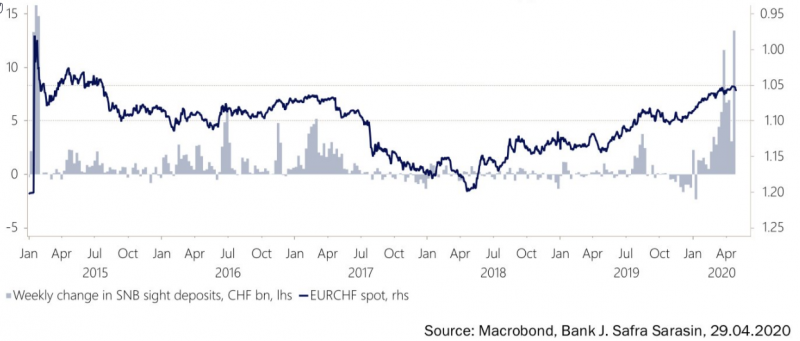
SNB Sight Deposits: decreased by 2.2 billion francs compared to the previous week
-
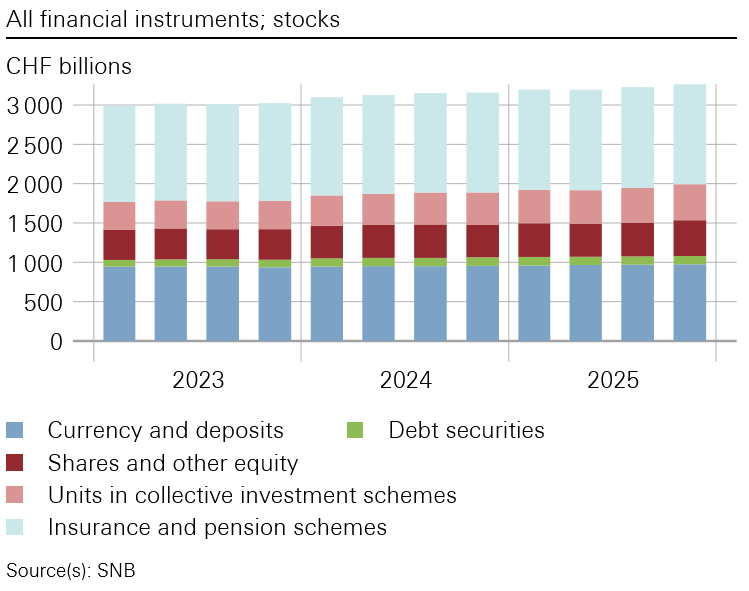
Household wealth in 2025
-
Heads up for NZD and CHF traders, RBNZ Gov Breman and SNB Chair Schlegel to speak
-
Swiss franc appreciation has led to tighter monetary conditions – SNB minutes
-
SNB’s Chairman Schlegel: A few months of negative inflation wouldn’t be a problem
Main SNB Background Info
Featured and recent
-
 SNB Sight Deposits: decreased by 2.2 billion francs compared to the previous week
 -
 Corrections vs. Bear Markets: Why 20% Declines Are Obsolete
 -
 -40 Kilo! Ricarda Lang feiert Abnehmerfolg! Das Internet feiert!
 -
 Steuerrecht digitalisieren mit KI – eine gute Idee?
 -
 Why Switzerland is launching a charm offensive in Southeast Asia
 -
 Ex-Raiffeisen bank CEO fined for tax evasion
 -
 The price of gold matters, but availability matters more.
 -
 FATAL: EU Chefdiplomatin blamiert ganz Europa! China außer sich!
 -
 India’s situation shows why physical gold is different from paper exposure.
 -
 ZUGRIFF auf dein Vermögen: So schützen sich INSIDER