Those who invoke Jesus for socialism face a tension: if the power to end suffering creates a moral obligation, then the Jesus who healed many but not all appears, by that standard, either unwilling or unable.
Read More »2026-04-17




2026-04-17
Those who invoke Jesus for socialism face a tension: if the power to end suffering creates a moral obligation, then the Jesus who healed many but not all appears, by that standard, either unwilling or unable.
Read More »
Those who invoke Jesus for socialism face a tension: if the power to end suffering creates a moral obligation, then the Jesus who healed many but not all appears, by that standard, either unwilling or unable.
Read More »2026-04-10
In studying history, it is key to avoid definitional anachronism—failing to note how a word has changed over time and assuming the present meaning was the same in the past. This is often the case with the word currency as used in colonial America.
Read More »
In studying history, it is key to avoid definitional anachronism—failing to note how a word has changed over time and assuming the present meaning was the same in the past. This is often the case with the word currency as used in colonial America.
Read More »2026-04-03
Despite the claims of the chartalists, early American monetary history tells a much different story than one falsely claiming state-issued fiat money undergirded the colonial economy. In fact, much of the historical evidence illustrates Menger’s monetary theory.
Read More »
Despite the claims of the chartalists and modern monetary theory advocates, early American monetary history tells a much different story. In fact, much of the historical evidence illustrates Menger’s theory.
Read More »2026-03-27
The TSA stories, especially at Atlanta, are illustrations of interventionist non-intervention: non-delivery of promised, paid-for, and monopolized service.
Read More »
The TSA stories, especially at Atlanta, are illustrations of interventionist non-intervention: non-delivery of promised, paid-for, and monopolized service.
Read More »2026-03-20
Combining binary and triangular interventions, the state coercively taxes citizens to pay for its services, monopolizes certain services, and then is incentivized to engage in paid non-delivery.
Read More »
Combining binary and triangular interventions, the state coercively taxes citizens to pay for its services, monopolizes certain services, and then is incentivized to engage in paid non-delivery.
Read More »2026-03-13
Contrary to what the Modern Monetary Theory advocates and their Chartalist allies are claiming, the 1690 colonial Massachusetts issuance of fiat money did not create an enlightened moment in U.S. monetary history. Instead, it was a monetary bait-and-switch.
Read More »2026-03-06
The current US conflict with Iran has its roots in the CIA-backed coup in 1953, which removed a democratically-elected prime minister and replaced him with the Shah. The Shah’s government ultimately collapsed, leading to the current Islamic republic.
Read More »2026-03-05
The current US conflict with Iran has its roots in the CIA-backed coup in 1953, which removed a democratically-elected prime minister and replaced him with the Shah. The Shah’s government ultimately collapsed, leading to the current Islamic republic.
Read More »2026-02-27
When the Massachusetts colony issued its own unredeemable paper money in 1690, it was with the promise that it would soon be redeemable in specie. Like all paper money issued by government, it lost value and the confidence of the people.
Read More »2026-02-26
When the Massachusetts colony issued its own unredeemable paper money in 1690, it was with the promise that it would soon be redeemable in specie. It was a lie.
Read More »2026-02-23
Unfortunately, slavery was not just propped up by policy in the slave states, but federally. It is often overlooked that the federal government—not just slave states—had implemented legal protections of slavery by policy for decades.
Read More »2026-02-19
Unfortunately, slavery was not just propped up by policy in the slave states, but federally. It is often overlooked that the federal government—not just slave states—had implemented legal protections of slavery by policy for decades.
Read More »2026-02-13
If one man may legally own another, then he should likewise have the right to disown this property. To deny this right by law involves simultaneously affirming the right of one human to own another as his property but not the right to stop owning another human.
Read More »2026-02-12
If one man may legally own another, then he should likewise have the right to disown this property. To deny this right by law involves simultaneously affirming the right of one human to own another as his property but not the right to stop owning another human.
Read More »2026-02-05
Superficial reading of some early texts in Acts seem to suggest the ideal of Christian communal property ownership, or communism, rather than private property, but this is mistaken and the evidence is within Acts itself.
Read More »2026-01-29
Ironically, an acatallactic pseudo-theory of money that emerged from a school of thought that rejected theory in favor of an empirico-realistic, historical theory of money now finds it intellectually acceptable, not only to reject catallactic economic theory, but also empirical history.
Read More »2026-01-22
Menger said alternative monetary theories were “unhistorical,” but one could argue that Menger’s theory also lacks historical evidence necessary to verify his theory. Did Menger display a double standard or a nuanced view as to what we should expect from different monetary theories?
Read More »2026-01-15
A. Mitchell Innes—a chartalist pioneer—wrote a pamphlet “What Is Money?” (1913) which found a credulous and ideologically sympathetic audience in J. M. Keynes.
Read More »2026-01-09
Anti-impact environmentalists want you dead; they will settle, in the short term, for you to feel guilty for existing, producing and consuming, and willing to comply with any degree of central planning and freedom curtailment to “save the planet” from you.
Read More »
Anti-impact environmentalists want you dead; they will settle, in the short term, for you to feel guilty for existing, producing and consuming, and willing to comply with any degree of central planning and freedom curtailment to “save the planet” from you.
Read More »2026-01-02
From an Austrian perspective, the Panic of 1893 provides key lessons, but this consequential panic has not received as much direct attention as it deserves.
Read More »2026-01-01
From an Austrian perspective, the Panic of 1893 provides key lessons, but this consequential panic has not received as much direct attention as it deserves.
Read More »2025-12-29
The Continentals and other paper monies only temporarily retained some value largely because of an initial promise of future redemption in gold and silver—a monetary “bait-and-switch.”
Read More »2025-12-25
The Continentals and other paper monies only temporarily retained some value largely because of an initial promise of future redemption in gold and silver—a monetary “bait-and-switch.”
Read More »2025-12-19
Instead of market competition, inflation forces young and old into rivalrous competition for housing.
Read More »2025-12-18
Instead of market competition, inflation forces young and old into rivalrous competition for housing.
Read More »2025-12-12
Inflation does more than just force up prices. It destroys the wealth-producing process, especially with young people who are prevented from acquiring the same kinds of assets earlier generations procured. The result is inter-generational conflict.
Read More »
Inflation does more than just force up prices. It destroys the wealth-producing process, especially with young people who are prevented from acquiring the same kinds of assets earlier generations procured. The result is inter-generational conflict.
Read More »2025-12-05
The Mexican-War resulted in more territory for the new American empire, but the US government started it under false pretenses. A young US soldier who fought—Ulysses Grant—knew better, exposing the lies from Washington.
Read More »2025-12-04
The Mexican-War resulted in more territory for the new American empire, but the US government started it under false pretenses. A young US soldier who fought—Ulysses Grant—knew better, exposing the lies from Washington.
Read More »2025-11-27
Warren Harding provides a case for how lies and myths—in the name of the truth—can be centralized and become the dominant narrative for generations, shaping views on policy.
Read More »2025-11-20
Even as historians have softened on their outlook on Hoover, they usually still manage to avoid the obvious connection between interventionism and lack of economic recovery.
Read More »2025-11-13
One of the most enduring myths of American history is that Herbert Hoover was a laissez-faire advocate who “did nothing” while the US economy slid into depression. How did he gain this undeserved reputation?
Read More »2025-11-07
If Hobbes is right about human nature, then he is wrong about the state as a solution. Ironically, his key arguments for the state are actually key reasons against it.
Read More »2025-11-06
If Hobbes is right about human nature, then he is wrong about the state as a solution. Ironically, his key arguments for the state are actually key reasons against it.
Read More »2025-10-31
When studying praxeology, something as trivial as the recipe for chocolate cake can become a way to better teach us Austrian economics.
Read More »
When studying praxeology, something as trivial as the recipe for chocolate cake can become a way to better teach us Austrian economics.
Read More »2025-10-24
As a true market entrepreneur, as opposed to a political entrepreneur, James J. Hill successfully built a transcontinental railroad, outcompeting his government-subsidized competitors.
Read More »
As a true market entrepreneur, as opposed to a political entrepreneur, James J. Hill successfully built a transcontinental railroad, outcompeting his government-subsidized competitors.
Read More »2025-10-20
Popular views of capitalism and free markets are not shaped by the facts, but rather by anti-capitalist intellectuals and the media.
Read More »2025-10-17
Popular views of capitalism and free markets are not shaped by the facts, but rather by anti-capitalist intellectuals and the media.
Read More »2025-10-10
The yearning for a state-controlled system is not born of compassion for others but rather of infantile selfishness.
Read More »
The yearning for a state-controlled system is not born of compassion for others but rather of infantile selfishness.
Read More »2025-10-03
Advocates for US military intervention have invoked the war against the Barbary pirates as justification. Yet, an examination of that conflict shows that President Jefferson’s actions were limited and followed the direction of Congress.
Read More »
Advocates for US military intervention have invoked the war against the Barbary pirates as justification. Yet, an examination of that conflict shows that President Jefferson’s actions were limited and followed the direction of Congress.
Read More »2025-09-26
We are not the government, and the government is not us. This abstraction hides the truth, teaching people to equate the state with “society,” “the people,” “the common good,” or other euphemisms.
Read More »2025-09-19
While the American people may have been ignorant of the foreign policy history of the 1990s to their detriment, and politicians—whether sincere or not—expressed bewilderment, many understood the direct link between foreign policy interventionism and terrorist attacks.
Read More »2025-09-12
From September 12, 2001—armed with a simple knowledge of the publicly-available foreign policy history of the 1990s—9/11 was a tragedy, and a terrible crime that demands justice, but it should not have been a surprise.
Read More »2025-09-10
What indicates that bin Laden was telling the truth about his motives and strategies in facilitating suicide terrorism? What about his Muslim constituency?
Read More »2025-09-05
While libertarians, and many conservatives, often rightly discuss problems of government intervention, there is a counterintuitive category where the government simultaneously monopolizes, taxes, and refuses to provide promised services.
Read More »2025-08-29
While monetary inflation has various economic effects—predictable and surprising, direct and indirect—this article seeks to explore the effects of monetary inflation on food. Specifically, debased currency leads to debased food.
Read More »2025-08-22
While Cantillon used the effects on family life to illustrate monetary theory, Degner lingers to employ sound monetary theory to trace out the effects on the family.
Read More »2025-08-15
The hackneyed argument for government regulation of speech — yelling “FIRE” in a crowded theater — has always been a red herring. As Murray Rothbard wrote, private property rights should be front-and-center when dealing with free speech issues.
Read More »
The hackneyed argument for government regulation of speech—yelling “fire!” in a crowded theater—has always been a red herring. As Murray Rothbard wrote, private property rights should be front-and-center when dealing with free speech issues.
Read More »2025-08-08
In examining the Austrian Regression Theorem of Money, Joshua Mawhorter takes on the Chartalist/MMT claim that government gives money its value. The Chartalist/MMT advocates lack a necessary cause-and-effect mechanism to prove their claims.
Read More »
In examining the Austrian regression theorem of money, Joshua Mawhorter takes on the chartalist/MMT claim that government gives money its value. The chartalist/MMT advocates lack a necessary cause-and-effect mechanism to prove their claims.
Read More »2025-08-01
While it is true that colonial era governments sometimes burned paper money after receiving it in the form of taxation, why they burned the money is for reasons other than what MMT advocates are claiming. In the end, the MMT promoters are telling a false history.
Read More »
While it is true that colonial era governments sometimes burned paper money after receiving it in the form of taxation, why they burned the money is for reasons other than what MMT advocates are claiming. In the end, the MMT promoters are telling a false history.
Read More »2025-07-31
Abraham Lincoln is best known for his role as a wartime president, but his economic policies were a precursor to the New Deal. From railroad subsidies to a national banking system, Lincoln paved the way to the Progressive Era and beyond.
Read More »2025-07-29
The goalposts are continually changing (more like fallacy-hopping), but one would-be goal of tariffs needs to be confronted—tariffs for domestic job protection.
Read More »2025-07-25
Even when MMT advocates are correct that colonial governments at times burned money after receiving it for tax revenues, they still manage to get both the history and the causes wrong.
Read More »
Even when MMT advocates are correct that colonial governments at times burned money after receiving it for tax revenues, they still manage to get both the history and the causes wrong.
Read More »2025-07-18
This article is dedicated to some of the quotes, especially from key participants and primary sources, about inflation and its consequences during the American Revolution. As usual, war led to inflation, which in turn facilitated war, and both contributed to centralization.
Read More »
This article is dedicated to some of the quotes, especially from key participants and primary sources, about inflation and its consequences during the American Revolution. As usual, war led to inflation, which in turn facilitated war, and both contributed to centralization.
Read More »2025-07-11
War, even the American Revolution, is the health of the state because it is almost impossible to avoid fighting a war on state-centric terms.
Read More »2025-07-04
When the American Revolution broke out, the American colonies were perhaps the least-taxed place on earth. How did this country move from that position to the colossus it has become today? Joshua Mawhorter provides some sobering July 4 reading to find the answer.
Read More »
When the American Revolution broke out, the American colonies were perhaps the least-taxed place on earth. How did this country move from that position to the colossus it has become today? Joshua Mawhorter provides some sobering July 4 reading to find the answer.
Read More »2025-06-27
America inherited the core institutional framework of Europe (especially Britain) but refined and amplified it through greater decentralization, lower taxation, and more expansive freedoms.
Read More »2025-06-25
America inherited the core institutional framework of Europe (especially Britain) but refined and amplified it through greater decentralization, lower taxation, and more expansive freedoms.
Read More »2025-06-21
The standard argument for government services is that only government can build enough roads to meet transportation needs. However, the disconnect between production and consumer choice ensures misallocation of resources under government roads, including traffic congestion.
Read More »2025-06-20
The standard argument for government services is that only government can build enough roads to meet transportation needs. However, the disconnect between production and consumer choice ensures misallocation of resources under government roads, including traffic congestion.
Read More »2025-06-13
We cannot allow the establishment to write the history of 2000–2025. To that end, consider this non-exhaustive bibliography for understanding this turbulent period.
Read More »2025-06-06
At first glance, it might seem extreme—even offensive—to compare anti-fossil fuel climate policies to Stalin’s deliberate starvation of millions during the Holodomor. But in truth, the comparison may be unfair— to Stalin.
Read More »2025-05-30
MMT and chartalism claims that money is a creature of the state and is valued because of state action. The fact that tobacco acted as colonial money independently of the state demonstrates this to be false.
Read More »2025-05-23
MMT uses chartalism and a few dubious examples to appeal to history to establish the theory‘s authority and validity, only to discard this element as irrelevant and unnecessary.
Read More »
MMT uses chartalism and a few dubious examples to appeal to history to establish the theory‘s authority and validity, only to discard this element as irrelevant and unnecessary.
Read More »2025-05-16
The MMT crowd now claims that the monetary history of the US is an example of chartalism. US history is actually an example of the opposite.
Read More »2025-05-09
The late P.T. Bauer provided much insight into the issue of the so-called First World sending aid to Third World nations in the name of “development.” Bauer demonstrated conclusively that such donations actually impede economic growth in poor nations.
Read More »2025-03-28
The first time I read about “white privilege” in college was on a Blackboard assigned readings list. This was not a class I attended, but had access to in order to provide some help to the professor. As it turned out, I had read the original paper on this topic: Peggy McIntosh’s “White Privilege and Male Privilege: A Personal Account of Coming to See Correspondences Through Work in Women’s Studies” (1988).While many critiques could be made—and have been made—to the author’s presuppositions, methods, and conclusions; and while the author admits that this piece was “based on my daily experience,” “is a partial record of my personal observations,” and “not a scholarly analysis,” there is one key aspect this article seeks to explore—the persistent complaint about the lack of “flesh”-colored
Read More »2025-03-14
In Frank W. Taussig’s The Tariff History of the United States, he describes the mass of unprecedented financial legislation that took place, which likely would not have occurred absent the context of the war,Probably no country has seen, in so short a time, so extraordinary a mass of financial legislation. A huge national debt was accumulated; the mischievous expedient of an inconvertible paper currency was resorted to; a national banking system unexpectedly arose from the confusion; an enormous system of internal taxation was created; the duties on imports were vastly increased and extended.In his course The Economics of the Civil War, Dr. Thornton explains that this mass of legislation and burgeoning of governmental agencies was actually the “first New Deal.” It was not FDR who primarily
Read More »2025-03-13
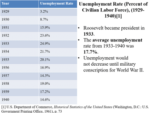
As a history teacher and an economist, it never ceases to amaze me at the success of certain historical myths (in this case, defined as verifiably untrue beliefs) have come to dominate popular understanding. Often it seems that no presentation of facts to the contrary of such myths are sufficient to dislodge them.Perhaps one of the most stubborn myths—and other myths related to it—is that Roosevelt’s New Deal policies brought about economic recovery from the Great Depression. (Other related myths would be that the Great Depression was caused by unbridled capitalism, Hoover’s economic non-interventionism, and that WWII pulled America out of the Great Depression because big government war spending stimulated the economy and solved unemployment).Simply by examining a few economic
Read More »2025-02-28
It is difficult to find a seemingly more unobjectionable term that “equality” is the modern West and America. Equality is often understood to be an unqualified good and part of the American creed: “all men are created equal.”The main reasons politicians love “equality” are because it is supposedly unquestionable in its obvious justice, slippery in definition, and unachievable. Consider the shifting definitions. “Equality” can mean equality before the law or rule of law—as Thomas Jefferson and others used it—which actually is an limitedly achievable and just ideal, but then the same word can be used to designate egalitarianism (sometimes distinguished by degrees: “equity,” “equality of outcome,” “equality of opportunity”).Rule of law or equality before the law (sometimes even called
Read More »2025-02-20
In one of his literary masterpieces, Socialism: An Economic and Sociological Analysis, Mises provided a chapter titled, “Christianity and Property,” in which he wrote the following statements regarding the teachings of Jesus,But all efforts to find support for the institution of private property generally, and for private ownership in the means of production in particular, in the teachings of Christ are quite vain. No art of interpretation can find a single passage in the New Testament that could be read as upholding private property. Those who look for a Biblical ukase must go back to the Old Testament, or content themselves with disputing the assertion that communism prevailed in the congregation of the early Christians….One thing of course is clear, and no skilful interpretation can
Read More »2025-02-13
This is not a joke. This is not hyperbole. This is not clever framing and not a fringe conspiracy. This is a verifiable reality that many Americans do not know, but ought to know, especially as they cheer on US foreign policy actions that morally undermine everything America stands for.World War II and 9/11 are often given as decisive and conclusive historical examples that justify US foreign policy: We had to fight the Nazis and we had to fight the al-Qaeda terrorists. Foreign policy debates notwithstanding, what most Americans do not realize is that the current US foreign policy (especially over the last two decades)—far from fighting modern-day Nazis and terrorists—gives them money, equipment, and support. For the sake of clarity, let it be stated very simply: American, your
Read More »2024-12-19
The issue of secession has been present in American history since the Declaration of Independence—itself an act of secession followed by a war for independence! The debate continued, involving discussions of National versus Compact Theory, the nature of the Union, the true vision of the Founders, under what circumstances secession might be legitimate, how a territory could theoretically secede, etc. All these things were discussed before, during, after the Civil War.The aim of this article, however, is to catalog a few notable quotes regarding secession from William Rawle in his A View of the Constitution of the United States of America (1825). Rawle and his views on secession have been discussed in other works on the topic of secession, even providing extended quotes, yet this article
Read More »2024-12-13
Slavery has existed throughout history in all places and cultures. In fact, while the American South dubbed it the “peculiar institution,” historically, voluntary-free labor is the true peculiar institution. Slave labor was not originally introduced by the political state yet, as with many things, slavery could not have had the scope or extent that it did in human history absent the coercive apparatus of the political state to uphold it. Through cronyism, slaveholders consistently had to seek privileged assistance from the legal system in order to maintain, socialize, and enforce slavery at the expense of the slaves and non-slaveholding population.The enforcement costs for keeping slaves slaves would have been too high for the minority slaveholding elite to maintain slavery to that extent.
Read More »2024-12-07
“I wanted to save a half million boys on our side…. I never lost any sleep over my decision.”—Harry Truman, (quoted in Alfred Steinberg, The Man From Missouri (New York, 1962), p. 259)It is estimated that there were 416,480 American military deaths in WWII. Thus, what we are invited to believe by Truman’s assertion that the atomic bombs saved 500,000 (or many more) American lives is that, had the US invaded Japan, more Americans would have died in such actions than in all the theaters of WWII combined. Further, that prior to the bombs, Truman, Stimson, and Marshall would have approved an invasion plan (as those of Honshu and Kyushu) had they actually believed that 500,000 American deaths would have resulted, as opposed to more likely alternatives prior to invasion.The Bomb and Big Fish
Read More »2024-11-29
Let me issue and control a nation’s money and I care not who writes the laws.—RothschildThe real truth of the matter is, as you and I know, that a financial element in the larger centers has owned the Government ever since the days of Andrew Jackson…—FDRThe American people are suckers for the word “reform.” You just put that into any corrupt piece of legislation, call it “reform” and people say “Oh, I’m all for ‘reform,’” and so they vote for it or accept it.”—G. Edward GriffinThough there had been steady steps toward centralization of the monetary and financial system in the United States—especially since banking and the federal government were connected by the National Banking System during and after the Civil War (ca. 1863-1913)—the financial-banking elite, especially in New York,
Read More »2024-09-26
What is the Mises Institute?
The Mises Institute is a non-profit organization that exists to promote teaching and research in the Austrian School of economics, individual freedom, honest history, and international peace, in the tradition of Ludwig von Mises and Murray N. Rothbard. Non-political, non-partisan, and non-PC, we advocate a radical shift in the intellectual climate, away from statism and toward a private property order. We believe that our foundational ideas are of permanent value, and oppose all efforts at compromise, sellout, and amalgamation of these ideas with fashionable political, cultural, and social doctrines inimical to their spirit.
Read More »2024-09-19
What is the Mises Institute?
The Mises Institute is a non-profit organization that exists to promote teaching and research in the Austrian School of economics, individual freedom, honest history, and international peace, in the tradition of Ludwig von Mises and Murray N. Rothbard. Non-political, non-partisan, and non-PC, we advocate a radical shift in the intellectual climate, away from statism and toward a private property order. We believe that our foundational ideas are of permanent value, and oppose all efforts at compromise, sellout, and amalgamation of these ideas with fashionable political, cultural, and social doctrines inimical to their spirit.
Read More »2024-09-16
Slavery has existed throughout history in all places and cultures. It was not introduced by the political state yet, as with many things, slavery could not have had the scope or extent that it did in human history absent the coercive apparatus of the political state.
Read More »2024-09-09
Given America’s history with slavery and eventual emancipation, especially the Emancipation Proclamation and the Thirteenth Amendment, the average person might be left with the impression that slavery was only ended thanks to the efforts of a powerful nation-state. In fact, one might even go as far as to assume that slavery could only be brought to an end through government policy and enforcement.What this misses is the important fact that governments were key enforcers of slavery such that slavery could never have expanded and remained to the extent it did absent government policies and enforcement. In fact, while slavery has sometimes been ended by positive law and enforcement against it, it was largely eradicated by government’s non-enforcement of the slavery system.Slavery is an
Read More »2024-07-08
Modern monetary theory (MMT) is not convincing to most trained economists of various schools of thought. This causes many to balk at MMT and mock it, some of which is warranted as a reductio ad absurdum, especially given some of MMT’s more outlandish claims. In fact, my own thesis was an Austrian critique of MMT.But there is also a fair amount of hypocrisy in the non-Austrian (e.g., mainstream, Keynesian, monetarist) critiques of MMT by mainstream economists. The truth is that most, if not all, of these economists share the same faulty presuppositions regarding what is euphemistically called “monetary policy.” The difference between mainstream and MMT economists is usually one of degree, not of kind.Alan Greenspan, former Federal Reserve chairman (1987–2006) and most definitely not an MMT
Read More »2024-06-25
What is the Mises Institute?
The Mises Institute is a non-profit organization that exists to promote teaching and research in the Austrian School of economics, individual freedom, honest history, and international peace, in the tradition of Ludwig von Mises and Murray N. Rothbard. Non-political, non-partisan, and non-PC, we advocate a radical shift in the intellectual climate, away from statism and toward a private property order. We believe that our foundational ideas are of permanent value, and oppose all efforts at compromise, sellout, and amalgamation of these ideas with fashionable political, cultural, and social doctrines inimical to their spirit.
Read More »2024-06-15
Several months ago, I was on a long car trip with my dad, and we listened to a podcast that gave some commentary on the following headlines from the New York Times and the Wall Street Journal: “AI Poses ‘Risk of Extinction,’ Industry Leaders Warn” and “AI Poses ‘Risk of Extinction’ on Par with Pandemics and Nuclear War, Tech Executives Warn.”Obviously, this was in the wake of new AI technologies like ChatGPT and others. This is also not a new issue. In 2017, the Wall Street Journal also published “Protecting Against AI’s Existential Threat.” Of course, AI has been impressively more developed recently, bringing the usual reactions—assumptions that this technology will totally change everything, amused interest, reasonable concerns (e.g., students cheating), and the typical hand-wringing.All
Read More »2024-04-03

Tu ne cede malis, sed contra audentior ito
Website powered by Mises Institute donors
Mises Institute is a tax-exempt 501(c)(3) nonprofit organization. Contributions are tax-deductible to the full extent the law allows. Tax ID# 52-1263436
Read More »2024-03-18
Our present cultural landscape is filled with the language of class conflict, ideology, bias (conscious or unconscious), and the politicization of everything. While there are many contributors to this, we can largely thank (or blame) Karl Marx and his theory of class consciousness and class conflict. While not necessarily following Marx in his economics, these concepts have captured the imagination of many, especially in the modern Western world.The claim is rather simple: people are inherently biased in favor of their own “class,” whether consciously or unconsciously; therefore, whatever they claim to be “true” or “right” is simply special pleading in their own favor. In other words, people are not in search of objective truth, nor is this possible; rather, they are apologists and
Read More »2024-03-14

Tu ne cede malis, sed contra audentior ito
Website powered by Mises Institute donors
Mises Institute is a tax-exempt 501(c)(3) nonprofit organization. Contributions are tax-deductible to the full extent the law allows. Tax ID# 52-1263436
Read More »2024-03-11
One of the first laws of economics—in fact, the condition that makes economics possible and necessary—is scarcity. On page one of Basic Economics, Thomas Sowell wrote, “Without scarcity, there is no need to economize—and therefore no economics.”While defining scarcity and its critical role in economics, I like to ask my students in a Christian school a question to tease this out: Would scarcity have existed in the Garden of Eden?
Read More »2024-03-05
There are others, besides the Austrians, who acknowledge the crucial role of monetary policy and even blame the Federal Reserve for the Great Depression.
Read More »2024-03-03
Tu ne cede malis, sed contra audentior ito
Website powered by Mises Institute donors
Mises Institute is a tax-exempt 501(c)(3) nonprofit organization. Contributions are tax-deductible to the full extent the law allows. Tax ID# 52-1263436
Read More »2024-02-27
War has generally had grave and fateful consequences for the American monetary and financial system.—Murray N. Rothbard, A History of Money and Banking in the United StatesGovernments have three ways to tax: direct taxes (the requirement to pay money to the government), debt (present government spending without tax revenue to pay for it with the assumption that it will be paid for in the future), and inflation (“printing money,” or the artificial expansion of money and credit beyond specie [e.g., a commodity like gold, silver, etc.]). Further, history demonstrates a tight connection between the expansion of government power, war, and the expansion of legal privileges and immunities for banks. These realities reinforce one another.War requires revenue, which is difficult to acquire from
Read More »2024-01-04

Why did you want to attend RGS?
I attended the Rothbard Graduate Seminar (RGS) in 2023 for several reasons. For one, it fulfilled a requirement as one of the final classes to complete the Mises graduate program. Additionally, RGS was part of the Mises summer fellowship program, which I was also a part of this year. That said, I wanted to attend RGS because of the unique format it provides for graduate-level reading, lectures, and discussions with the professors and fellow attendees.
The readings, both required and supplemental, informed me of things I didn’t even know I needed to read. One of the underappreciated benefits of assigned reading is being told what to read by those who are well-read in the subject. For example, the supplemental reading made me aware of just the right material
2023-08-31
Economic calculation is not an either-or proposition. Even in so-called market economies like that of the USA, there is plenty of government intervention that distorts market processes.
Original Article: "Economic Calculation Is Nonbinary"
Read More »2023-08-14
By corrupting the meaning of inflation, mainstream economists have given a false picture of what happens when monetary authorities expand the money supply. Mises and Rothbard understood.
Original Article: "Taking Back the Meaning of "Inflation""
Read More »2023-08-07

One of Ludwig von Mises’s important contributions to economics was demonstrating the impossibility of economic calculation under socialism. He did it by showing three necessary preconditions for the generation of meaningful market prices in the factors of production—private property, freedom of exchange, and sound money. Since socialism would, by definition, socialize the factors of production, there would be no nonarbitrary and meaningful way to calculate the prices of various factors of production, the costs of alternative plans in money prices, and expected future profits of a given plan minus the costs.
In short, when factors of production—producer goods (tools, machines, etc.)—are privately owned, there is freedom to trade property. When the economy has advanced to using money, which
2023-07-20

Words matter and definitions often become imprecise and “slippery.” There is a natural evolution of language wherein words gradually change over time, but often a key meaning gets lost and there no longer remains a single word to describe a concept. This has been the case with the common word “inflation.”
Over the last few years, I have kept a list of quotes about the accurate definition of inflation (and I am always looking for more quotes). What inspired this list was the recognition that what most people mean and understand by the word “inflation” is price inflation—increasing consumer prices. But this is not inflation; it is a consequence of inflation. In fact, a former coworker and friend asked me during the time of massive covid spending by the government, “Where is the
2022-11-20

Dieser Artikel ist bereits am 23. März 2022 bei Mises.org unter dem Titel erschienen «The Statist ‘Sollution’ Really Is a Non Sequitur». Übersetzt von Johannes Beifuss.
Read More »2021-10-26

It may come as a surprise—though it should not—that one of the very first acts of the new Congress, under the Constitution, was a tax program at least as great as the one imposed on the colonies by Great Britain. It turned out that taxation with representation could be just as oppressive as taxation without representation or worse.
Read More » On Swiss National Bank
 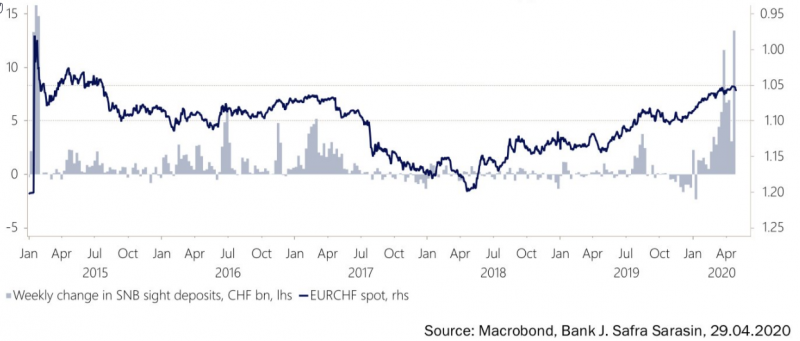 Main SNB Background Info