



Ray Dalio

Ray Dalio

Raymond Thomas Dalio is an American billionaire hedge fund manager and philanthropist who has served as co-chief investment officer of Bridgewater Associates since 1985. He founded Bridgewater in 1975 in New York. Within ten years, it was infused with a US$5 million investment from the World Bank's retirement fund.

Videos by Ray Dalio

Easy Money Seems like Cure All— Until It’s Not

Easy money is a cure all, until it’s not. It’s hard to know when you have to put on the brakes and when things might pop.

Today, the stock market is at its peak, gold is through the roof, and the wealth gap continues to increase. And in terms of what comes next, it looks like we’re going to see a significant easing of monetary policy along with less regulation.

I recently sat down with CNBC’s Andrew Ross Sorkin to discuss all of this and more. You can find the full video at the link in the comments.

View more


Giving Tuesday

This year, I’d encourage you to consider a unique kind of holiday gift — a donation your friends and family can give to the charity of their choice. This kind of gift is far more meaningful, and it’s simple. Anyone can do it.

If you’re interested, check out organizations like TisBest and @donorschooseorg .

I think gifts like these are more in keeping with what the holiday season is really about, so I wanted to pass it along. #redefinegifting #givingtuesday

View more

The Most Important Lesson: Humility

In 1979, I was so broke that I had to borrow $4,000 from my Dad to help take care of my family.

I had calculated that American banks had lent much more money to foreign countries than they would be able to pay back, and anticipated an imminent debt crisis.

But I couldn’t have been more wrong. I didn’t fully understand the impacts of quantitative easing, and so I lost money for myself and I lost money for my clients.

Looking back, it was the most painful experience I could imagine — but it was also the best thing that ever happened to me, because it taught me humility.

View more

Charitable Gifting This Holiday Season

Trying to figure out your holiday gift giving this year? I have a great suggestion for you.

There are organizations like @TisBestCards and @donorschooseorg that will give a donation to your recipient’s favorite charity, on your behalf.

I think gifts like these are more in keeping with what the holiday season is really about, so I wanted to pass it along. #redefinegifting

View more
The True Source of My Motivation

The most important thing is that you have the life that you want to have. So, how you define success is important. There isn’t one path that’s right for everyone.

I was lucky in the sense that I fell in love with markets and playing the investment the game, which is what I’ve done for 50 years.

I recommend that people think about their own nature and what game they’d love to spend years playing. It’s okay to explore different paths—not everyone knows right away. Think of your journey as a process of discovery.

If you’re interested, you can find my full conversation with Bloomberg here. We discussed life, debt, global crisis, and the importance of investing in our oceans:

View more
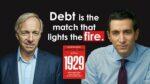
1929 vs. Now: The Difference is Where the Debt is

Economic bubbles throughout history tend to follow similar patterns, but they are never exactly the same.

In 1929 and 2008, there was a lot of debt — but most of it was owned by the private sector. Today, the government sector has a lot of the debt.

Still, one man’s debts are another man’s assets. And when the bill comes due and the debt assets aren’t as appealing as the alternatives, some sort of monetization is inevitable.

I recently sat down with CNBC’s Andrew Ross Sorkin to discuss this in the context of his latest book, 1929: Inside the Greatest Crash in Wall Street History — and How It Shattered a Nation. The parallels between that era and now are striking.

You can watch the full conversation here:

View more
Principles for Success: The Call to Adventure

I’ve taken my best-selling book “Principles” and distilled it into a video mini-series that focuses on the life principles that have helped me the most. This will especially help those who are graduating this Spring and entering “the real world.”

This is Episode 1: The Call to Adventure, I hope you find these helpful.

View more
Ray Dalio on His Secret to Success

If you want to be successful, you have to do 3 things:

1) Surround yourself with great people
2) Develop meaningful work and meaningful relationships
3) Use technology, like AI, to systemize your thinking

Do you agree with this list? What would you add? @TheProfGPod

View more
If you are worried, then you don’t have to worry.

One of my principles is that if you’re worried, you don’t need to worry — and if you’re not worried, you need to worry.

That’s because worrying about what can go wrong will protect you and not worrying about what can go wrong will leave you exposed.

I’ve found this to be true in business, and in life.

View more
The Time the United States Ran Out of Money

When I was a young clerk on the floor of the New York Stock Exchange in 1971, the US ran out of money and defaulted on its debts.

Now, they didn’t say it that way. But by moving away from the gold standard — the idea that people could exchange paper dollars for gold — money, as we understood it, ended.

I expected the stock market to plunge the next day, but when the opening bell rang the market was way up. And it went on to rise nearly 25%.

That surprised me, because I had never experienced a currency devaluation before. But when I looked into it, I discovered the exact same thing happened in 1933 and it had the exact same effect.

But in both cases, breaking the link to gold allowed the US to continue spending more than it earned, and so the value of each dollar fell.

View more
The Best Principle to Deal with Pain

Don’t just react to pain — reflect on it. To overcome any obstacle, you must think deeply about how reality works and develop principles to guide your actions. That’s the only way to learn from your mistakes so you don’t repeat them. The pain is the signal! @TheDiaryOfACEO

View more
What Happens When a Country Accumulates Too Much Debt?

History shows us that having too much debt during an economic downturn leads to a classic, self-reinforcing cycle where:

1) The empire can no longer borrow the money to repay its debts
2) It prints a lot of new money, which devalues the currency and raises inflation
3) Living standards decline, leading to the rise of political extremism
4) Turbulent economic conditions undermine productivity and there is conflict about how to divide the shrinking resources
5) Populist leaders emerge pledging to take control and bring about order

View more

Why Adding Gold to Your Portfolio is a Good Idea

As an investor, you don’t want to concentrate your bets — you want diversification, so you’re protected in different economic environments. That’s why alternative assets like gold are so valuable in balancing your portfolio. @TheProfGPod

View more

How Ray Dalio Got Hooked on the Markets

My first real job was caddying, and it changed my life.

It was the 1960s, and the people I was caddying for were always talking about the stock market.

So, I took my caddying money and bought Northeast Airlines because it was the only company I had heard of that was selling for less than $5 a share.

Little did I know, but the stock was so cheap because they were about to go broke. But I got lucky and they got acquired, so I tripled my money.

And just like that, I was hooked.

View more

How the Economic Machine Works Part 5

This simple animated video series answers the question, "How does the #economy really work?" Based on my practical template for understanding the economy.

This series breaks down economic concepts like #credit, #deficits and #interest rates, allowing viewers to learn the basic driving forces behind the economy, how economic policies work and why economic cycles occur.

This is Part 5, I hope you find these helpful.

View more

Ray Dalio & Andrew Ross Sorkin on His New Book “1929” and How Debt Drives Every Crash

I sat down with CNBC’s Andrew Ross Sorkin to discuss his latest book, 1929: Inside the Greatest Crash in Wall Street History — and How It Shattered a Nation.

A lot of what Andrew learned researching this book is analogous to what happened during the 2008 financial crisis, and also to what is happening today. That’s because history moves in cycles — the same cause-effect relationships are at play, and there are important lessons to be learned.

While the details are different, the mechanics behind people’s behaviors and policy choices are largely the same.

Throughout history, people ignore these similarities because the mechanics are not well understood. My hope is that research and conversations like these can help us collectively make better choices in the future. Learn more about

View more

Ray Dalio and Bloomberg’s Francine Lacqua Discuss Life, Debt & Global Crisis

The U.S.’s debts are on the edge of becoming unmanageable to the point where it could default if conditions are not changed.

But this problem isn’t a unique one. It has happened many times in history, which is why I believe studying the past is so important. The same cycles repeat over and over again, and there are important lessons we can learn from those experiences.

I recently met with Bloomberg @markets ahead of the UN Ocean Conference to discuss our debts, the possibility of global crisis, and the importance of investing in our oceans.

If you’re interested in learning more about our collective debt burden — and what steps we can take to solve these issues — I explain my thinking in my new book, How Countries Go Broke: The Big Cycle.

I hope you will read it and let me know your

View more

Interest is the United States’ Second Largest Expenditure

This year, the US will spend 40% more than it’s taking in. This number is increasing each year — and our debt plays a major role.

This is a big problem, especially because cutting our spending is a difficult political issue. And as we continue to add to the debt, the supply-demand picture worsens.

I fear that we are approaching the point where we won’t be able to rectify it.
@TheProfGPod

View more

Why I’m Pessimistic About the Debt Problem

The way I see it, any serious effort to solve the debt crisis will likely come too late.

It’s a timing issue. 2026 is a midterm election year — politicians won’t want to take the painful steps needed to improve our economic picture: cutting spending, raising taxes, and the like.

Any sort of bipartisan effort that comes after will both take time and be unlikely to be effective, because those commissions generally don’t work very well in practice.

That’s what it looks like to me. I’m curious to hear if you see things similarly.
@TheProfGPod

View more

Ray Dalio on His Biggest Failure

In the late 1970’s, I calculated that we were going to have a global debt default. I was so confident in what that meant for the markets that I went to Congress to share my perspective.

I couldn’t have been more wrong. While several countries defaulted on their debt, the impact on markets was the opposite of what I expected.

And I lost a lot of money — for me and for my clients. I had to let all of my employees go.

But it was the best experience that ever happened to me because it taught me that pain + reflection = progress.

And it taught me three lessons that became the foundation of Bridgewater’s success.

1) It gave me humility — the fear of being wrong was so strong that I had to always ask, “How do I know I’m right?”

2) It taught me the power of diversification — and how 15

View more

Ray Dalio on the #1 Issue Facing the United States

Ultimately, it’s all about human nature.

In my view, the biggest risk we face are our own selfish, mutually-destructive tendencies. If we’re able to rise above them and find compromises, we can avoid the worst possible outcomes.

But to do that, we need to stop fighting with each other and align on policies that improve conditions for everyone.

View more

Why I’m Pessimistic About the Debt Problem

The way I see it, any serious effort to solve the debt crisis will likely come too late.

It’s a timing issue. 2026 is a midterm election year — politicians won’t want to take the painful steps needed to improve our economic picture: cutting spending, raising taxes, and the like.

Any sort of bipartisan effort that comes after will both take time and be unlikely to be effective, because those commissions generally don’t work very well in practice.

That’s what it looks like to me. I’m curious to hear if you see things similarly.

@TheProfGPod

You can watch the full conversation here: _JLSAat94?si=AIGAM6BTiw7ZWCCC

View more

Why We Are at an Inflection Point with U.S. Debt

I want to explain in a nutshell why the US debt situation is at a very dangerous inflection point.

Put simply, the US is now spending 40% more than we’re taking in. This accumulation of debt service payments has spiraled over decades and is starting to squeeze away buying power.

And if you run the numbers, there’s an imbalance between how much debt has to be sold, who the buyers are, and the likelihood of it all being bought.

Together, these two influences are why I worry about suffering an economic heart attack in the near future.

View more

Ray Dalio on the Legitimacy of Bitcoin

I can’t say exactly how effective Bitcoin is as a money, but it’s being perceived by many as an alternative money and so is worth paying attention to.

Money needs to be both a medium of exchange and a storehold of wealth — and the latter is more important.

I doubt that any central bank will take it on as a reserve currency. That’s because all of the transactions are public, so there’s no privacy to it, and there’s a risk that in the future the code could be broken to make it less effective through government controls.

My personal approach is that I do have some Bitcoin in my portfolio, but not much. @TheMasterInvestorPodcast

You can watch the full conversation here:

View more

How the Economic Machine Works – Part 4

This simple animated video series answers the question, "How does the #economy really work?" Based on my practical template for understanding the economy.

This series breaks down economic concepts like #credit, #deficits and #interest rates, allowing viewers to learn the basic driving forces behind the economy, how economic policies work and why economic cycles occur.

This is Part 4, I hope you find these helpful.

View more

How to Hedge Against Risk

I like inflation-indexed bonds — or TIPS (Treasury inflation protected securities) — because they guarantee a real return.

The markets are a zero sum game, and if you’re speculating, you’ll probably be the loser. But these bonds are among the safest asset classes you can find.

View more