



Contribution by action forex,
EUR/CHF – 1.2347
EUR/CHF: Wave (iv) of 3 of (C) ended at 1.3835 and wave (v) / 3 has ended at 1.0075
The single currency did hold above indicated support at 1.2121 and has staged the anticipated rebound, adding credence to our bullishness (we recommended to buy in our previous update at 1.2160) and further gain towards previous resistance at 1.2391 would be seen, however, a daily close above this resistance is needed to confirm early fall from 1.2573 has ended at 1.2121 and bring further gain towards 1.2490-00. Looking ahead, a breach of resistsance at 1.2515 is needed to bring retest of 1.2573, once this resistance is penetrated, this would signal the upmove from 1.0075 low (wave 3 bottom) has resumed for a stronger correction of early downtrend to 1.2650 and eventually towards 1.2762 (50% Fibonacci retracement of 1.5448-1.0075) which is likely to hold from here.
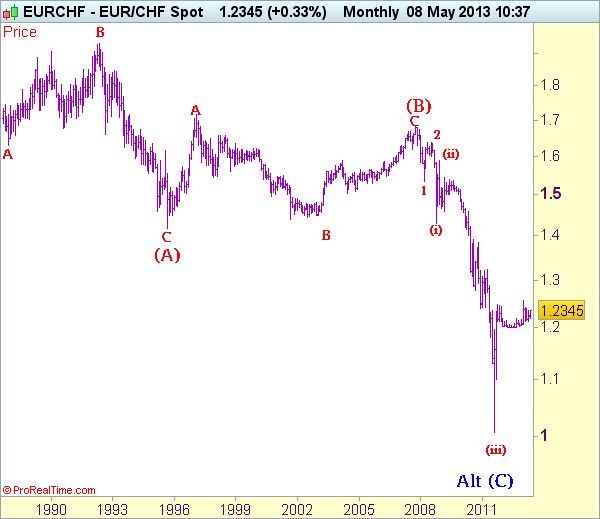
To recap our preferred count, the decline from 1.6828 (end wave (B)) is labeled as the beginning of wave (C) which should unfold as an impulsive move with 1: 1.5326, 2: 1.6377 and wave 3 is sub-divided into (i): 1.4300, (ii): 1.5880 and wave (iii) is still unfolding with (1): 1.4577, (2): 1.5448 and wave (3) is an extended 3rd with i: 1.5006, ii: 1.5383, wave iii: 1.3073, then wave iv ended at 1.3925 and wave v at 1.3073, wave (4) ended at 1.3925 and wave (5) has ended at 1.2765 which also marked the low of wave (iii) and wave (iv) has ended at 1.3835 and wave (v) as well as larger degree wave 3 has ended at 1.0075. Under this count, wave 4 has commenced and may bring correction to 1.2482 (38.2% Fibonacci retracement of 1.6377-1.0075) and later towards 1.2600.
On the downside, whilst pullback to 1.2250-60 cannot be ruled out, last week’s low at 1.2197 should hold and bring another rebound. A break of this support would prolong choppy trading and risk weakness towards indicated support at 1.2121, however, only below this level would abort and signal the fall from 1.2573 top is still in progress for weakness to 1.2090-00 and possibly 1.2062 support but still reckon 1.2030-35 would hold, bring another rally later.
Recommendation: Exit long entered at 1.2360 with over 185 points profit and look to buy again at 1.2250 for 1.2450 with stop below 1.2190

The long-term downtrend started from 1.9626 (Apr 1985) to 1.4166 (Sep 1995) is treated as wave (A) with A:1.6285 (Dec 1987), B: 1.9342 (May 1992) and C: 1.4166, then wave (B) ended at 1.6828 with A: 1.7147 (Feb 1997), B: 1.4398 (Sep 2001), C: 1.6828 (Nov 2007), therefore, wave (C) is now in progress with the breakdown indicated as above. This wave (C) already met indicated downside target at 1.1455/60 and 1.1300, it could have ended at 1.0075 or may extend one more fall to 1.0000 before major correction.
Why Elliott Wave is compatible with fundamental analysis?
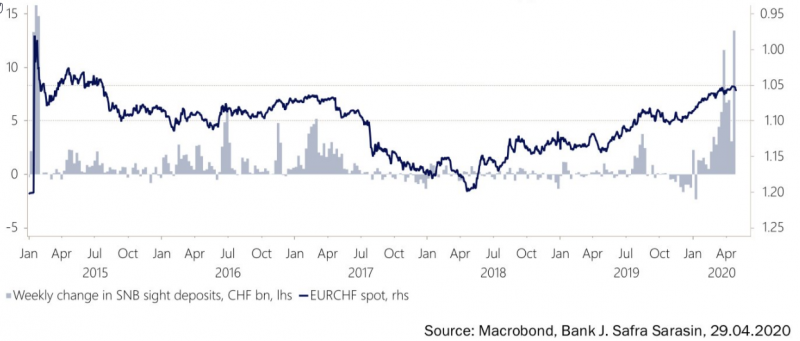
Elliott wave analysis reflects first long-term trends, e.g. the continuing appreciation of the CHF against EUR due to lower taxes, higher competitiveness, better trained personnel (see more) and consequently lower inflation (see the inflation rate parity).
Secondly it mirrors long-term capital movements, for example:
- 1990-1992: Wave A to top of wave B: EUR/CHF rises, Swiss capital moves to Germany to finance the German reunification and to profit on higher German rates. Excessive and overblown spending.
- 1992-1996: Wave B to bottom wave (A): EUR/CHF falls with European monetary system breakdown in 1992.
- 1996-1998 Bottom wave (A) to A: EUR/CHF rises: Swiss housing crisis, optimism in periphery thanks to euro introduction
- 1998-2003: EUR/CHF falls after German fiscal austerity in 1997. EUR at 0.80 USD. Capital moves to the U.S. and to Swiss banks.
- 2003 – 2007 Wave B: The housing bubble in the European periphery and the capital flows from Switzerland to finance that bubble.
Thirdly, it may mirror shorter term capital movements – 1 or 2 years long – like the current capital flight from the euro zone and China to the United States and back in 2014.
Disclaimer: The opinions expressed above are not intended to be taken as investment advice. It is to be taken as opinion only and we encourage you to complete your own due diligence when making an investment decision. Even if we often write about Forex trading, our advices aren't written for day traders who follow technical channels, but rather for mid- and long-term investors. Our aim is to show discrepancies between fundamental data and current asset valuations, which can lead in mid-term to an inversion to technical channels. ----------------------------------------------------------------------------------------------------------------------------