







 by
by George Dorgan
My articles My siteAbout meMy videosMy books
Follow on:LinkedINTwitterSeeking Alpha
CFA SocietyEconomicBlogs
We show that Target2 imbalances and the SNB currency reserves represent the same issues, namely current account surpluses/deficits and capital flight. Therefore it makes sense to compare them, in total and by inhabitant.
For the full Target2 background please refer to Beate Reszat’s Q&A on Target2.
In a recent post we explained that currency reserves represent the cumulated balance of payment surpluses over the years, in particularly the cumulated account surpluses and the cumulated capital account surplus.
Similarly, the Target 2 (im-) balances reflect these two aspects, namely:
- Current account surpluses and deficits – vigorously defended by Hans Werner Sinn and many German economists. They claim that the current account imbalances need to be reduced, so that the periphery no longer lives “on the costs of Germany”.
- Change in capital account or the “capital flight” – fiercefully defended by Paul de Grauwe, Willem Buiter and Karl Whelan, et. al. They insist that the weak countries must continue consumption and generate growth. With growth the capital flight and consequently the Target2 imbalances will be reduced.
These two fractions fought big battles in the financial and academic press, wrote long and complicated articles (see links associated with the names above), in our eyes it was a purely academic fight. Maybe they should have simply said that the first group were “Current Accountist” and the second one were “Capital Flightests“. And that they want to start reducing the (im)balances of payments reflected in Target2 either with the first or with the second methods.
The current solution to the euro zone crisis is the first, the German solution or the Merkel compromise, namely that the weak countries need to implement austerity and increase competitiveness so that they can reduce their current account deficit. This has been successful so far: Italy even has a current account surplus, Spain and Greece reduced their deficit. And, oh wonder, the capital flight and target imbalances were reduced and money came back to the periphery. Still De Grauwe and Whelan will claim that austerity will trigger lower growth over many years and weaken the countries’ finances over the long-term.
In the following graphs we want to now present the link between the reserves of the Swiss National Bank (SNB) and the Target2 (im)balances, which, as we have learned now, are essentially the same.
For the SNB, however, and this is strange, the reduction of Target2 balances did not imply a reduction of currency reserves: the capital flight from Spain to Germany was reversed, but not the capital flight into Switzerland (or that the Swiss current account surplus was higher than the capital account outflows).
We give some hints, the gap between the latest movements in Target2 balances and SNB reserves, has to do with a capital movements of “positive animal spirits” that want higher investment yields (e.g. asset prices in Switzerland are rising, but falling in the periphery) and “negative animal spirits” that just want to preserve their money against a euro zone collapse.
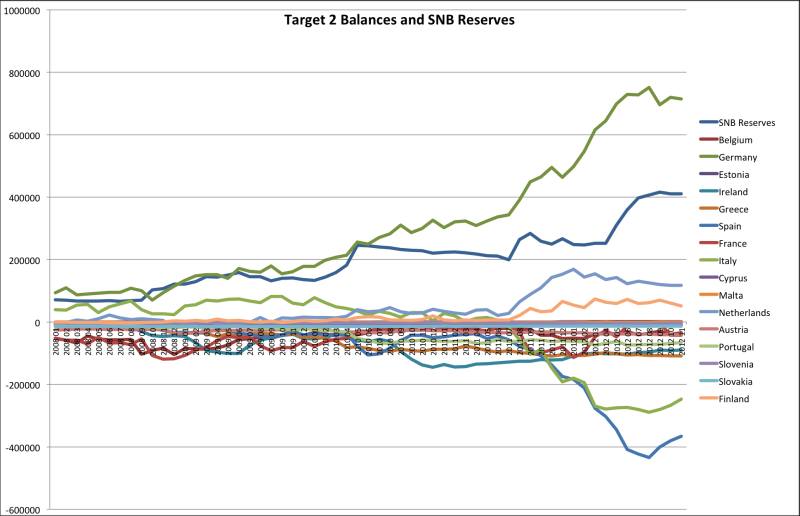
(click to expand), Target2 Balances in Mil. € vs. SNB reserves (data sources University Osnabrück and SNB IMF data)
Hence, the Swiss occupy the second position with 400 billion € reserves, whereas Germany has a Target2 surplus of 700 billion € inside the so-called “euro system”. That Greece, Spain or Ireland have deeply negative Target2 balances means that their central bank would have deeply negative equity and their country would be probably bankrupt, if there were not the euro system that keeps them together.
Representing this on a per person level, we obtain the following graph.
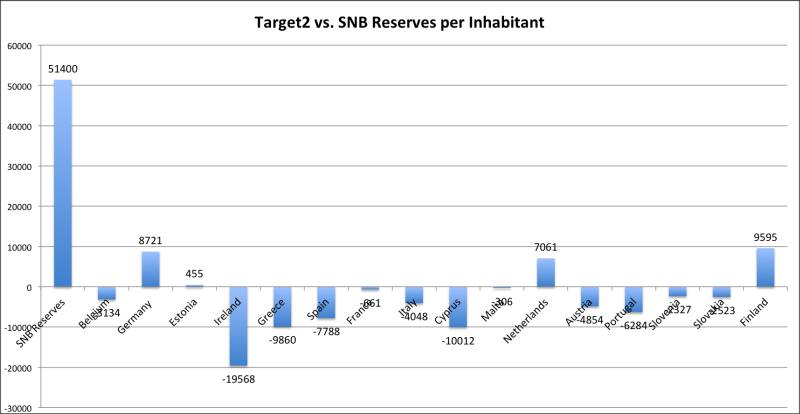
(click to expand), Target2 Balances vs. SNB Reserves per Inhabitant (same sources as above)
Apart from Luxembourg (see below), the Swiss possess the biggest “imbalances” with 51400 € per person, while Germany has a surplus of 8721 € and Finland 9595 €.
We imagine now that one day the euro zone breaks up – maybe not because the periphery goes bankrupt as suspected between 2011 and 2012, but because German, Finnish (and also Swiss) inflation gets far higher than inflation in the periphery, but Mr Draghi does not want to hike rates. (The latest German CPI MoM change was +0.9% !).
Or because Mr Berlusconi wants Draghi to lower rates and if not, then Italy leaves the euro zone. In case of a break-up, we suggest an exchange rate difference of 20% between the North and the South and the Bundesbank and other Northern central bank lose 20% of the value of its assets. At the same time, the EUR/CHF exchange rate drops by 20%.
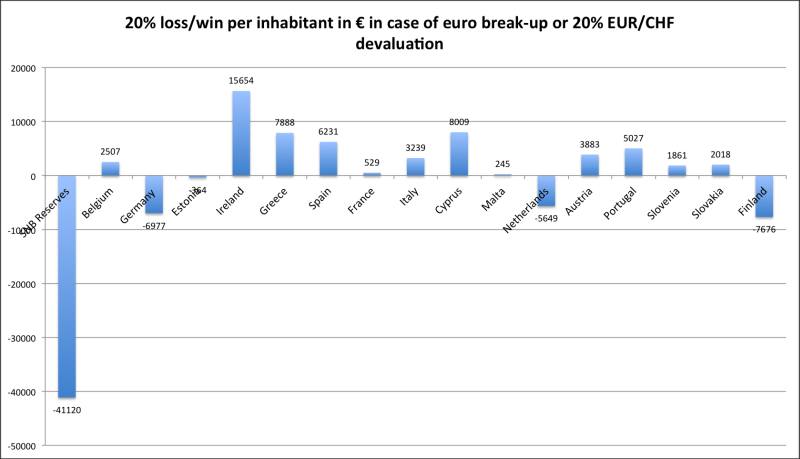
20% loss/win per inhabitant in € in case of euro break-up with 20% haircut or 20% EUR/CHF devaluation
While for the German tax payer, the euro break-up would be relatively cheap with 6’977 € per inhabitant, it would be very expensive for the Swiss: they would need to pay 41’120 € each.
The Luxembourg case
It is well known that Jean-Claude Juncker, the former Luxembourg prime minister, is maybe the biggest euro guardian claiming regularly that Germany must bail out the European periphery. We know why: Luxembourg has a Target2 balance of 210’802 € per inhabitant and would suffer a loss per person of 168’642 € in the case of a euro zone breakup. The numbers of Luxembourg, that possesses a big private banking center, were that big that they did not fit into our graph.








6 comments
4 pings
Skip to comment form ↓
Bernd Klehn
2013-01-29 at 17:06 (UTC 2) Link to this comment
You and all others forgot to add the distribution of
Banknotes to Target2. Luxemburg has printed a lot of 500Euronotes. These notes
are leaving often Luxemburg as dark money. Luxemburg has printed banknotes for
about 70Mrd. and Germany 170Mrd. more then their portions in the Eurosystem. So
if the Eurosystem is breaking Luxemburg has as claim of 36Mrd. instead of
106Mrd. and Germany 486Mrd instead of 656. towards the rest of the Euirosytem.
Bawerk
2013-10-07 at 13:31 (UTC 2) Link to this comment
Mr. Klehn,
We have gone through the balance sheet data from the various NCBs and you are absolutely right! The numbers today, 8 months later, are more than 80bn for Luxembourg and more than 200bn for Germany.
Unfortunately, not all NCBs disclose information on that level of detail. We tried to look at the MFIs liabilities, sub-component “banknotes in circulation”, and compare that to the allocated amount. The results form this exercise is so far futile!
Bawerk.
DorganG
2013-01-29 at 18:03 (UTC 2) Link to this comment
Thank you Bernd,
To my knowledge the IFO institute includes bank notes in German responsibility, possibly Univ. Osnabrück does not.
Bernd Klehn
2013-01-30 at 00:28 (UTC 2) Link to this comment
No, Prof. Sinn excludes also the banknote distribution. Because the blance sheet item 9.2 Liabilities related to the allocation of euro banknotes within the Eurosystem (net) (170.489 Mio Euro end 2011) of the Bundesbank is not understood as a capital import and so it is no part of the monthly reported claimes within the Eurosystem and German NIIP, which I find some what strange. . .
Held-Khawam
2015-04-30 at 13:41 (UTC 2) Link to this comment
George,
Would you have un update of your charts please? Thank you. Liliane
George Dorgan
2015-05-30 at 14:11 (UTC 2) Link to this comment
Thanks for the comment, data sources are, as mentioned above.
Target2:
http://www.eurocrisismonitor.com/
and my page https://snbchf.com/snb/imf-data/
with the underlying SNB data
Both simple excel export and putting it into a new table
Just try
Comparing Trade Balances with FX Rates: Will the European Miracle End? - SNBCHF.COM
2013-01-27 at 07:53 (UTC 2) Link to this comment
[…] Eurostat recently published the European exports, imports and trade balance for 2012 compared to 2011. The data and recent market reactions show that the strategy of “Current Accountists” around Angela Merkel and Hans-Werner Sinn were right (see more on the difference between Current Accountists and Capital Flightests). […]
Guest Commentary: Trade Balance Threatens European Miracle | Forex Protocol News
2013-01-28 at 20:17 (UTC 2) Link to this comment
[…] Eurostat recently published the European exports, imports, and trade balance for the first ten months of 2012 as compared to 2011. The data and recent market reactions show that the “Current Accountists” strategy from Angela Merkel and Hans-Werner Sinn was right. (Read more about the “Current Accountists” strategy on snbchf.com.) […]
Guest Commentary: Trade Balance Threatens European Miracle | AnyOption Review – Binary Options
2013-01-28 at 20:25 (UTC 2) Link to this comment
[…] Eurostat recently published the European exports, imports, and trade balance for the first ten months of 2012 as compared to 2011. The data and recent market reactions show that the “Current Accountists” strategy from Angela Merkel and Hans-Werner Sinn was right. (Read more about the “Current Accountists” strategy on snbchf.com.) […]
Guest Commentary: Trade Balance Threatens European Miracle | Top Binary Options Brokers Reviews
2013-01-28 at 21:05 (UTC 2) Link to this comment
[…] Eurostat recently published the European exports, imports, and trade balance for the first ten months of 2012 as compared to 2011. The data and recent market reactions show that the “Current Accountists” strategy from Angela Merkel and Hans-Werner Sinn was right. (Read more about the “Current Accountists” strategy on snbchf.com.) […]